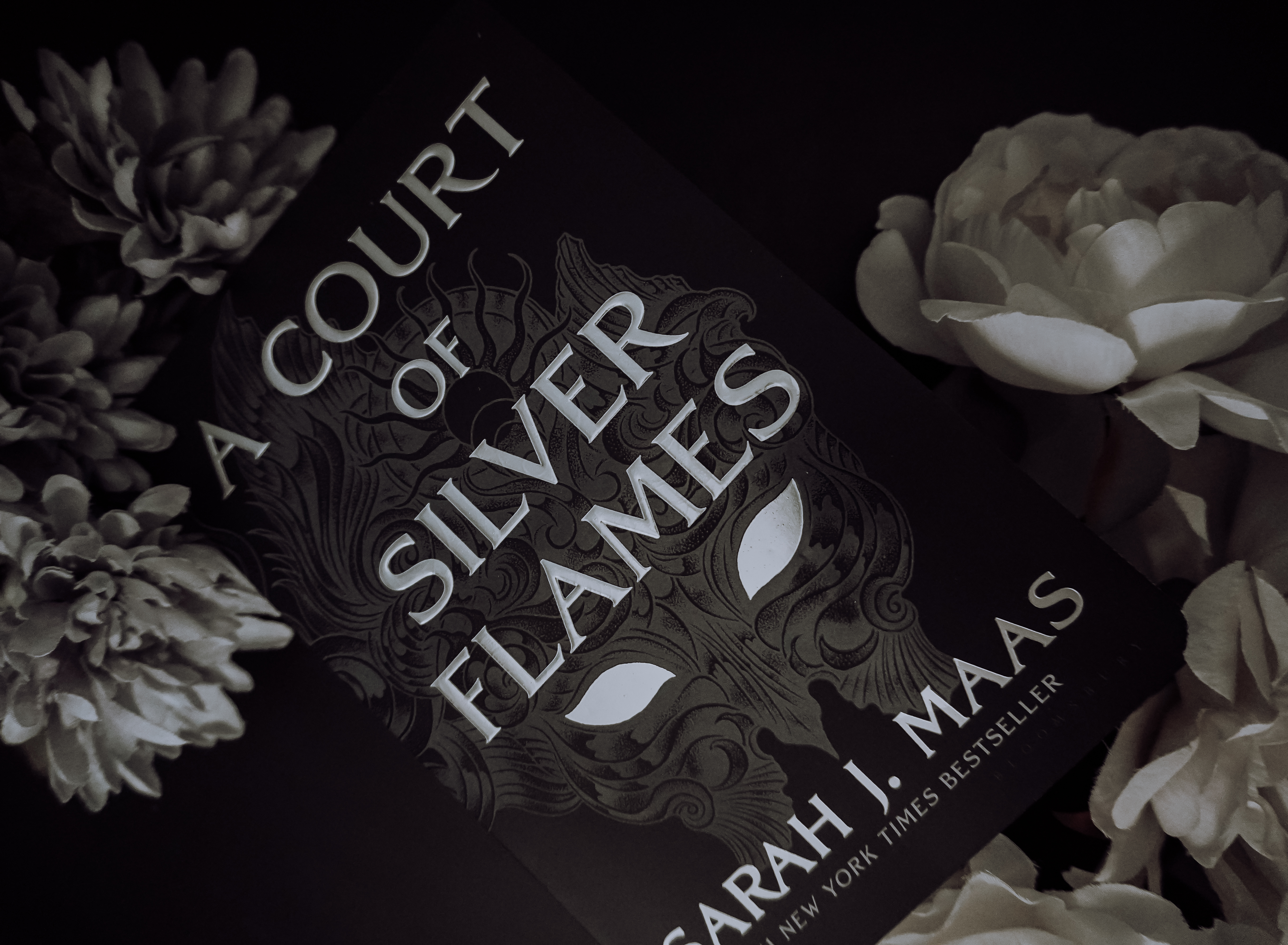
“Keep reaching out your hand.”
What in the Breaking Dawn did I just read?
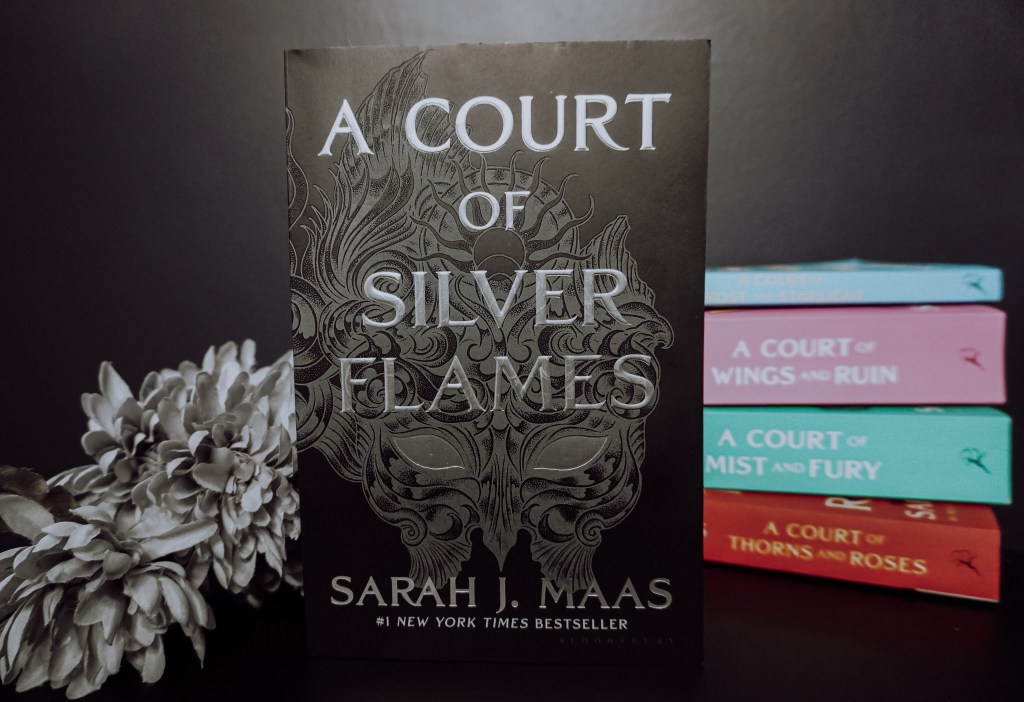
I finished A Court of Silver Flames by Sarah J. Maas, and I can’t remember the last time I felt so conflicted by a book or series.
Silver Flames was nearly 800 pages long yet had the dodgiest plot yet; but once again, I read it in about four days. It’s addicting.
What Maas does consistently well is highlight how trauma affects everyone differently, and this book does that exceptionally well with Nesta’s story and some of the glimpses we get of Cassian’s.
Nesta’s personal journey to live after everything she’s been through, the presentation of female friendships and empowerment, and the glaring flaws finally revealing themselves in the Night Court’s most powerful were all high points for me while reading.
However, the plot is thin and dodgy. Nesta’s training is the center focus, while major plot points of war and turmoil play out in the background and only take our main protagonists on side quests that other characters claim are life-or-death issues but don’t serve enough of the story to hold that weight. It’s a cluttered mess that has absolutely no direction and gave me war flashbacks of reading Twilight: Breaking Dawn in middle school with none of the nostalgia.
Plus I know Maas sells books because of her smut, but it’s too much in this one. Not ‘clutch my pearls’ too much, but it’s EVERYWHERE for absolutely no reason. We could’ve used this page space to make this story make more sense and cohesive, but instead we’re going to have another sex scene that is exactly like the 10 prior. It’s better integrated, better written and better paced than the four previous books, but it’s just too much and too repetitive compared to how much is left unsettled outside of the bedroom.
Let’s get into things.
Here are all my very-spoilery thoughts on A Court of Silver Flames.
Where are they?!
It probably is a statement of these books itself that my favorite characters are Azriel and Mor … the two we probably see the least. I was so disappointed to not see them more in Silver Flames. I literally had to scour the Internet for some Books-a-Million exclusive chapter from Azriel’s POV, which only made me sad. Rhysand chooses this stance to pull rank on? Get out of here. Az gets to do whatever he wants.
I hope Maas will actually dig into the potential of Azriel and Mor in future books — as individuals and not as a weird unrequited love thing. It’s been 500 years, let’s communicate and not simmer in the uncomfortableness. I don’t care about Elain’s story (I’m not apologizing, she’s boring), but I NEED more background into these two.
Also, if they show up in Maas’ other works, let me know! I know nothing of Maas’ expanded universe, and I didn’t really plan on reading any more of her writing, but this could sway me.
The Valkyries, the witch and the himbo
I’m just going to say it … I like Nesta (and the relationship between Nesta and Cassian) better than Feyre and Rhysand, which is surprising considering I was so annoyed with Nesta in every other book.
I see more personal traits in Feyre for myself, but I think Nesta has a more resonating story overall. Feyre and Rhysand felt like a fairy tale of sorts — which makes sense considering the whole Beauty and the Beast parallels and then Hades-Persephone trope — whereas Nesta and Cassian are more realistic. Rhys and Feyre weren’t as flawed as self-sacrificing High Lord and all-giving Cursebreaker, but Nesta and Cassian’s story really focuses on and highlights their flaws rather than power or position. Their flaws push the narrative forward, and that’s something I really love when books do well.
We’ll start with Cassian (who admittedly gives me the vibes of the guy who once he starts dating a girl becomes the boyfriend of the entire friend group. … That’s not important at all, but I needed to just say it to get it out of my head).
I saw some discourse about how he uses the “bastard brute” … excuse? … too much or to downplay Nesta’s trauma, and I can’t see that view at all. This insecurity honestly felt like a natural one that someone would carry around for eternity. It was used to belittle him every step of his life and keeps getting thrown in his face by people who still don’t respect him, and I’m sure there’s also the side that realizes that his closeness with Rhysand growing up attributed immensely to his current position.
And Cassian only ever brings up this trauma to Nesta in a way to relate to her, because in this Inner Circle where everyone feels too polished and confident, it’s important to show the reality of what lies beneath the perfect image they paint.
Even when Nesta uses that insecurity to hurt him, Cassian doesn’t hold it against her. In fact, at one point he says: “Whatever you need to throw at me, I can take it. I won’t break.” Because he knows Nesta only says hurtful things to rid herself of the rage building up in her heart, and he’d rather she say something to him than to someone who would hold it against her.
I think what I enjoyed most about Cassian’s character is that he matched Nesta’s energy and knew when to push and when to back off. He simply knew what she needed and when without Maas having to straight up say it like she did constantly with Feyre and Rhys. A perfect example is the scene the above quote is from. Cassian tries to challenge Nesta to use her training to force him to let go of her wrist, but he sees she’s not playful and pulls back. Then Nesta kisses him, and he goes in for the second kiss because she initiated it. Then on the opposite spectrum, after Nesta tells Feyre about the real dangers of her pregnancy and Cassian takes her to hike as punishment (I’m not getting into the fact Nesta had to literally flee for being honest with her sister when Rhys’ cowardice actually put Feyre and his Court in more danger; it’s not worth it), he knows she needs that tough love. He pushes her to help dissipate that personal rage and just have the time to reflect and be able to fall apart.
Even when Nesta, Emerie and Gwyn are dropped in the Blood Rite, Cassian comes to the conclusion that he doesn’t need to be her knight in shining armor — “And even if the laws had allowed it, he would never take that away from her: the chance to save herself.” Nesta needed to know that she could save herself because of this very line earlier in the book: “She couldn’t stop it. Couldn’t save Elain, sobbing on the floor. Couldn’t save herself. No one was coming to rescue her, and these males would do what they wanted, and her body was not her own, not human—not for much longer—”
Cassian isn’t perfect in his approach, but that made me love him more. Sometimes he snaps. He says the wrong thing … often. … He feels more human than Rhys, which is important to reside alongside Nesta’s yearning for humanity.
That true push and pull is something that we don’t get with Feysand, because neither of them calls the other out on their bullshit. They are each other’s savior, whereas Nesta and Cassian are their own saviors.
Also, Cassian has himbo energy, and I love it. He’s definitely not stupid, but I really enjoyed his fumbling with Eris as he tried to play courier. It was so different from the calm, confident and oh-so-powerful Rhysand (and even Feyre). Taking Cassian out of his element showed more of his personality than anything he could do on the battlefield, which was very clever of Maas. It allowed for Cassian to experience some uncomfortableness in learning a new role, much like Nesta, and the fact Nesta is better at the courier position than Cass also allowed her to see that she may be different from the others in the Court but serve a purpose with her own talents.
Since we’re on the topic of Nesta, I want to say that she got the storyline I wanted for Feyre. I kept waiting for a moment in the previous four books where Feyre really held her own in a physical battle. She gets it once in Mist and Fury when she defeats the Abbotor and then never again.
Nesta’s whole journey is really about learning to stand on her own both mentally and physically without the same privilege, position and support that Feyre was given in the previous books.
In that, Maas successfully wrote a really fucking good redemption arc for Nesta and made her a character to sympathize with and root for.
The first step was Maas laying the groundwork for Nesta’s childhood, because Feyre was too young to really be impacted by their life prior to losing their wealth. Feyre was always a bit of a wild animal in that sense — allowed to step out of the lines of society because of youth and general negligence. Nesta was trained for propriety with the expectations of becoming royalty. And that’s a weapon she used, just as Feyre used her bow — which we see when Elain tells the story of Nesta humiliating the Duke at 14 with a dance and a denied marriage proposal. And it’s also something Nesta was going to use to protect Elain when they were in poverty. She mentioned marrying the abusive Tomas in hopes his family could for Elain, too, and later says she would’ve sold her body on the street, if needed.
Nesta was willing to sacrifice for Elain, but she didn’t feel the need to do so for Feyre, who proved she could survive on her own wits — both a bitter and heartbreaking fact for all involved.
With all that presented, it’s easy to see why Nesta, who’s never really been allowed to choose a life for herself, would be reluctant and vicious toward the idea of letting her younger sister give her one.
Which is why isolating Nesta from her sisters and allowing her to find her own found family in Emerie and Gwyn is so important. — another thing I wanted with Feyre.
Side note: Maas uses the wolf analogy for Nesta, just as she did with Feyre. Nesta says it about herself first:
“So Nesta had become a wolf. Armed herself with invisible teeth and claws, and learned to strike faster, deeper, more lethally. Had relished it. But when the time came to put away the wolf, she’d found it had devoured her, too.”
Then Feyre brings it up, which Cassian further explores:
“Nesta is a wolf who has been locked in a cage her whole life.”
“She was a wolf who had never learned how to be a wolf, thanks to that cage humans called propriety and society. And like any maltreated animal, she bit anyone who came near.”
Feyre had to learn to be the wolf rather than a sheep in her side of the series, and finding that side of herself is something Rhysand encouraged and helped her with. Together they had a balance. Nesta didn’t have that. Her wolf instincts were bottled up because of the world she was born into. They were left to consume her.
This paralleling analogy is so good at allowing the sisters to be compared without diminishing either one. They are both wolves, not prey, but with different hunting styles.
And I truly loved seeing Nesta falling in with Emerie and Gwyn. So rarely do books focus on female friendships in this way, and it’s such a breath of fresh air. Yes, the sleepover was cringe as hell — a whole entire corn field, if we’re being honest — but it was also just sweet to see Nesta get to have a moment like that to ground herself in humanity. All three of these women feel as if their trauma stripped them of parts of their humanity, and together they find that again and reclaim it. The training allows them to not just protect each other and themselves, but to have more control over their minds and bodies. It’s such a beautiful message, and the recreation of the Valkyries allows them to have a common mission to work toward — one that also coincides with Cassian’s personal mission in a way that doesn’t take away from Nesta’s choices.
Nesta finds her own role in this world she was shoved into, and that’s what I think she wanted. She didn’t want to be bailed out by her sister, but didn’t know how to navigate a very scary world she knew little to nothing about which led to her falling into depression. She found a way to save herself.
And it comes to a head in the Blood Rite, which is my personal favorite plot line in this series. It worked so well to have Nesta survive without special powers, but to also allow her to do something to save herself and the women she made her sisters — not because she felt an obligation by blood or debt, but one out of love.
“She was herself a Made thing—and yet she was a person, too. The magic recognized her as a person and not a thing. She hadn’t realized how badly she’d needed to be shown that distinction.”
That final hand-to-hand fight with Bellius was *perfection*. I don’t even mind that (possessed?) Cassian is the one to kill him, because it makes more sense. Nesta is well-trained, but she says it herself that he’s just a much larger, more trained and less worn down guy. She wasn’t going to win that fight.
Through all of this, Nesta paves her own path to who she wants to be, and Cassian simply gives her the tools by holding out a hand for her to take or bite (I adored that overall theme of just holding out a hand btw). I just loved it.
The rest of Nesta’s story … I’ll get into it later. Less to love.
Let’s talk about narrators
I mentioned way back in my MAF review that I wasn’t sure if I liked Rhysand because Feyre was our narrator and forced me to like him, or if I genuinely enjoyed his character. Back then I insisted I just liked him for him and not because of narrator manipulation, and I did LOVE him as a concept in the early books. He plays the ‘dickhead-but-actually-a-good-guy’ role very well. However, I slowly grew bored with him, irritated with him and now infuriated with him.
Prior to Nesta, we only get POVs of people who not only respect Rhys, but feel as if they owe him something. Feyre is obviously swayed because he saves her Under the Mountain, then rescues her from Tamlin, and ultimately is his mate. Then Cassian, Azriel and Mor all have personal connections with Rhys, and they feel guilt for what he had to do to protect them and Velaris from Amarantha. They are loyal to him almost to a fault.
But then we get Nesta’s perspective and suddenly there’s cracks in this perfect image, because she doesn’t have these same ties. She has no reason to trust or respect Rhysand, who has only ‘helped’ her because she is his mate’s sister.
That got me thinking about narrators, which is one of my favorite things to analyze in books. You can frame any given story hundreds of ways based on whose perspective you tell it from.
Particularly, I was wondering if Feyre was an unreliable narrator — and thus so are Cassian and Mor? Because up to this point, I was dogging on Maas’ writing for the deconstruction of Rhysand’s character. But I think it can be a mixture of both poor writing choices and POV.
Feyre is privy to Rhys for all the reasons I mentioned above, but she also has no reason not to think this way. The nature of his character is shown rather well through his actions. Velaris stands as a testament to his goodness, and the people there show him a lot of warmth and respect. He does allow Feyre the opportunity to make choices for herself — or just, y’know, basic human decency and a little more — and decide on who she wants to be. He’s open and honest with her while also setting this boundary of talking when ready, his Inner Circle is less of a formal command and more of a family, he does a lot of good with his power and wealth, he doesn’t often pull rank, High Lord’s like Helion attest to his goodness, etc. etc.
While Feyre is biased, she’s not unreliable in that sense. The same goes for Mor and Cassian, who also do not reveal any reason not to believe that Rhysand is anything but genuinely good. An unreliable narrator is one that has their credibility compromised often by manipulating the story, which I don’t believe is the case with Feyre or the others.
Their perspectives more so fit the narrative Maas created rather than manipulate readers into seeing something that isn’t there. If anything, it’s the opposite. The narrative is more unreliable than the narrator.
Maas made Rhys this image of intrinsic goodness. A man who ruins himself with a wicked persona for the betterment of his people. She strips him of that sympathetic villain role and molds him into an (in my opinion, disingenuous) hero, at least until Silver Flames. And I think that’s a writing inconsistency rather than a storytelling choice.
The main reason I think this way is because the only instance I can recall where I’ve sort of backed up from Rhys and said, “This doesn’t feel right,” is the High Lady deal. I went off about it in my Frost and Starlight review so I’m not going to reiterate, but basically Maas pushes the narrative that Feyre and Rhysand are political equals in their positions when they are clearly not by the roles they take.
I don’t think Maas is smart enough to do this on purpose, because even in SF the pretense is kept up despite them not giving Feyre equal opportunity to decide on and worry about the fate of THEIR LITERAL CHILD and HER LIFE and HER MATE’S LIFE and ultimately the future of THEIR COURT. However, nobody ever questions their equality or their roles and it’s all happy-go-lucky still. That whole ordeal is swept away rather easily, making it less about Feyre not having that weight she was claimed to have and more about Nesta being the one to tell her. Actually, the inequality is never brought up, and Nesta doesn’t mention it in her very critical perspective.
In fact, Nesta doesn’t even necessarily challenge that Rhysand isn’t all he’s chalked up to be. She says in one of the earlier chapters that Rhysand hated her, but remained civil out of love for Feyre — which throughout the story she mentions and has an underlying respect for. She’s almost jealous of what they have and the happiness they’ve found, which I don’t think is meant to bring scrutiny to these characters the way readers will do based on what they are reading. She calls Rhys out for being a cocky prick, but that’s not something that Maas ever tried to hide even with Feyre’s POV.
Though I also don’t think it’s wrong of Rhys to be angry with Nesta and her actions. She consistently hurts Feyre — even if it’s because of her own trauma — and has pushed away their offers of help to turn to a life of ruining herself on their dime. That’s a reason to be a bit pissed.
Overall, I don’t think Rhysand’s previous character development was because of unreliable narrators, though it benefited from biased narrators.
That being said, I wanted to brawl with Rhysand this entire book because his character flipped in a weird, out-of-pocket way.
What I bet was the intention for Rhys becoming an actual dick in this book was that he had a pregnant mate, which Cassian brings up: “You have a pregnant mate, Rhys. You’ll kill anyone that presents a threat to Feyre. You’re a danger to all of us right now.” That magic or whatever you want to call it now allows for there to be probably more tension than originally between Nesta and Rhys to advance the story.
Because, at least to me, Rhys is entirely out of character in this book.
He doesn’t give Nesta the same … benefits … he gives Elain and Feyre when healing from trauma. He always had a much gentler approach to them. He’s always been cold with Nesta, and it could be because Feyre has the most strained relationship with her. But also her trauma response is way less palatable to him than the two sisters or the priestesses in the library. Did he simply not know how to help Nesta or anyone not wanting to be helped, and thus matched her cold energy? Is this the same tough love that Feyre delivers but in a more aggressive way?
I sort of doubt it.
The truth is that Nesta’s a threat.
Because he doesn’t know the nature of her powers, she wouldn’t succumb to him to let him know what she took from the Cauldron, and she can’t be influenced the way Feyre could. Nesta challenges Rhysand (not on his morality but his power) in a way that few do, and he has to act like a hard ass to compete. Add that to the weird mate stuff, and that’s our excuse for bitch boy Rhys.
I hate it. Thanks for asking.
He doesn’t even give Nesta any sort of credit in the midst of her bettering herself. She’s making progress, and they can see it at different points in the narrative, but Rhys still thinks the worst of her. It doesn’t fit his character based on what we’ve seen prior. Even in War and Ruin, Rhys was appreciative of what Nesta did to aid them, even if it was a struggle to get there. He’s meant to be patient and understanding, especially with the most vulnerable. An injured wolf will still bare teeth if you bet it. Where did that go?
The only reason Rhys gives Nesta respect is because she saves him, Feyre and the baby. Only then, when Nesta gives away part of herself and her identity to save them, does Rhysand not act as if she’s a burden. It’s not because she took the time to become a person she’s proud of or wanted to be a better sister or be a part of this Court, it’s because she saved their lives.
If I was Nesta, I would’ve pushed him over when he fell to his knees.
And while I’m ranting, you’re telling me that if Feyre was dropped into the Blood Rite, Rhys would say his hands were tied and not turn that stupid fucking mountain to rubble to save her? He cheated at nearly all of Amarantha’s challenges to save Feyre Under the Mountain. He’s the king of loopholes! And telling Azriel to stay away from Elain because of the politics with Lucien? Fuck you, Rhys! Politics didn’t exactly keep you from Feyre. … Also it’s a good thing Lucien isn’t actually Beron’s son, so there’s a loophole to the whole duel thing for mates in the Autumn Court. Check mate, bitch. (Are we ever going to tell him that? No, OK. Got it.)
*deep breath*
In conclusion, I don’t like where Maas took Rhysand’s character.
I can understand why and how she got to this point and even respect that the tension allowed readers to see flaws in Rhysand and Feyre that otherwise weren’t highlighted, but I think Maas should’ve set it up better to not make his character feel disingenuous. I like a feisty, wicked Rhysand but do it for good reason and not because he’s a bitch boy.
Breaking Dawn war flashbacks
Before I even start with this bullshit, I need to ask Sarah J. Maas a question about her world building: You’re telling me that Cassian can be saved after having to literally hold his guts from falling out of his body in War and Ruin, but these healers can’t perform a C-section?
And just a fun fact: The first successful C-section was performed in 1337.
OK, let’s move on.
The pregnancy plot line was ass. It didn’t make sense and was only truly used to add a degree of separation between Feyre and Rhys from the narrative. They had to have a reason to not save the day and pass the responsibility off to the others. It was the cheapest of cheap low blows for this story. Absolutely hate it.
That being said, I do like the tension it brought. First with Nesta being the one to tell Feyre the truth — and that Feyre didn’t blame her sister for doing so — then with Rhys and his Court overall. It also gives Cassian an avenue to challenge Rhysand a bit when they are sending him and Az to rescue Eris rather than going themselves. All of that is wonderful.
There’s also something nice about Nesta being the one to save Feyre’s life in that moment — it’s like payback for all those years Feyre kept them alive. And Rhys falling to his knees — those stupid, stupid tattooed knees — was oddly satisfying after hating the way he treated Nesta.
But overall the ending is awful.
I hate that Nesta had to sacrifice the majority of her powers for this. Maas doesn’t like consequences. She likes happy endings, which is whatever, but those “happy endings” always include a female protagonist losing some of her abilities — a consequence in itself, but one that punishes the woman for using the strength she’d been trying to find. We saw it with Amren, and now with Nesta. The men hold onto all their power, while women lose theirs.
I wish we could’ve had this moment where Nesta saves Feyre in this act of her finally accepting this power and life. She wields it rather than have it wield her. Instead, she gives it up. If the message is sacrifice, then is it truly a worthy sacrifice if Nesta never cared for or wanted those powers to begin with?
I just … *sigh* … I don’t know. It all felt gross. It sucks considering how much I enjoyed other aspects of Nesta’s story.
Side note! I think I’m in the minority here when I say I kind of like the idea of a High King plot line for Rhys. I say this solely because to get that position, Rhys has to play more into his wicked political side, which I personally adore. I want to see him fight for power — power for the purpose of making the world he wants for his son. And I only think he was adamant against it in Silver Flames because of the bargain with Feyre. He knew there was a very good chance he didn’t survive, so there was no point in thinking further ahead than weathering the current storm.
My issue is that with only Elain and Azriel’s story left, the High King plot would fall into the background like the Trove stuff in this book. It won’t be given proper attention with the right framing. That would be a story that needs to be told by Feyre and Rhysand, which I don’t think Maas wants to do. It can’t be a side quest.
Framing is everything
I feel like Maas has so many ideas for this world that she doesn’t know what to do with them and just tosses them in a cauldron and stirs.
A lot of fantasy books rely on chaos to push stories forward, but there’s a strategy to frame chaos in a way that makes each element impactful to the overall story. That’s Maas’ biggest flaw, and it comes to a point in Silver Flames.
As I said, I loved Nesta’s journey, the rebirth of the Valkyries and the Blood Rite. I also enjoyed the tension brought on by some of our background noise like Eris, Feyre’s pregnancy, the trove and the mortal queens; but the way everything was set up was awkward.
I never felt any pressure or sense of urgency with these background elements, despite our characters saying they were dire. I believe this is because there’s a degree of separation between those in charge — Rhysand … end list — and our main protagonists. Cassian is the liaison between the main narrative and the side quests, but it’s pretty much just him getting orders barked at him by a bitchy Rhys as the Inner Circle sits around and talks about how bad things could get. It’s a lot of telling instead of showing, which does very little to create suspense.
(Also the Night Court is gatekeeping a lot of very powerful magic objects right now — the three trove items, the Cauldron and those Made items from Nesta. I don’t think the other courts are going to like that.)
The trove tasks felt more to me like pulling Nesta away from her narrative, than truly showing her progress. It wasn’t natural, because orders came from sources outside of her plot or were used against her. Then with the pregnancy plot, nobody seemed that worried about Feyre or the baby or even for Rhys later on. Maybe it’s because everyone held hope that Rhys could figure it out as he’s figured everything else out, but it could also be because we don’t get Rhys or Feyre’s POV to feel the pain and worry. We as readers are detached from that emotion. And the mortal queens? I just don’t think I had enough information about them to care.
A better way to frame all of this would be for Nesta and Cassian to figure out more stuff on their own rather than acting as dogs on Rhys’ orders. It would have a more natural feel to it, and it’s such an easy fix. Framing is everything.
Some overall final thoughts
I have a love-hate relationship with this series. Maas’ writing is pretty terrible, she can’t frame a story to save her life, the world-building is inconsistent, the plots are all dodgy, and I am most definitely scarred for life by these books, but also I’m kind of obsessed. She did create a compelling world and characters that are interesting and relatable. The magic and whimsy and mystery of this Faerie realm and its politics has so much potential. That aspect is what got me through them. They’re also just really fun to read. They made me laugh so much — not necessarily because they’re humorous books, but because sometimes they’re just that wild. They made me so angry, and I loved the process of tearing these books apart (analyzing bad books is way more fun than good books imo).
So while I don’t think ACOTAR will ever land on my list of favorite series, I do think there’s something oddly enjoyable about them that has to do with their simplicity and abundance of flaws. Lovable trash in the most affectionate way possible. I will probably preorder the eventual Az-Elain book.
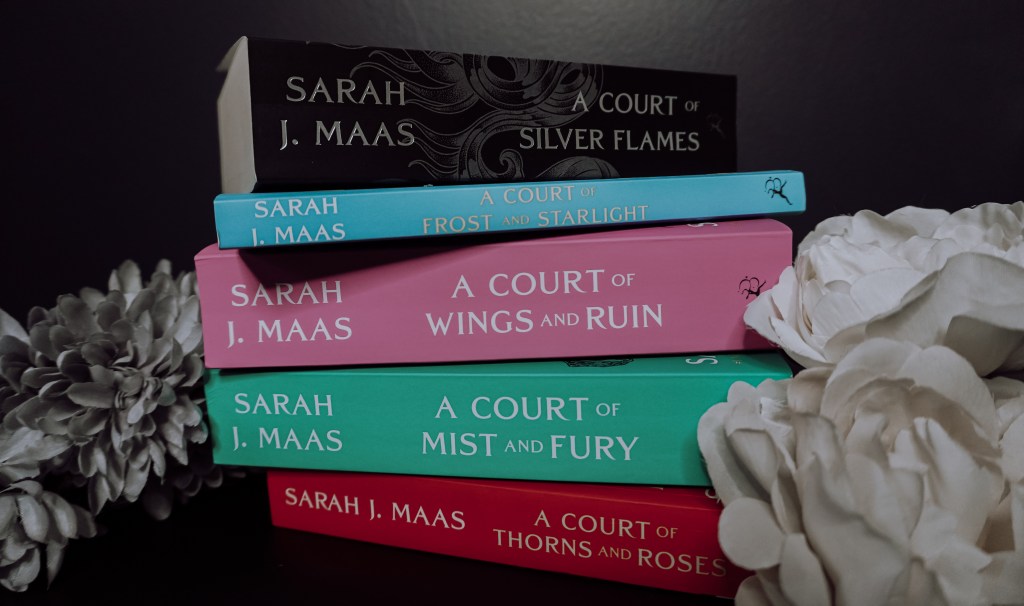
My rankings: Wings and Ruin – Silver Flames – Mist and Fury – Frost and Starlight – Thorns and Roses
Rating
3.25 imaginary pegasuses out of 5.




 Life of Bry
Leave a reply to Bry Cancel reply