My soul needed a good binge series.
I used to love reading, it was my escape from the burden of ordinary life. However, a heavy college course load and a rigorous work schedule left me no time to read anything that wasn’t assigned to me. When I graduated, I would check off maybe three or four books from my TBR list each year. Books would lay on my headboard for months untouched because my heart wasn’t in it.
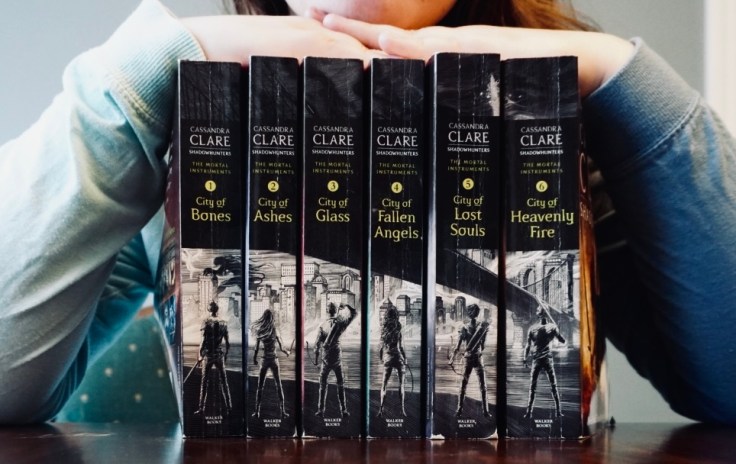
The Mortal Instruments by Cassandra Clare soothed my soul and lit a spark in my heart. While it wasn’t the best YA series I’ve ever read, it did give me a sense of nostalgia for the days I binged entire books in a single sitting. TMI kept me up late, turning pages and thanking the Angel that I already had the entire series on my shelf. There were moments that made me cackle, Kim Kardashian ugly cry, and shut the book entirely as I held it close to my chest, deep in thought. I fell in love with the characters, many of whom reminded me of myself and friends. I thought I grew out of my phase of overtly worrying about the lives of fictional characters, but TMI dragged me right back into it. Overall, these books made me happy despite tearing my heart out.
I’m not getting too far into the details because I wrote posts for each individual book, but I do want to give my final thoughts and a few of my favorites from the series.

Favorite Quotes
These books are packed with memorable and iconic quotes, so I can’t pick just one. Instead, I chose four based on the reasons I loved them.
Quote that made me laugh way too much:
“I guess it’s true what they say. There are no straight men in the trenches.”
“That’s atheists, jackass. There are no atheists in the trenches.”
Jace & Simon, City of Ashes
Quote that made me cry for no reason:
“Jules, being parabatai is a big deal. It’s — it’s forever.”
“Aren’t we forever?”
Emma & Julian, City of Heavenly Fire
Quote that gave me all the feels:
“But Magnus, he thought. You never told me. Never warned me it would be like this, that I would wake up one day and realize that I was going somewhere you couldn’t follow. That we are essentially not the same. There’s no “till death do us apart” for those who never die.”
Alec, City of Fallen Angels
Most memorable Quote:
“The boy never cried again, and he never forgot what he’d learned: that to love is to destroy, and that to be loved is to be the one destroyed.”
Jace, City of Bones
Favorite Character(s)
OOF. I really did fall in love with all these characters. They each gave the story exactly what it needed, from badass Izzy with her six inch heels and whip, to nerdy Simon with his vast knowledge of pop culture and heart of gold, to Clary with her unwavering bravery and spark of creativity. However, if I had to pick favorites, I’d go with Alec Lightwood and Jace Herondale.
These two are stark opposites. Jace is the reckless blonde warrior with a death wish and just enough arrogance and sex appeal to hide all that inner turmoil. Alec is the responsible, dark-haired and blue-eyed mother hen with so many insecurities weighing him down I’m not sure how he can even lift his bow.
There’s also so much teen boy angst between these two that you can practically smell the Axe Body Spray. Wait … do Alec and Jace even know what Axe is? I need Simon to teach them how to light a fire using it. Nevermind, I’m getting off topic.
Despite their differences, they take care of each other. They’re not only parabatai, they’re best friends and brothers. They build each other up, although Alec knows when to knock Jace’s ego down a peg. They both learn to overcome their trauma and self doubt and grow to love and be loved. The character development with these two is just ✨chef’s kisses✨.
Favorite Scene
Immediately I thought about the Bone Chandelier scene in City of Lost Souls. It was so beautifully written and described that I felt like I was in the club with Jace and Clary. The imagery Clare presents is gorgeous even in words with the silvery liquid faerie drug raining from the ceiling onto their faces and down their bodies, clinging to their hair and clothes as explosions of bright lights filled the stone room.
Just the overall feeling of the scene was immaculate. It starts with Clary worrying about what Sebastian is truly up to, but Jace takes her hand and allows her to let loose despite the troubling circumstances. However, it’s not really Jace — he’s still under Sebastian’s influence — and Clary knows this, but she’s fighting against the knowledge of reality and her heart that’s yearning for the Jace she fell in love with.
Then all this beauty is stripped away as the faerie drugs make Clary trip out and see tanks full of dead bodies and her own body covered in blood.
It’s intense, and I loved every second. I reread that scene like five times already.
Honorable mention goes to the moment where Jace tells Alec that the best thing Valentine ever did for him was send him, not just to the Lightwoods, but specifically to Alec.
Alec spent the last seven years in Jace’s shadow, knowing the only person who didn’t think he was lesser was Jace himself. Alec protected Jace so that he never had to worry about being overtly reckless, and, in return, Jace gave Alec little pieces of himself that proved he trusted his adoptive brother — trust being something the boy didn’t give out openly or frequently.
It just really warmed my heart.
I Could’ve Done Without That
The proposed incest.
I think it goes without saying that the whole story line of Jace and Clary thinking they’re siblings was atrocious. I understand that it was a plot device to show how Valentine would stop at nothing to destroy and manipulate even his own adopted son just to get what he wanted.
However, it was so gross to read about these two making out while thinking they’re related. The Wayland Manor scene in City of Glass made me internally scream, “Get away from her, she’s your sister!” and “He’s your brother, don’t pull him closer!”
There were clues indicating they weren’t siblings throughout everything, but it made me feel icky. I didn’t like it one bit.
Cassandra Clare’s Writing Style
Clare’s overuse of commas was disastrous. I majored in Journalism and Public Relations in college, which means I was forced to take multiple grammar quizzes a week. A big part of those quizzes was how to properly use a comma. A professor actually yelled at my class one time because, “You damn kids don’t know when to just end a fucking sentence!” She was absolutely right. We didn’t know when to end a sentence and neither does Cassandra Clare.
Watching Clare throw commas around all willy nilly killed me. I can excuse an Oxford comma, even though I personally believe they’re a waste of ink and space unless absolutely necessary for clarity. However, Clare placed commas in spots that made zero sense to me. She carelessly used commas instead of opting for more appropriate transition words (such as, like, and, then, while, as, etc.) or simply ending the sentence and starting anew. It interrupted the flow of the story, and I found myself having to reread sentences to understand fully what she wanted to say.
Other than the commas, I enjoyed Cassie’s writing style. Third-person omniscient POV usually isn’t my thing. I prefer a good first-person narrative. However, TMI needed an all-knowing narrator due to the amount of characters leading the story.
The writing style was relaxed and informal which was perfect for the subjects at hand. The story follows teenagers, and I appreciated that the writing reflected that. Clare doesn’t try to dazzle readers with long intricate words that are only found in a Thesaurus and obscure references only a scholar could fully grasp, instead she makes average and casual wording into something extraordinary while sprinkling in some classic lit and pop culture. It allowed the story to flow seamlessly and for readers to get lost in it.
Cassie also gets major props for creating teens that act and think like teens. They’re messy, chaotic, angsty and selfish. They’re also able to adapt and adjust as they learn and grow through life. Did I mention they’re chaotic? That’s my favorite attribute.
Themes
TMI hit all the major themes that every YA fantasy novel does: coming of age, good vs. evil, power and corruption, courage and strength, love, found family, etc.
While these are the boxes that seemingly get checked for all YA series, I thought Clare did a wonderful job presenting love and good vs. evil in a way that differed from other books I’ve read.
Clare showed that love can be utter bliss but also decimating. There was so much pain when Jace thought he was destined to kill the girl who he felt he could give his heart to and could finally prove that love doesn’t destroy. There was Alec’s inner turmoil when he finally accepted who he is in his sexuality and fell head over heels for Magnus Bane only to realize there will come a day when he will die but the warlock will live on without him. Then there was Izzy who kept the burden of her father’s affair a secret for so long and closed off her heart to prevent it from being shattered just like her mom’s.
These characters had to learn and grow (I recognize I use this phrase a lot, so I’m sorry) in order to love and be loved. Love isn’t about taking and demanding, it’s about giving freely and openly.
A lot of YA authors seem to take a very one-dimensional stance on love. Girl doesn’t notice boy, boy loves girl, girl slowly falls for boy. Boring. Clare spiced it up and gave useful and real lessons on love.
Now onto the theme of good vs. evil. I LOVED that Cassie didn’t paint a black and white picture of good guys and bad guys. Instead she gave us all shades of morally gray and had her characters staring at their own contradictions in the fight between darkness and light.
Shadowhunters are supposed to be representatives of Team Good, yet they consistently do things that are morally questionable. In our main group of characters, Jace murdered an Iron Sister while under Sebastian’s influence and threatened the Seelie Queen when she deceived the Nephilim, Alec shot Meliorn in the heart for being a traitor and Clary allowed for her father to be killed by Raziel and never felt an ounce of remorse. While these characters are technically the protagonists, they are forced to do questionable acts in order to uphold what they believe is right.
Clary even mentions the downfall of being good when you’re fighting against evil throughout the series. Goodness, virtue and mercy are weaknesses when you’re battling against those who don’t care to uphold any of that. Sometimes you must be cruel to fight back against the darkness. Sometimes the right thing for Team Good is stabbing your own brother and letting him die in your arms.
Don’t even get me started on the Clave. The government body of the Nephilim is pretty shitty throughout the entire series. However, they really lowered the bar at the end of City of Heavenly Fire, when they voted on three key things that were just absurd and heartless.
- To disband the Seelie Courts’ armies, disallow faeries to carry weapons and place the blame and burdens of the Dark War solely on the shoulders of the Seelies.
- To not negotiate the release of Mark Blackthorn from the Wild Hunt.
- To exile Helen Blackthorn to Wrangel Island to study the wards until it can be determined that she can be trusted.
Magnus is the one who steps up to let the Clave know that these motions would only leave the faeries scorned and bitter toward the Nephilim whom they already considered merciless. Per usual, Magnus is right, but the motions still get passed. In this we get what I consider to be the start of Emma Carstairs’ villain origin story.
“If this was peace and victory, Emma thought, maybe war and fighting was better after all.”
Emma, City of Heavenly Fire
For being the leaders of Team Good, the Clave is ruthless, idiotic and overly harsh. The Law is hard …
On Team Evil, we have Valentine, who had good intentions but awful tactics, and Sebastian/Jonathan, who was never given a chance to be good. I talked a lot about Sebastian in my CoHF review, so check that out for more on my favorite book villain.
My favorite type of villain is one where you can see their perspective and understand why they are so cruelly evil, and my favorite hero is one who must do seemingly evil things to protect what is good. Cassie perfectly displayed both these things incredibly well which gets an A+ from me.

Biggest Critique
Often my No. 1 complaint with any book series is the lack of long-standing consequences. I don’t want perfectly happy endings after tragic events. Call me masochistic, but I love a story where the ending leaves me in pieces in at least one way.
The characters talk a lot about consequences (getting Marks stripped, breaking the Accords, war, injury, death, etc.) in TMI; however, we rarely see these consequences reaped by the actions of our protagonists or, if we do, they often don’t stick.
When Jace is killed by Valentine in City of Glass, he’s brought back by the Angel Raziel. Then again, when Clary stabs him with Glorious in City of Lost Souls, it’s believed he’s dead, but he’s not. Clary gets off spot free with the Clave for using Raziel’s wish to resurrect Jace because of the loophole that Valentine was technically the one who summoned the Angel. Simon dies and becomes a vampire, so Clary doesn’t lose her best friend. Then, when Asmodeus steals his memories and makes him mundane again, Magnus finds a way to make Simon a Shadowhunter and help him regain his memories. Despite Alec and Magnus breaking up briefly, all of our couples end up together still at the end.
While death happens all around our group of main characters in the form of unknown or lesser known Shadowhunters and Downworlders, we only get a couple deaths that leave readers rattled. Valentine’s death meant nothing to me personally. He couldn’t be redeemed, and he was just an asshole who got power hungry. Sebastian/Jonathan’s death hurt because he was born and bred to be evil without any opportunity to be good. However, he still deserved to die for his actions. Both of these deaths were expected and necessary.
The death of Imogen Herondale to save Jace only mattered because it’s later discovered that she was his blood grandmother and a key to his true identity. I actually forgot about her until now.
This one is a hot take, but Raphael Santiago’s death didn’t bother me either. I didn’t particularly like his character. He was an asshole to Simon for not wanting to be a vampire, for clinging to any bit of life he could and for essentially being able to do things he couldn’t. In my opinion, his character doesn’t get redemption just because Clare tossed us the sad backstory of his mother begging Magnus to save her son’s life 50 years ago moments before Jonathan stakes him.
The one death that did make me feel hurt and left a lasting effect on our characters was Max Lightwood, the 9-year-old sibling of Izzy, Alec and Jace. Losing Max was tragic and traumatic for all our young protagonists. This is the first time someone Clary knows personally is killed, and, for the other Lightwood children, it’s a stark reminder that Shadowhunters die young all the time and nobody is safe. Max’s death haunts the Lightwoods and lingers in their minds long after their little brother is buried. Jace, Alec and Izzy all dream of Max being alive when the demon shows them their greatest wishes while entering Edom.
They all blame themselves for what happened to Max, and, in return, fiercely defend and protect their remaining siblings. It’s why Alec panics so feverishly when Izzy is injured in Edom, why Izzy is so heartbroken over Jace’s disappearance in CoLS and why Jace is willing to risk himself to ensure Alec and Isabelle’s safety. They all can’t bear the thought of losing another sibling.
That’s the only long-standing consequence that I can even think of, and it’s a consequence of war, not of any wrong-doing by our protagonists.
Farewell
Usually when I finish a book series, I end up mourning the characters I fell in love with because their story has ended. However, upon closing City of Heavenly Fire, I felt both overwhelmed and excited. There’s a long list of Shadowhunters books just waiting for me to read, including ones that follow these characters that I already gave my heart to. As a life-long bookworm, it was almost a relief to end a series and know that I don’t have to say goodbye just yet.
However, I did spend a long time deciding how I wanted to proceed. A major part of me wanted to jump right into The Dark Artifices, but I stuck to a list I saw on Tumblr that suggested I go back to read The Infernal Devices first, then The Bane Chronicles and Tales from the Shadowhunters Academy, before diving into TDA.
Overall, I’m so glad I read TMI as an adult. I’m a firm believer that certain books find us when we need them most. If I read this series as a teenager or preteen, I think I would’ve been too caught up crushing on Jace to truly appreciate and grasp the themes and concepts that Clare presented. *Ugh, I just had a flashback of my Twilight phase I went through at 12 and the life-size Taylor Lautner poster I had on my door. So much cringe.* I have a little bit more life under my belt at 24 than I did back when I was in high school and first put TMI on my TBR list.
The biggest thing I learned while reading this series was that I am growing up. I found that throughout everything, I simply wanted to give these characters hugs and tell them they were going to be OK. I essentially wanted to be Magnus Bane so that I could help these little Shadowhunters in the fight against darkness. I also kept asking myself, “where is the adult supervision? These are children!” Then I’d realize that Alec, with his faded, hole-ridden sweaters and fragile heart, was 18 and technically an adult. I still have some youth left in me though. I was constantly rooting for Jace to do something reckless and stupid purely in the name of doing cool shit. I can’t help it; I love the chaotic energy.
That’s all from me for now! I genuinely had so much fun reviewing these books and sharing my thoughts as I read. Everyone I know who has already read The Infernal Devices has said it’s even better than TMI, so I’m super excited to get into that series and give my heart over to another group of Shadowhunters while screaming more of my unwanted thoughts and opinions into the void of this blog.
Until then, farewell.


Leave a Reply