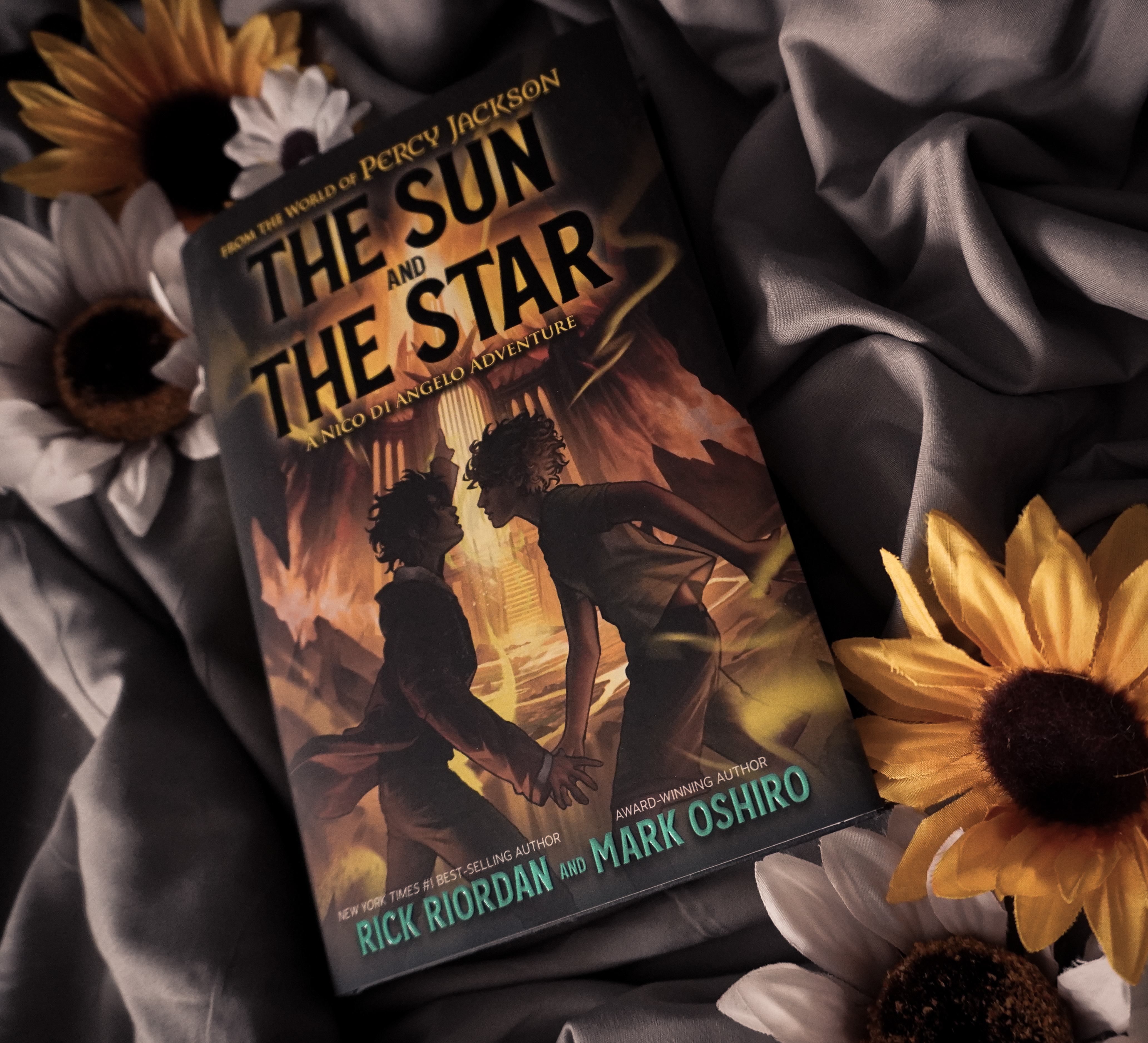
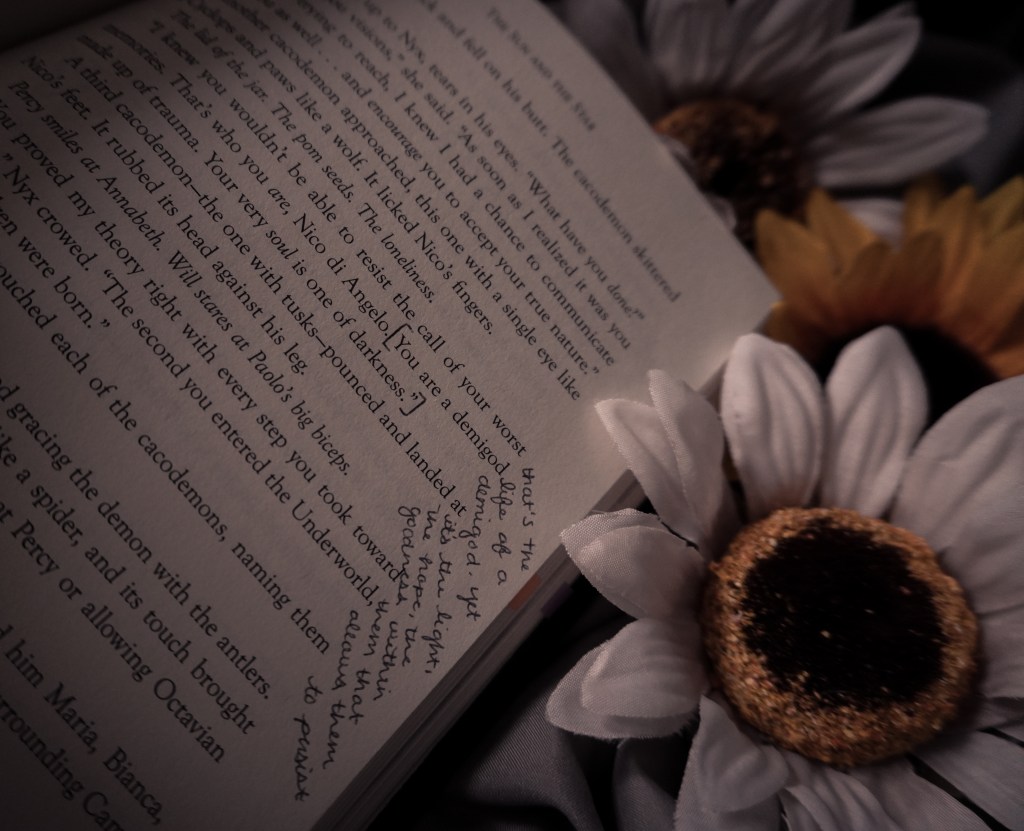
“Life finds a way to persist, even
in the land of the dead.”
I swear, this book healed something in me.
The Sun and The Star by Rick Riordan and Mark Oshiro isn’t a perfect book in any way, shape or form. Yet, I adored each and every page. I grew up with Percy Jackson, and I’ve been waiting for a Nico di Angelo solo adventure since I was 12 years old — about 14 years now — and this was such an incredible way to tell more of the son of Hades’ story.
TSATS follows son of Hades Nico and his boyfriend the son of Apollo Will Solace as they travel down to Tartarus to rescue the Titan Bob, who has been captured by an ancient entity after saving Percy and Annabeth’s life when the pair fell to the deepest depths of the Underworld. Will and Nico not only have to navigate their way through Tartarus, but their relationship and all the secrets they still hold after three wars and an ungodly amount of childhood trauma.
Here’s the good, the bad and the best from The Sun and The Star.
But first a non-spoilery review: The Sun and The Star by Rick Riordan and Mark Oshiro is rough around the edges, much like Nico di Angelo himself. A twist on Riordan’s usual adventure-packed writing, TSATS takes an inner look at what it means to survive as a demigod after the fight rather than during the battle itself. It’s a beautiful message of accepting yourself, of coming to terms with your inner demons, of healing, and of finding the balance between the light and dark that resides within us all. The story is character-driven, which makes the pacing quite slower than the usual demigod tales, and there’s plenty of inconsistencies and errors in the writing. However, it’s still a typical Riordan book that’s clearly been freshened by Oshiro’s hand with snarky comments and dark humor and Will and Nico being the most adorable cringey teenagers in hell. It’s not a perfect story, but it’s the story Nico deserves.
Rating: 4 cocoa puffs out of 5
Spoilers ahead … (also I didn’t proofread this. Sorry in advance.)
A rant: A warning ahead of time. This whole post will be an endless rant, because I’ve seen so many negative responses to this book that are such unfair takes.
The first is that TSATS is too “cringey,” which it is … in the same way all of Riordan’s books are slightly cringe. Nico and Will are 15, and they act like 15 year olds. They argue over which Star Wars characters they’d date and make Care Bear jokes and just are a bit irrational and moody and insecure like the teens they are. They are kids.
I think part of what made Riordan’s books so popular to begin with is how they resonated with children who saw themselves in the pages, because he worked with middle schoolers and could establish that connection. That’s why I gravitated toward Percy Jackson in middle school even. Camp Half-Blood is meant to be a safe haven for the unseen.
Percy was not some suave hero. He was a cringe kid who just loved his mom and wanted to fit in somewhere. The ‘dam’ joke in … I think it was The Titan’s Curse … was cringier than any bit of dialogue in TSATS. Or literally anything that came out of Lea Valdez’s mouth in The Heroes of Olympus.
Riordan and Oshiro do the same thing in TSATS, but in a more modern setting — hence the Lil Nas joke in lieu of Hillary Duff. (I also saw so many people saying the Lil Nas joke was inappropriate for a middle-grade book, to which I say that those people must not be around kids much. I was shown the Montero video for the first time on the scratched-up iPhone of my husband’s younger cousin, who was maybe 10 or 11 at the time. Kids aren’t clueless.)
It seems to me that people picked up a Riordan book and then were mad it was a Riordan book.
That’s where I think the root of the problem is. It’s OK to not like a book — I’ve hated quite a few — and I’m always on the side of literary criticism. However, tearing apart a book for being exactly what it’s meant to be is unbased.
A lot of the readers with negative takes that I’ve seen are older. They grew up with Percy Jackson just as I have. I know that I’m no longer the target demo of these middle-grade novels, and I go into them with that in mind. I read them differently than an adult book or even YA. At some point, it’s OK to just say you aged out of the genre and move on, but don’t be angry that the author is still writing books that are now no longer for you. But it seems a lot of fans don’t want to accept that these books aren’t for them anymore. They want the content to grow with them or die.
Along those same lines are the critiques of the timeline being skewed. That’s just a Rick Riordan staple. It’s purposeful. He’s said many times before that he doesn’t “date” his books so that they feel timeless. Nowhere in any of his books will you see a year for that reason.
Sure, there’s pop culture references that are representative of the years the books were published, but they’re not enough to “place” the setting because references are fluid. Percy wears band t-shirts from the 80s, that doesn’t mean the story is set in the 80s but readers often still catch the reference and know he’s into rock music. There were flip phones in The Last Olympian, but my grandma had a flip phone until this year.
Just think about how many old pop culture references you make on a day-to-day basis — I, for one, still quote Vines like it’s my job. That doesn’t mean it’s still 2012.
There’s a fluidity to all the books in Riordan’s demigod tales that reminds me a bit of A Series of Unfortunate Events. You don’t know when it takes place, but it doesn’t matter anyway.
It’s not my favorite choice in writing, but it’s a smart one by Riordan to help his stories transcend time. If you don’t like that and can’t get past it, don’t read it.
I also saw a lot of people claiming both Will and Nico were mischaracterized. This one is what stumped me the most. We have never gotten a Will POV. We have only seen him through the eyes of others, and prior to TSATS, readers know very little about him aside from his affinity for cargo shorts and flip flops, his mom’s occupation and his skill as a healer. The intricacies of Will’s character weren’t established — like his inner thoughts, insecurities, rooted personality.
And with Nico, the only time readers got a canon POV was nearly nine years ago in The Blood of Olympus when he was damn-near dead and struggling to get the Athena statue back to camp. TSATS gives a Nico that’s unraveling that, and it felt to me like a seamless transition. His base character traits stay the same, but he’s more focused on unwinding those strings rather than bunching them up.
I think the fanon characterizations of Nico and Will because of their popularity gave a lot of people in the Percy Jackson fandom a version of those characters that didn’t exist and yet was allowed to fester through the years.
Which brings me to …
The Good
Will and Nico’s personalities: I absolutely adored how Riordan and Oshiro wrote both Will and Nico in this book. They are so different — with Will’s positivity and caution and Nico’s pessimism and reckless agency — yet you can tell how they fit together in their goofy humor and care for each other and humanity.
At their core, the pair just want to help people. They go about it in dramatically different ways, but it’s a fundamental part of who they are. I loved seeing them sort of teeter totter on how to accomplish that shared goal or tip the scale when it can’t be met. It carries the overall theme of balance, and fits with what we’ve seen of these characters throughout the Riordanverse.
Nico honestly reminded me of the boy we first met in The Titan’s Curse — curious and a bit dorky but now with a sharpened edge. To me, that shows progress in Nico.
I might be alone on this, but I don’t want a scared, isolated and hurting Nico forever. I, much like Hades, wanted this boy to be happy. What I wanted out of a Nico solo adventure was healing or a journey toward it.
While he’s clearly still learning to live with everything he’s done and endured, he’s starting to find himself again. We see that with him talking about MythoMagic and his family and just opening up this door that he shut when Bianca died. That’s character development, baby, and that’s what this whole book is about.
And Will … I didn’t have strong opinions or emotions toward him prior to TSATS, but I fell in love with him. He’s such a loser in such a wonderful way. Him wearing cargo shorts in hell was my favorite thing ever (and also the most teen boy-coded thing), and I adored that he brought a bag of KitKats just for Nico because he knew his boyfriend liked them.
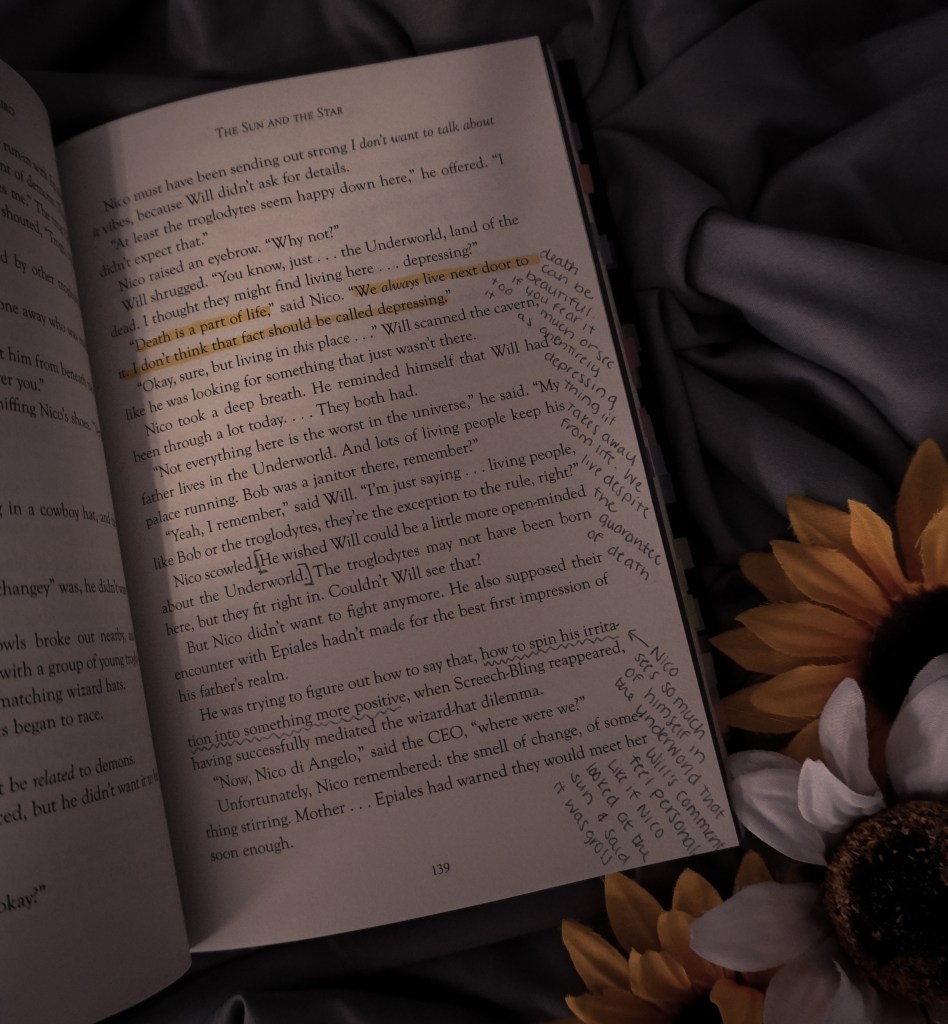
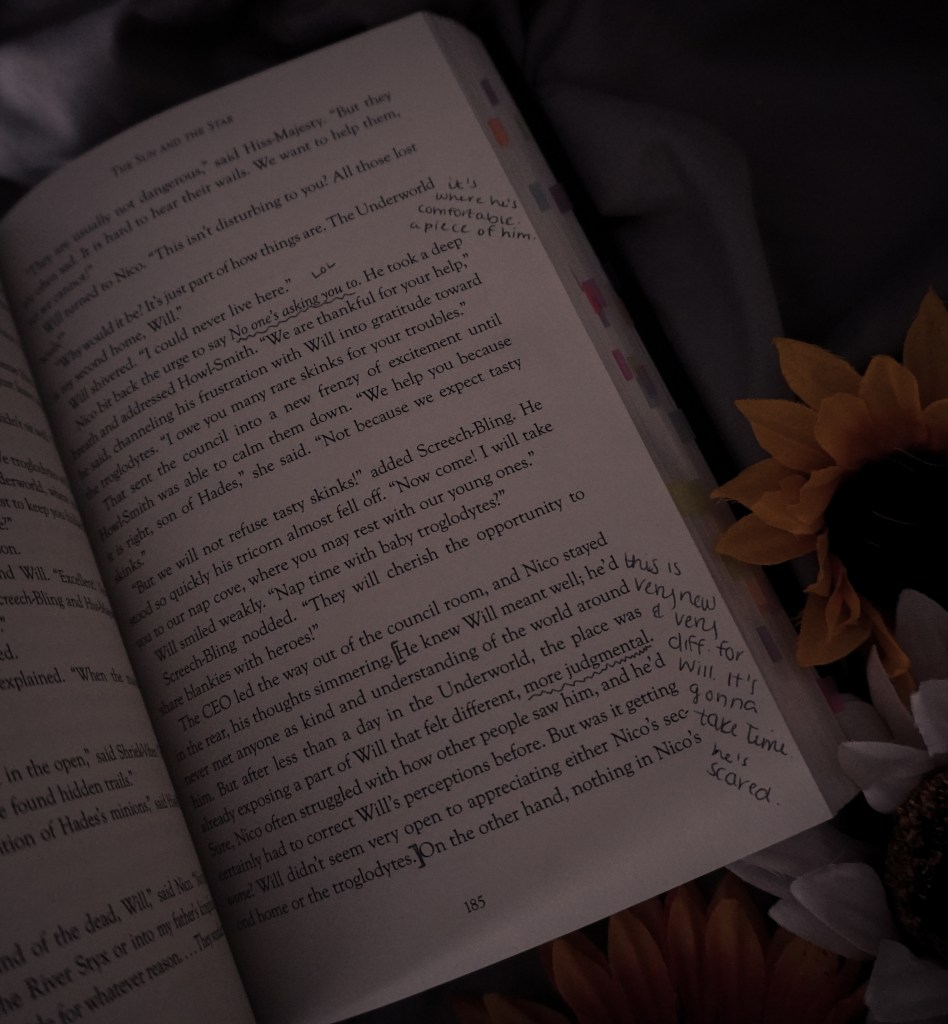
Yes, he was whiny and closed-minded toward the Underworld, but that’s usually what happens when you throw someone in a new environment. It wasn’t his element, it weakened him and it was terrifying. Give my boy a break. He realized he was being unfair and was trying to understand for Nico’s sake, which shows the type of person he is — one that is always willing to learn and grow.
Characters without conflict or flaws are boring and don’t carry stories. If Will was just chill the entire time, there’d be no growth and this particular story was meant to be about the two of them learning that light and dark can and do coincide.
Anyway, I love these two dorks.
Flashbacks: Going along with that is how Riordan and Oshiro showed readers some of Will and Nico’s pasts, particularly with their mortal parents. So often in these stories, writers focus on only the traumatic and bad because conflict drives the plot. However, in this case it was perfect in showing that not every moment is life or death. There are times of peace. There is happiness.
Will being a big ole’ mama’s boy is so sweet, and it was interesting to see that he spent so long touring with her. The memories of them traveling together, Will sitting in the back of clubs to watch her perform, him humming a song she wrote to comfort and heal, and her taking him to get a sun tattoo in honor of his father all genuinely made me tear up. It makes me wish we saw an actual interaction with Naomi. I want to see her give Nico the biggest mama hug and for him to not even be able to make a joke about how he doesn’t do physical affection.
And Nico having soft memories of his mom, Maria … my heart. I wanted more of them. Just him talking about her shows a huge step in his healing — to allow himself the happy memories even though they’re painful. The dream where he’s on the balcony in Italy with Maria is just … stop. A memory that reminded him he was loved, and he still is.
The vibes: You got that right, the vibes of TSATS are on point. It’s more modern than the previous books and a bit darker, but still gives off the same vibes from the PJO days. It’s a bit silly, in a heartwarming way. It’s full of that sweet, sweet nostalgia.
Also Mr. D respecting Nico made me so emotional.
The Bad
Character cameos: The absolute worst part of TSATS was the cameos from past characters. Percy always makes an appearance in a series, but this time it felt so uncomfortably awkward, forced and completely unnecessary. Nico thinks that talking to Annabeth and Percy will make Will less nervous about going to Tartarus … why? Percy and Annabeth don’t talk about Tartarus for a reason. I feel like Percy especially would try to stop them or convince them not to or want to do it himself — especially since Bob being left down there is solely their fault (not that they had a choice otherwise, but they did make the decision). Percy literally took on the Great Prophecy to protect Nico, and you can’t expect me to think that he and Annabeth would just be mildly sad to see Will and Nico going down there.
Even if you can accept that Percy and Annabeth wouldn’t be hightailing it out of California to stop these adorable losers, it was just a weird interaction in general. There was nothing in the conversation that showed readers the connection these four had as campers and fellow soldiers and friends. The advice Annabeth gives is sound, but unnecessary considering we get another interaction down the road with the same connotation.
The trip to Sally’s apartment should’ve been left out entirely. It was fan service in the worst way.
The call with Piper at the end was equally awkward, and I understand that it was supposed to be a bit awkward. It just felt so out of the blue. Jason Grace’s death is mentioned throughout TSATS — as it should be as another loss that truly affected Nico as a reason he’s so … adverse or fearful of love — however, it didn’t feel necessary to throw in the call with Piper. It came out of the blue. Maybe if Nico thought about reaching out to her somewhere before or mentioned it to Will, it would integrate better into the story. But how it is, it felt very clunky.
From a writing standpoint, I know what they were going for in showing how Nico is trying to open himself up more and stop self-isolating, but from a reader’s view, it needed to be done better. Did we ever get a Piper-Nico exchange in the books even? (I honestly didn’t care for HoO, so I can’t remember much about it lol) Death often brings the deceased’s loved ones together and it’s nice to share the burden of grief with people who understand, but it also doesn’t have to do those things. If there’s no previous relationship with Piper and Nico even after Jason’s death, I personally don’t think it needs to happen. Either way, it still felt weirdly placed.
Weird choice: Will brought a bottomless backpack into Tartarus but no weapons. Why? Will mentions he wishes he honed his archery skills, but that’s no excuse to not bring anything. Will’s been at camp for like five years or so, he should be adequate at fighting with something. We know everyone trains. Even if he’s not adequate with weapons, he should still carry one to at least have the possibility of defending himself.
(Unless we’re trying to explain this by saying Will spent so much time in the infirmary as head apollo counselor after the wars to treat people that he can’t train in anything else? But seems like a cop out considering all demigods are supposedly “hardwired” for combat.)
It’s even mentioned before they start their quest that they aren’t sure if Will’s demigod powers will work in the Underworld, so why is he not equipped? It doesn’t make sense in the world Riordan created for a demigod to go on a quest unarmed. The choice made it so Will felt helpless all the time. I enjoyed Will not feeling like a hero, but it also just isn’t logical for him to be that defenseless. I’m sure a dagger could fit into one of the pockets on his cargo shorts.
Structure/pacing: This is the biggest thing, and it’s a two-sided coin. I loved that TSATS was a different take on the demigod experience, which I’ll discuss later, but it screwed up the pacing of an already oddly structured story.
TSATS focuses more on the unraveling of trauma rather than experiencing it. It’s gorgeous, beautiful and a bit breathtaking, but it’s slow. The pacing is much slower than any other Riordan book I’ve read. If you go into it expecting The Lightning Thief, you will be shocked and I could see people putting it down because of it. It’s a lot of internal processing and progression, which lulls the adventure. It feels uneventful as a whole, because the action sequences are toned down and spaced out to leave room for that internal reflection.
The structuring of the novel plays into the slow pace, because we are pulled around between dreams and flashbacks. It’s jumpy, which makes it so readers have a hard time getting into the rhythm of the story.
What I personally thought was the main problem with the structure is the reminiscing with Gorgya. It was oddly placed to have this lead off the book and then stop a little over half way through. From a Doylist perspective, I understand that this was done to carry hope and love into Tartarus, but I think it could have been integrated in a different way.
It would have been lovely if the entirety of TSATS was told as a story by Nico and Will; that the visit with Gorgya and sharing of what they’ve been through led them out of Tartarus. That’s honestly what I thought it would be — the whole story of Solangelo.
We already had the awful pep talk with Annabeth and Percy about how love kept them alive in the pit, so did we really need to reiterate it again?
Marketing: This goes along with the above, but Riordan and Oshiro should’ve marketed this book as a fresh, new perspective on demigods. I can’t fathom why the two of them and their teams thought TSATS wasn’t a shade different from previous RR books. I think a lot of the hate/harsh criticism I’ve seen of this book could have been solved if the authors explained that it would be more of a focus on healing rather than a typical quest. This is a borderline romance novel.
That’s the old PR major in me though. Save yourself the trouble and be proactive rather than reactive.
Nyx: This is a product of having a one-off book when you’re used to getting series from an author. Nyx is a very interesting villain, especially with her personal connection to Nico; however, that dynamic is not explored nearly enough due to the nature of this being a singular book. When I look back at some of the previous CHB/Camp Jupiter adventures, it’s hard to compare Nyx to the masterpiece of Luke/Kronos or the terrifying entity of Gaia or the mythological connection between Apollo and Python. These conflicts took time to establish and root the fear/stakes, but Nyx singles out Nico which narrows things to make it feel uneventful.
The main battle itself was sort of meh, though to be fair, I don’t think the action is the selling point for this book.
*** … also, at one point Nico’s mom is called Bianca. … yikes. ***
The Best
No sub-categories for this one. The best part of The Sun and The Star is how it tells a deeper story with an extremely beautiful message that expands past the typical battle between man and monster. I did not expect to sob as much as I did while reading this book.
It can be summed up in these two quotes:
“There cannot be light without darkness, nor darkness without light. You must have the contrast for both to exist.”
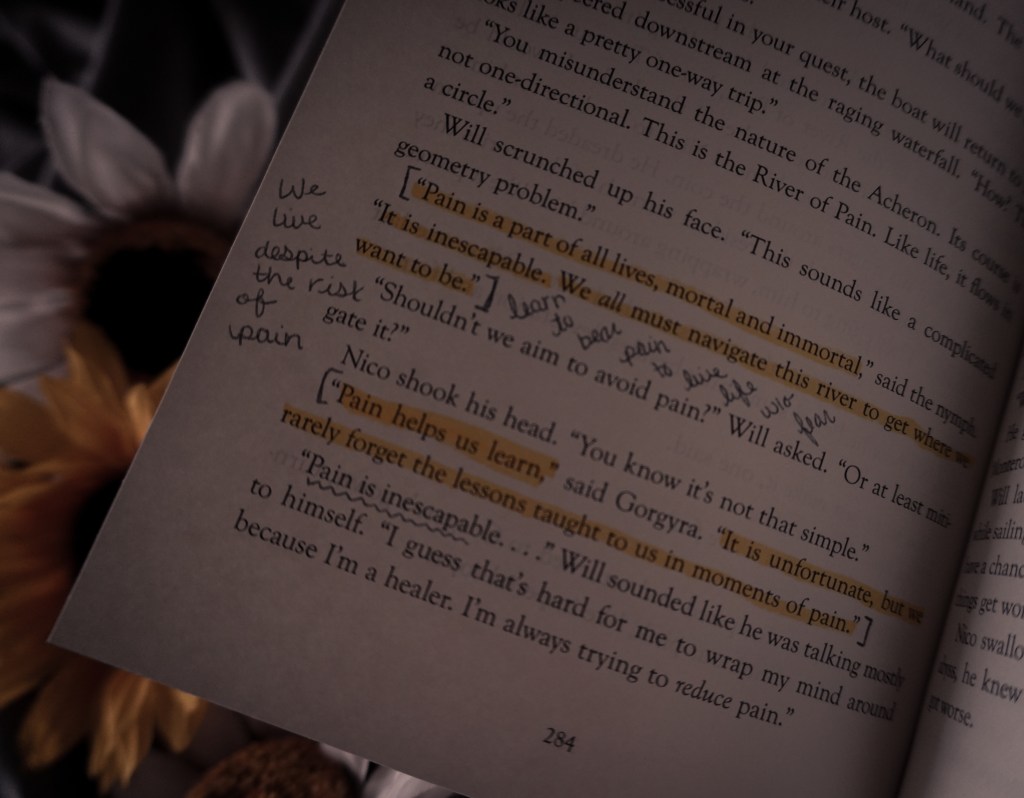
“Pain is a part of all lives, mortal and immortal. It is inescapable. We all must navigate this river to get where we want to be.”
I always felt as if the trauma of heroes in media is not explored enough. What happens after the battle when it’s no longer just about surviving, but living with everything? Riordan and Oshiro found a way to do that in a way that’s palatable and relatable to children, while also delivering a very moving story for readers of all ages.
And Will and Nico are the best options for this story because of their differences. Both have insurmountable trauma simply for being born as demigods, but their life experiences are vastly different. Nico lost his mom and sister, his time in the Lotus Casino put him in a different generation, he’s been through Tartarus alone, he’s felt isolated, unloved and inadequate for so long. Will’s seen the worst of battles as a medic, faced with the task of treating literal children who are dying while he’s a child himself and sometimes you just can’t save them.
A soldier and a healer — two contrasting positions that share a common experience of life and death and must coincide for any battle. They are the perfect pair to carry this story.
TSATS is about facing your inner demons. All those voices in your head that say you are not enough or you are a bad person for doing the things you’ve had to do to survive. It’s the doubts that creep into your thoughts and the insecurities that pick at your skin. Every painful memory that haunts your day dreams and nightmares.
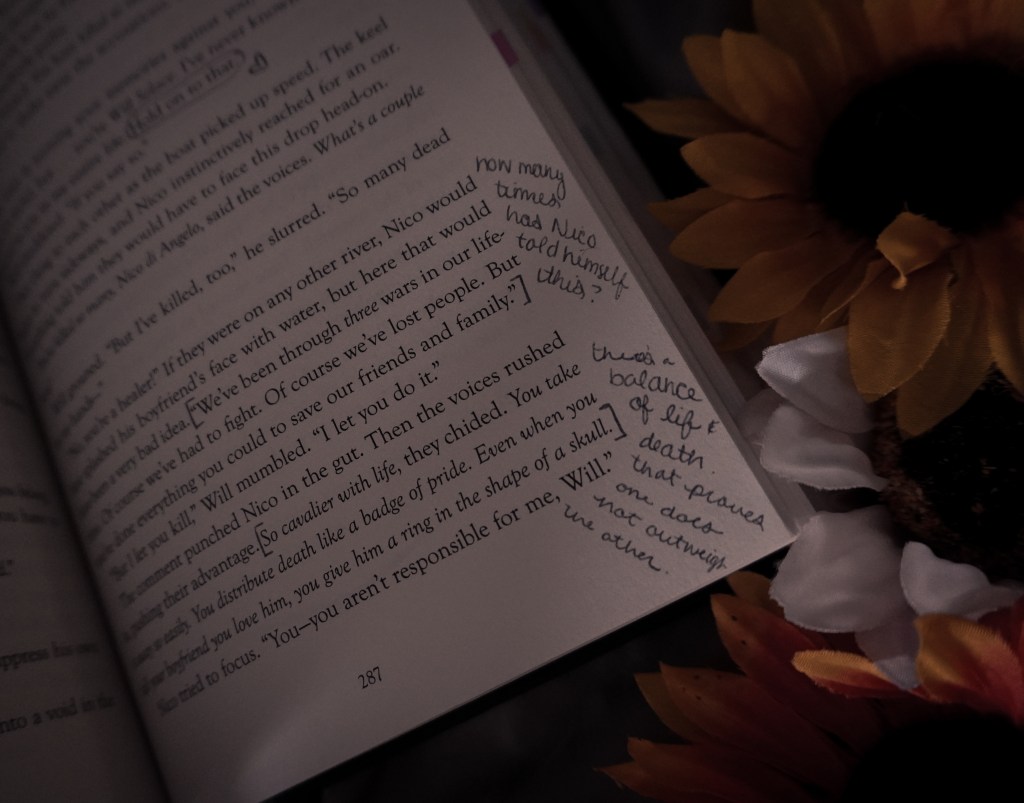
However, it’s not about pushing away all these things, it’s about accepting that they are part of you and that there can be a balance.
Nico and Will are a very obvious symbol of the balance between light and dark. A child of the Underworld and one of the sun. A fighter and a healer. A grumpy ball of darkness and a literal ray of sunshine. Dark hair and pale and blonde and tan. The sun and the star. It’s not a subtle distinction.
It’s all about how these distinctions can and do coincide, which is what Nico and Will learn throughout their journey.
I thought this was a really interesting concept because it conflicts with the very roots Riordan set in his lore when writing the first Percy series — not in a bad way. Riordan set this pattern of demigods of certain deities being very similar with set characteristics that define them like Percy having a very tumultuous emotions like the ocean, all Athena kids being strategists with blonde hair, the Aphrodite kids being the ones you go to for dating advice, etc.
It’s nice to see it exemplified that these stereotypes don’t mean that’s all they are.
And the journey it takes to come to this realization is wonderful. It’s finding beauty in the unlikeliest places. Like in a garden in the middle of the Underworld.
Will’s talk with Persephone was especially moving: “A god or demigod so surrounded by death … they seem to appreciate life more than anyone else. They understand it, even if they don’t always drift toward it.”
I think that says so much about Nico, even though it’s directed toward Will’s question on how to love someone from the Underworld. He appreciates life so much because he’s seen the things humanity takes into the afterlife and he’s afraid his very presence will take away some of the things he loves about it. And Will is symbolic of life. So maybe Nico will be a bit hesitant to open up because of that same fear, but it doesn’t mean he doesn’t love Will.
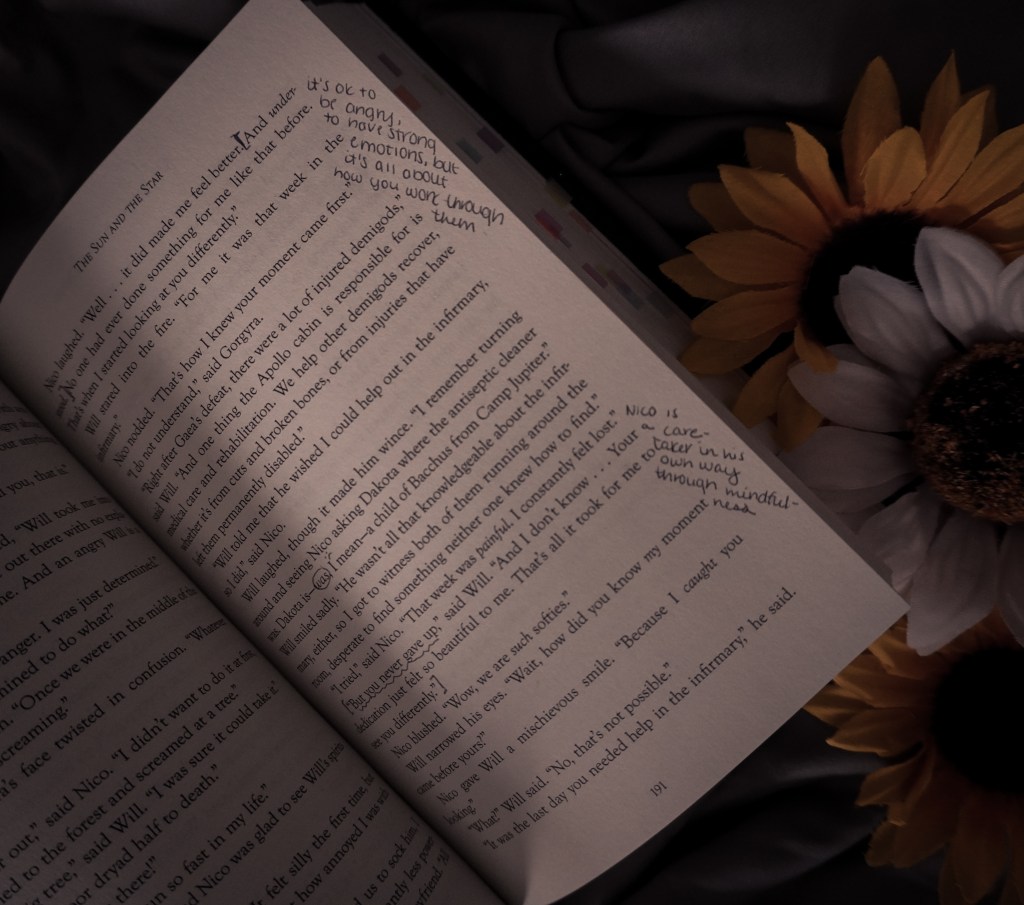
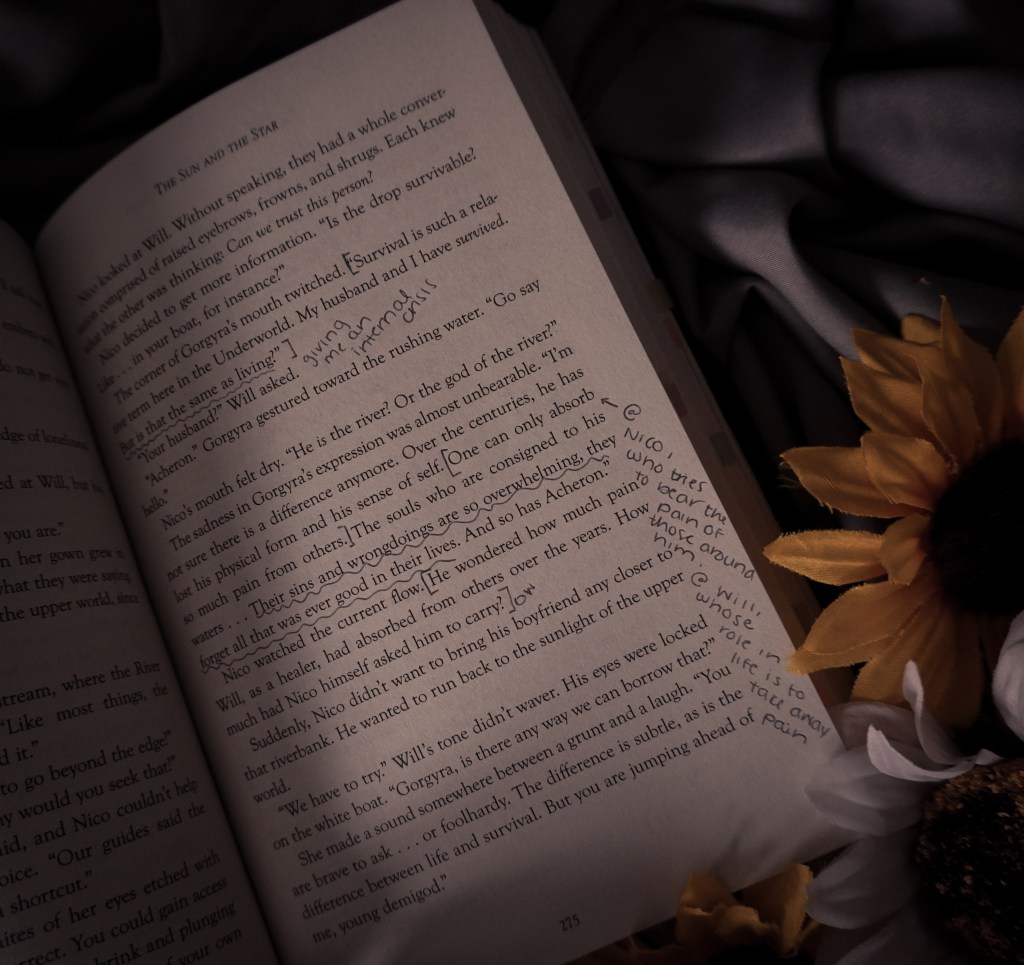
And there’s the flip side of Will also realizing all these things he kept bottled up. Every life he couldn’t save, the monsters he’s had to kill and some of the loneliness he felt touring with his mom that maybe he thought he couldn’t show because of his position, but he has to face it in the Underworld as the voices call out from the river to him. That allows for Nico to swap roles with him and be the one to comfort him and let him know that he is also not a bad person for that.
The case of the mania Amphithemis and how Will sent him after monsters to protect the two of them, while Nico wanted to help him was perfect in showing that both have had to make questionable decisions and they aren’t defined by the choices they have to make in moments of survival.
And finally, the closure Nico gets in this book to move on with his life. He’s this character that’s always felt a bit stunted or stuck, which makes sense because he’s a relic of the past. All the dreams, the final moment with his family and his little cocoa puffs that he grows to love are a way to heal Nico and allow him to finally live his life the way he wants untethered by his past experiences.
I loved it.


 Life of Bry
Leave a comment