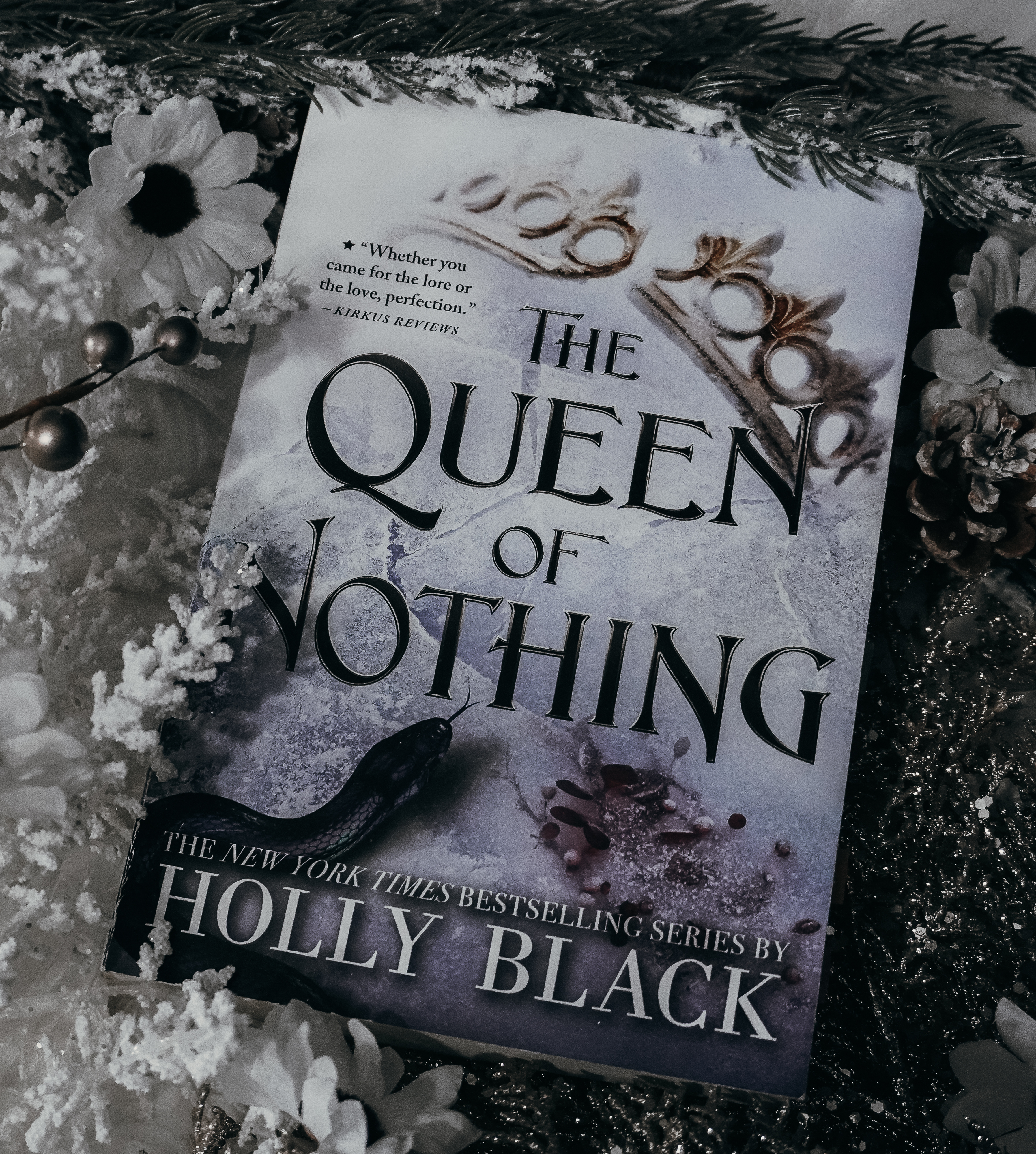
“How do people like us take off our armor?
One piece at a time.”
Guys, gals and non-binary pals,
A new challenger has entered the ring.
I think The Folk of the Air might be one of my favorite YA series. It’s not No. 1. The Hunger Games will never be dethroned. However, it’s in my top three and maybe the best that’s been published in the last decade.
Holly Black is definitely the smartest YA author I’ve read recently, and as someone who loves the art and intricacies of writing probably more than the story itself, that’s saying A LOT.
The Queen of Nothing isn’t a perfect five stars like The Wicked King, but it’s close and I am officially obsessed with Jude and Cardan.
I was going to sit down and pull quotes and write a super in-depth, academic-level analysis, but after finishing TQoN, I decided I just want to enjoy this series and the experience of reading it for the first time. I will be doing a reread eventually, and maybe then I’ll be more inclined to dig deeper. For now, just some thoughts.
But first a synopsis: Jude Duarte learned the hard way that power is easier to take than keep. Now the Queen of Elfhame is exiled to the mortal world, and Jude is left to seethe and scheme a way to reclaim the power she believes Cardan tricked her out of. That means finding a way to sneak back into a Faerieland at the brink of a war that will be Jude’s greatest test yet.
And a non-spoilery review: The Queen of Nothing is a combination of incredibly smart writing, beautiful and tense storytelling, lovable and dangerous characters, and themes that test your own morality. It’s a calculated and thrilling adventure that plays in the shadows as Jude navigates the pull of power after a life of feeling helpless and fearful while Cardan figures out what type of rule he wishes to be after never thinking he’d find himself on the throne. There is no redemption in this series, only hard choices that continuously blur the lines of right and wrong as readers get sunk deeper and deeper into political and personal turmoil that emphasizes how power isn’t always sweeping acts, but often intimate gestures. While the climax is a bit lackluster with a trope I personally can’t stand, it doesn’t entirely take away from how incredibly well-plotted and paced out this finale is. Trust, loyalty and love intertwined with cruelty, bloodlust and moral ambiguity make The Queen of Nothing and The Folk of the Air series a story to violently cherish for its turning of ethics and emotions.
Finally my rating: This finale was nearly perfect, but I’m docking it a quarter point for having a specific trope I hate at its center. 4.75 angsty serpent kings out of 5
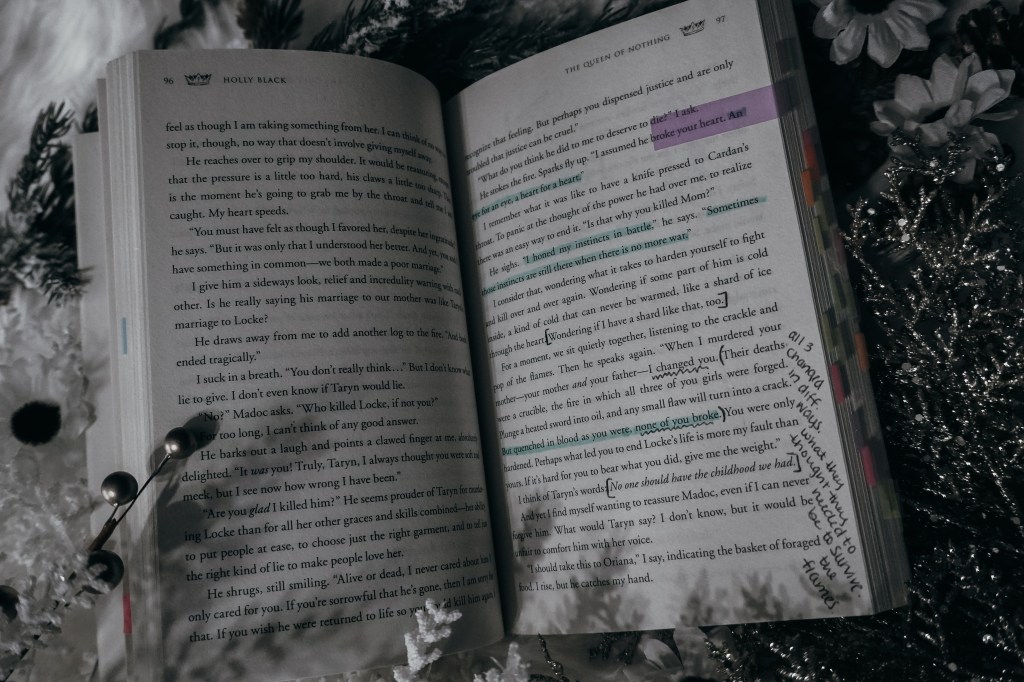
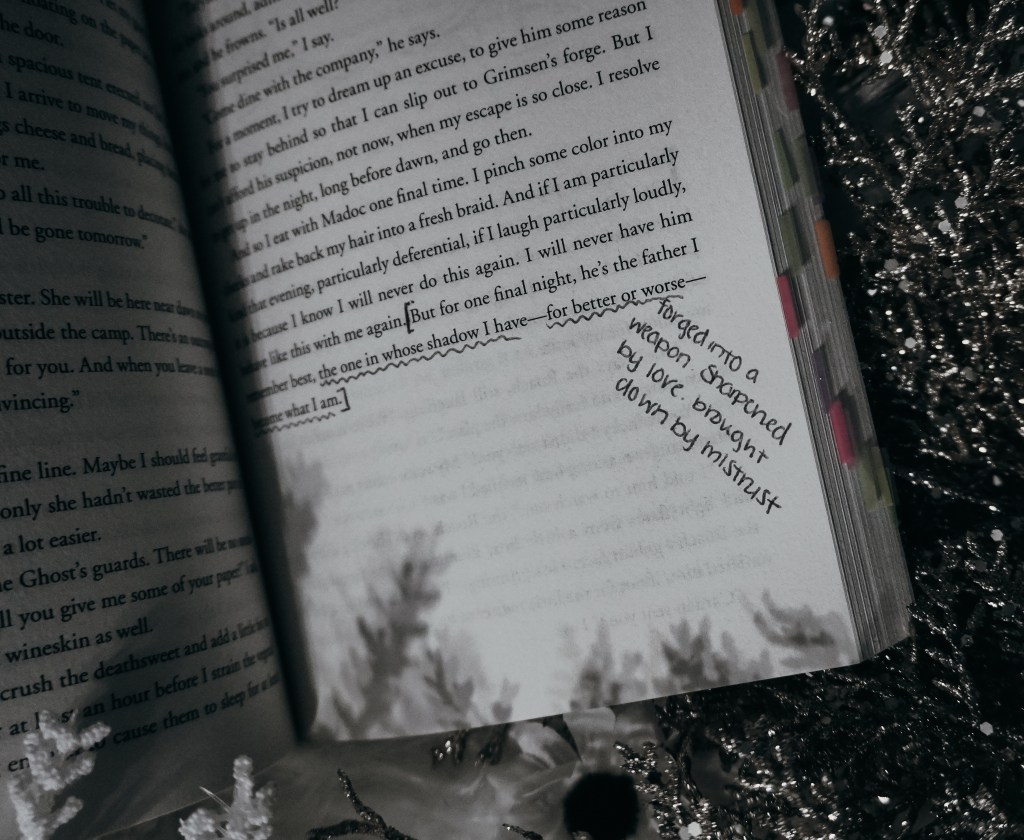
Some annotations …

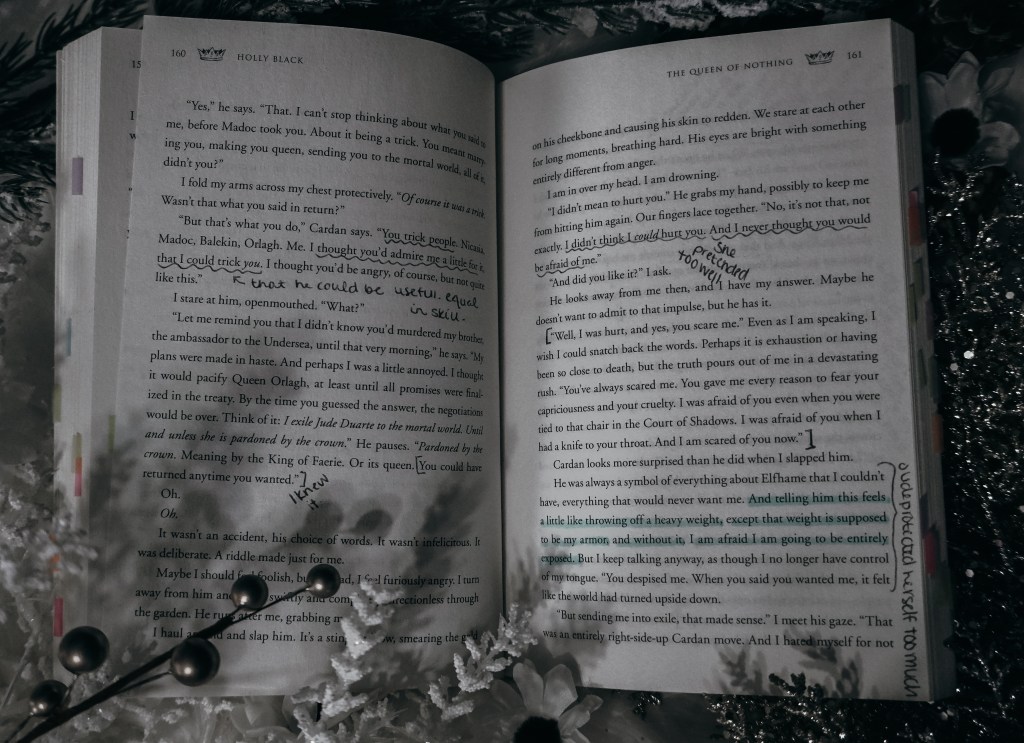
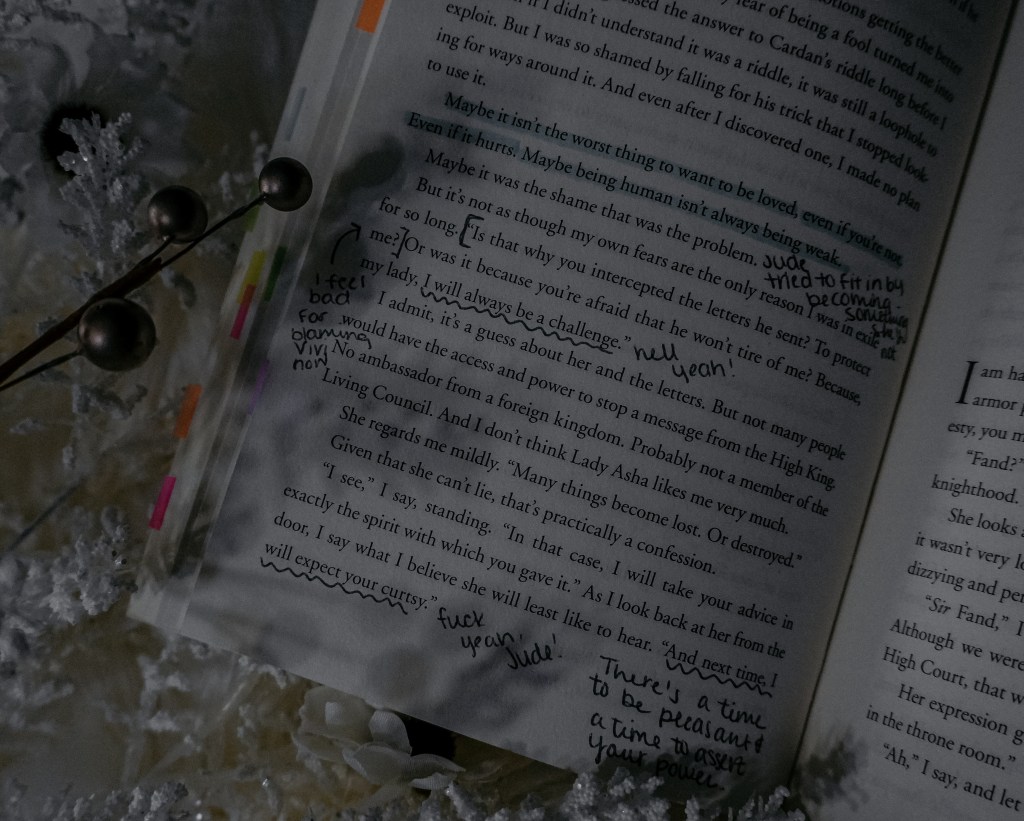
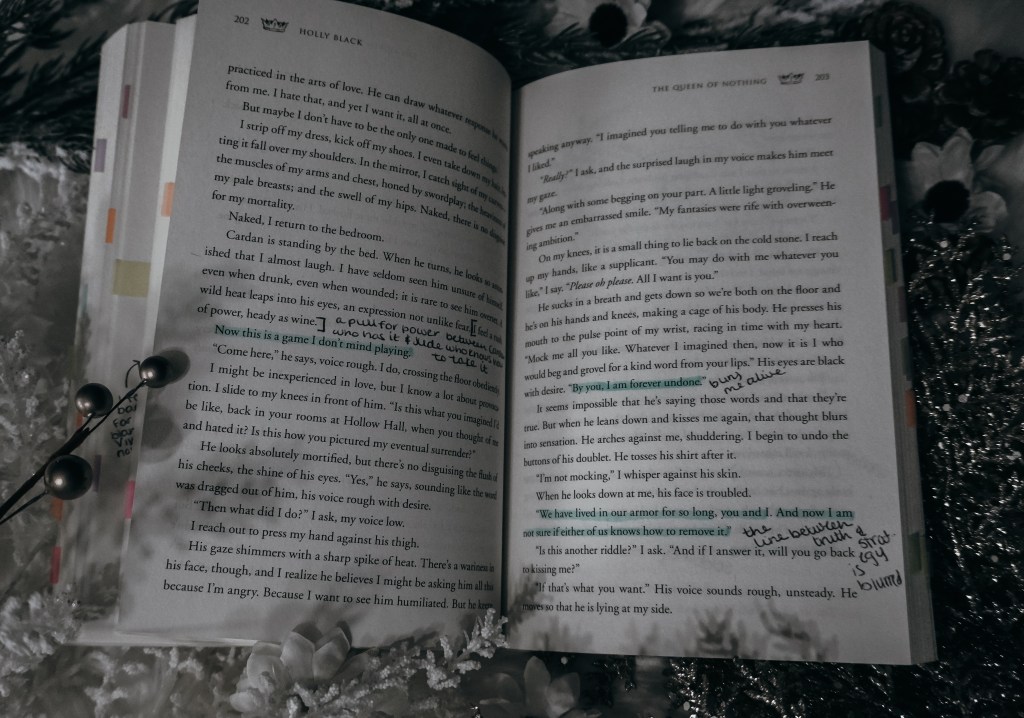

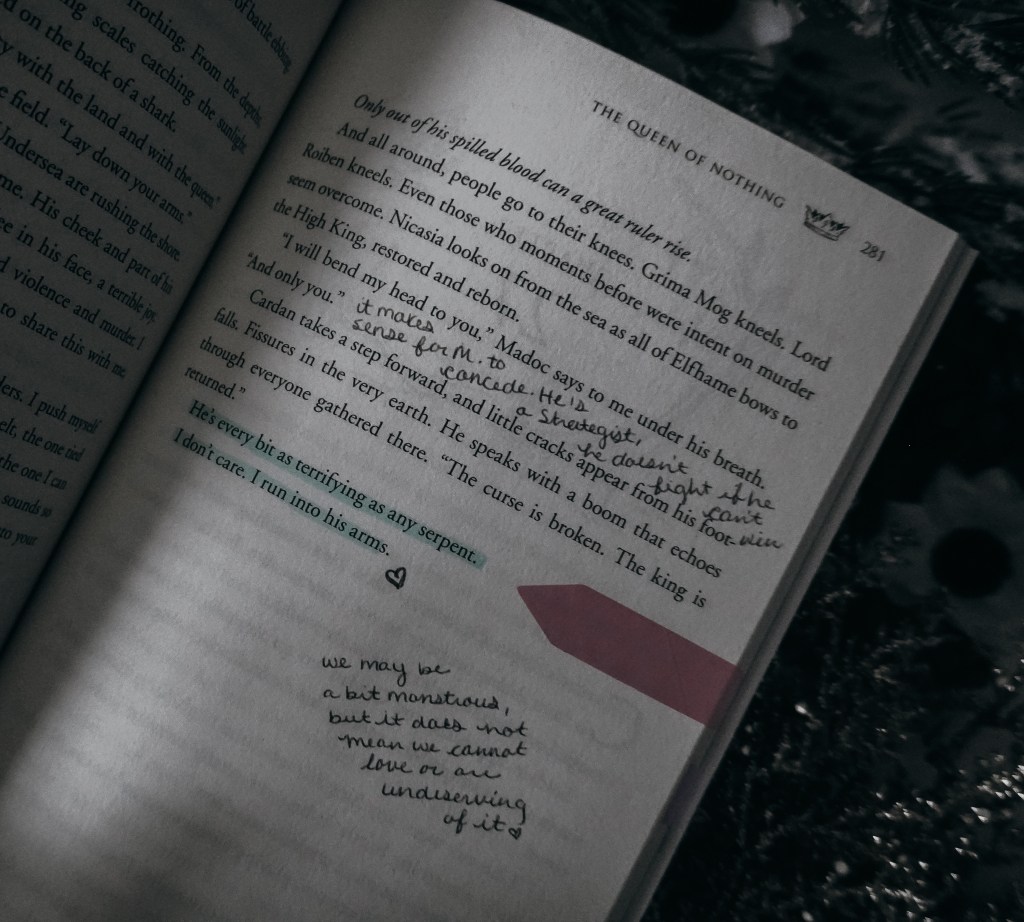
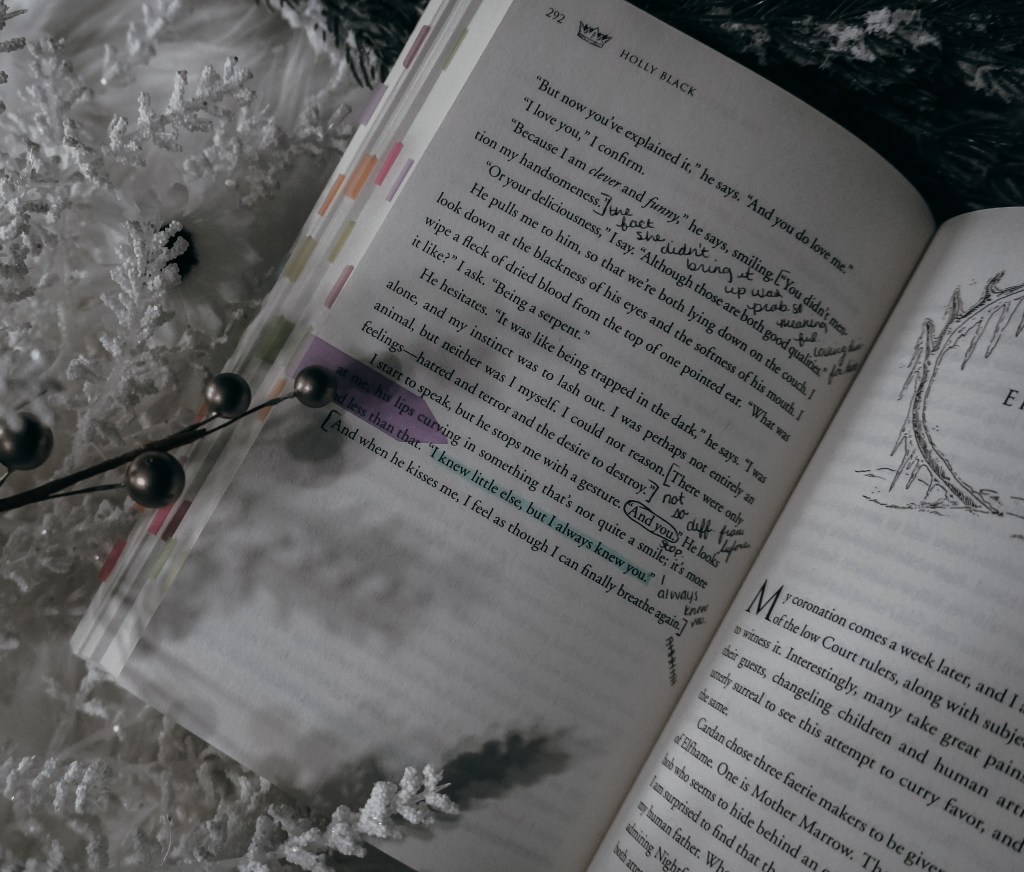
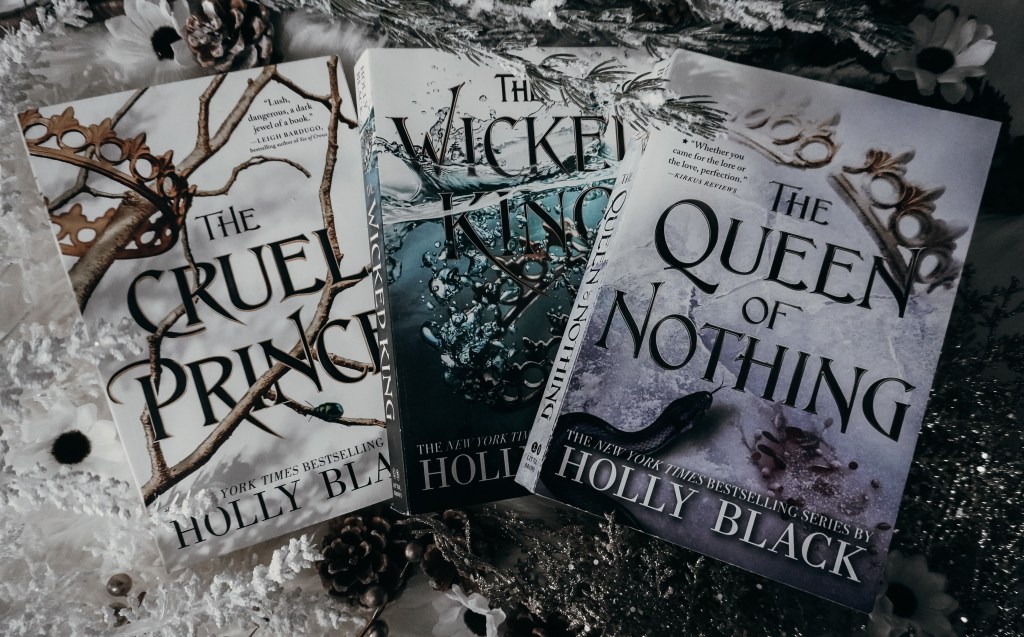
Now time for some thoughts … spoilers ahead
I told me so
Most importantly, *me to me* I told you so. I predicted in my Wicked King review that Cardan specifically worded Jude’s exile so that she could pardon herself at any time, and that’s exactly what he did. And that decision was so fucking smart by Holly Black for two reasons:
- Jude wonders during exile if she could pardon herself, but ultimately throws the idea away because she doesn’t see herself worthy enough to actually be considered the Queen and also doesn’t think Cardan would give her this loophole of sorts because he’d rather have her gone. That’s so important for continuing the established character trait of doubt that makes Jude more human while also showing that her perception that a title or power would change that part of herself isn’t entirely correct. By essentially removing Jude from her position of power, it allows the reader to see how she’s changed and what lingers. She’s technically a Queen but still feels powerless. It also proves the point of how easily power can be lost and what it means to have it.
- Cardan being so excited that he tricked Jude is adorable in the most pathetic way. (Pathetic in an ‘I love him so much’ way, of course.) He wants to prove himself, especially to Jude. As much as he loves to be a pretty boy, lounging on the throne with goblets of wine, he has this underlying need to show he’s worth something that stems from a life of being overlooked. I think that’s why he wanted to be taught by the Ghost. He wanted to both impress Jude and become useful to mend something broken in him that believes he’s useless. It’s so sweet in that sad way. After a life of being the youngest, the cursed, the forgotten son, Cardan is trying to find ways to do something other than wreak havoc through debauchery.
My sweet nemesis …
I absolutely, positively adore Jude and her journey.
Before I get into it, I wanted to mention how amazing it was that Cardan, despite being a larger-than-life character, didn’t overshadow Jude or anything she was going through. So many times in YA fantasy, the heroine’s journey is dictated by the man standing beside her, but Jude is truly the orchestrator of her own character development and the story as a whole.
Cardan is not an idle character by any means, but he acts as a complimentary piece. I used the metaphor in my other reviews that Jude and Cardan are mirrors. However, I think Cardan is more so the frame to Jude’s mirror. He accentuates her, but she’s still the main focus.
Particularly in The Queen of Nothing, Jude learns her personal worth.
She’s sacrificed almost everything in her to find a place in Elfhame, to survive, to protect her little brother, to keep Taryn safe and happy, to make her foster father proud, to keep Cardan on the throne. But it’s not entirely black and white. She’s also selfish by circumstance. Her life has made her justly paranoid, and that feeling of helplessness has poisoned her. Her cravings for power are based on not wanting to be helpless or reliant, though it’s mixed with that very selfish feeling of enjoying the rush of having control.
But her idea of power is skewed because of her upbringing. Madoc raising her made her think power came through conquest, and Faerie’s innate cruelty to mortals only furthered the appearance that safety and strength were only found in sharp blades and spilled blood. Madoc mentioned that his three daughters didn’t break, but they hardened. When they hardened, it upended their ideals — especially for Jude.
So The Queen of Nothing is her learning what it means to truly have power of varying degrees. Power over self in having confidence in her capabilities to scheme, to fight, to love and be loved. But also power in presence as she commits to her role as Queen when Cardan is cursed and has to make decisions for the betterment of we rather than me, which ultimately leads her to make the choice to kill the serpent.
First, she begs Nicasia to help her. She sets aside her pride and desperately looks for help anyway she can, because this is something she can’t do alone. Or doesn’t want to. She knows she’s capable of what needs to be done, but she doesn’t want to put her emotions aside to do it.
And it’s that act of choosing to kill the serpent despite personal consequences that proves her worth and capability to be Queen to her subjects, but mostly to herself, and we see the rulers she and Cardan want to be at the very end when Jude hands down Madoc’s punishment of mercy.
There’s also the full-circle arc of Jude coming to terms with her humanity through this all. In The Cruel Prince, Jude mortality is seen as a mark of Other, hindering her aspirations at times and being used as a weapon when needed. In The Wicked King, she begins to separate herself from her mortality and the morality that comes with it as much as possible because she sees it as a weakness — which is symbolized in her tossing her childhood stuffed animals into the fire. In The Queen of Nothing, she comes to terms with her mortality not by accepting that one day she’ll die, but by honing the values she learned in the mortal world with her human parents. Jude understands how those aspects of herself aren’t something to hide away.
I don’t care if he’s a murderous, bloodthirsty tyrant. I love him.
Speaking of Madoc’s punishment, exiling him to the mortal world and not allowing him to pick up a weapon is such a full-circle way of wrapping up the series. Madoc must change his way of life to fit into the mortal world, just as he forced the Duarte sisters to do the same in Faerie. He will have his family, but he will have to take a look at himself and who he is without a sword in his hand and scheme in his head in order to survive. He will have to adapt and adjust to a new set of moral and ethical codes and learn to live with everything he’s done. It’s poetic justice.
“I told you once that I am what you made me, but I am not only that. You raised me to be uncompromising, yet I learned mercy.”
Also with Madoc, the moment he nearly kills Jude is incredible in showing the difference between him and his foster daughter. I really enjoyed his character but it does seem that he has so much affection and adoration for his girls and Oak. Even Oriana tells Jude that Madoc is smitten with his daughters. And I really do believe he loved them all, but I think he loved what they gave him — weapons.
Each of them were only good for what they offered, and that’s why he and Vivi have the most-strained relationship. She refused to be what he wanted, which was a luxury because of her being safer as part-Fae. However, he trained Taryn and Jude to be useful through their position of being mortal and vulnerable. Jude was his biggest asset, yet she turned against him because he couldn’t account for her mortal ethics and values being applied to his lessons of brutality.
Jude knows love with no strings attached because of her mortal parents, but Madoc is the opposite — love for worth/purpose. He hesitates to deliver the final killing blow on Jude. He wants to take her back with him to save her life, but it’s all with the idea that she can still be useful to her. She’s an important piece on the strategy board, and whoever has her has power over the King (because everyone but Jude knows Cardan is a simp for her).
It’s a phenomenal dynamic between Jude and Madoc, but great in contrasting how Jude cares for the people she surrounds herself with not for what they provide her but out of pure affection. The Ghost is a great example because he betrayed her. It would’ve been easy and smart to simply kill him, yet she is appreciative of what he’s done for her and cares about his well-being. The same goes for Taryn. Jude could’ve easily allowed her twin to face her own judgement for killing Locke, but cared enough about her sister to save her life despite the past betrayal. Jude can be ruthless and cruel, but she’s merciful and genuine. She is not her father.
…. And she is passing those values down to Oak, which we see with him wanting to help Queen Suren.
Baby girl Cardan
Ugh. I love Cardan. I love how subtle he is in the narrative despite him being this over-the-top, flashy personality. Readers don’t get Cardan’s POV, so we never know what is going on in this boy’s head, and I’m obsessed with that. I love that we have to pick apart his words even though he can’t lie and analyze each tiny gesture even though he’s a good actor. His body language screams. It’s the intricacies of his character that make him impeccable.
And his development sort of happens in the shadows, because we simply don’t know his inner thoughts and Jude only really pays attention to what pertains to her and the task at hand. Jude’s suspicions cloud the reader’s view of Cardan, and Holly Black gives us just enough to understand why he is the way he is. However, it’s nothing like Jude’s constant inner monologue of panic, fear and doubt.
The Queen of Nothing gives us the biggest piece of Cardan’s puzzle to start off the finale — how he was prophesied to destroy the throne, his being neglected and the rise of his reputation.
The fact Cardan’s cruelty began not by his own hand but by his brother’s was so deflating (in a good way for readers). It exemplified Cardan’s own helplessness despite his title as Prince. His mother was locked away in his stead for an act he refused to commit. It was a harsh lesson that he couldn’t even trust his own family, and gave him little options as to who he could become in his position. It also told him that no matter what he did or didn’t do, he’d be punished. So why not use all that anger to find power and attention wherever possible? Cruelty as a coping mechanism.
Much like how Jude hardened to survive in Faerie, Cardan had to do the same to survive being the cursed prince.
However, Cardan is baptized in blood at the coronation. It’s a nearly identical experience to Jude watching Madoc murder her mortal parents as a child. It resets the course of his existence. Just as Jude had to learn to adjust to her new life, Cardan must do the same as the High King.
And he does in his own way. He spends The Wicked King being an aggravated puppet, but by the end he wants to rule or at least make use of the power he’s come into. I think that’s mostly because Jude was taken right out from under him, and he realized being King wasn’t a drinking game. He had people he cared about and who cared about him getting hurt while he had the power to better protect them.
Then in TQoN, he fully takes charge. He’s conducting official business when Jude returns to Elfhame as Taryn, he goes to save Jude from Madoc’s camp with the Court of Shadows, he is in a council meeting when Jude tries to stop the assassination attempt. Just these little details show how he’s changed from TCP just by his initiative. He has ambition for the first time that doesn’t involve just pissing people off.
And it leads to his speech when Madoc challenges him to ask his subjects if they accept him as High King.
Cardan tells Madoc and the court, “A king is not his throne nor his crown.” That’s something he’s learned from Jude, because she was acting as King without any of the perks. She sought peace (and some murder) simply to protect the lands and their subjects and had none of the respect. A title doesn’t make you a leader, it’s the act of leading.
Cardan’s journey to get to that understanding is such a great example of showing instead of telling, because Jude doesn’t say “Cardan is doing a good job! Good job, Cardan!” No, she’s watching his actions with scrutinizing eyes, and we experience this transformation first-hand to the point it’s a surprise to us just as much as her when he makes his grand gesture of breaking the crown.
Especially since Jude consistently doubts him (because he gives her every reason to lol).
“There is no banquet too abundant for a starving man.” The phrase Madoc tells Jude about Cardan is constantly repeated in the leadup to Cardan’s curse. Cardan is starving for love, for belonging, for acceptance, for kindness, for worthiness. He’s been starved and deprived of so much. But when the moment comes, he knows what matters and that’s free will, not personal indulgences. Because of Jude.
Beautiful, breathtaking, exquisite.
Baby girl Cardan, everyone.
Other thoughts …
No redemption ahead: I was so afraid Holly Black would defang one or both of these characters. Black choosing not to write a “redemption” arc for either is what I would consider the selling point for this series. Any character is capable of redemption, but it’s not always needed. Jude and Cardan have done awful things both to survive and out of selfish whims. Their moral ambiguity is what makes them interesting.
Loving each other despite what they’ve done, especially to each other, is very important to the story, too. It’s the mutual understanding that they have the capability to be cruel and awful, but they choose when to be. It’s the two of them knowing the other was made into what they had to be out of fear. It’s seeing the worst parts of you in the other and loving them anyway.
Especially for Cardan’s character, if you explain away the cruelty completely, it sanitizes the narrative to the point Jude’s paranoia, fear and double throughout the entire series becomes null.
Black took a risk with this choice because we’re in an era where so many people want to sanitize fiction, and it pays off BIG TIME here. She doesn’t explain away or romanticize the cruelty and selfishness that both Jude and Cardan show, instead she offers explanations as to why they do it. Black doesn’t try to make them look like angels, they are products of their environments and it’s not pretty.
Cardan did send Jude the coronation dress, it’s rumored he saved some of Belekin’s mortal servants and he’s terrified when Jude falls from the rafters; however, he still nearly had Jude killed by nixies in TCP. The same goes for Jude. She’s murdered … more than Cardan has. She often resorts to violence before diplomacy. She thinks about killing Cardan simply because she’s falling in love with him. But that doesn’t take away from her mercifulness, the way she loves her siblings, how she saved Cardan’s life, etc.
People are not black and white. Just as everyone has the capability to be cruel, they are capable of kindness.
And this is why they’re so perfect for each other.
Power dynamics: I know people don’t want to hear me compare The Folk of the Air to A Court of Thorns and Roses, but Holly Black really did everything right that Sarah J. Maas did wrong, especially when it comes to power dynamics with her leads.
Jude and Cardan are a phenomenal showing of a couple having equal standing in power. They work together with their shared assets to rule. Jude is a strategist and soldier. She’s good for the semantics of ruling. Cardan has stage presence and authority. He knows how to capture a crowd. They both are capable of all of those things, as we see when Cardan must make decisions with Jude in exile and Jude stands as Queen while Cardan is cursed; however it works best when they allow the other to do what they’re more capable of.
That actually made me think that we see this play out in each book. Cardan being an authoritative prick of a prince in TCP, Jude acting as an expert strategist in TWK and the pair coming together in TQoN. Nice.
At the end of the finale, Cardan has Jude deal out the punishment to Madoc, and he doesn’t undermine her even when there’s protests to her mercy. Cardan even goes out of his way to make sure their subjects respect Jude by playing to what they appreciate — her brutality. He uses his higher authority as a blood royal to position her beside him on equal footing.
That’s how you do it.
Now these two quotes:
“We have lived in our armor for so long, you and I. And now I am not sure if either of us knows how to remove it.”
“How do people like us take off our armor? One piece at a time.”
Give me a moment to breathe and scream into the void.
I love them. I love that they’re still so guarded. That their armor can’t be taken off so easily in one go. That love doesn’t just topple walls built up and reinforced for years to protect against a world that has made them bleed. No, trauma and coping mechanisms can’t be erased entirely by a kiss.
It’s a slow process to accept something you’ve never had, that you’ve spent so long pushing away, that you don’t quite understand, that you still fear. That vulnerability will linger.
However, the acknowledgement of wearing that armor and the want to start to take it off is a beautiful step forward in healing.
I adore that a love confession doesn’t “fix” Jude or Cardan. They are works in progress. They are their strengths and their vulnerabilities.
… a tacked on thought … I think Cardan and Jude were drawn to each other because they are both mirrors and windows. They’re reflections of each other — two young adults who’ve turned to cruelty and brutality in order to feel less helpless — and they are glances of what they want — Cardan wanting to have the love Jude has for her family and her strength/intelligence and Jude wanting the power in title, belonging and safety she initially sees in Cardan.
The Sisters: Ok, so I still don’t care for Taryn or Vivi. I’m just being brutally honest. Vivi grated me simply because of her ignorance, and Taryn was … bland. From a Doylist perspective, I thought their roles were well-written, but from a Watsonian perspective, I didn’t like their characters.
What I did appreciate was they were not all carbon copies of each other forced to run along the same track. They remained individuals with different goals and aspirations throughout the story, despite all being raised under the same roof.
They were all hardened by their collective childhood trauma, and it’s showcased in different ways as they move forward through life due to it.
Vivi wants nothing to do with this place where she should belong, and beats feet back to the mortal world at any opportunity to seek the quiet, normal life she spent a decade knowing before her biological father destroyed it. She has that privilege because she can use magic to go back and forth and make her way in the mortal world. She has safety and protection in who she is to disobey.
On the other hand, Taryn and Jude have to adapt to Faerie to survive because they have to be more careful due to their mortality. Faerie becomes their home because of that, and they want to belong. Taryn wants to fall into a soft life, while Jude is more ambitious. There’s tension between them because of it, but it doesn’t overtake the narrative.
They all support each other in their decisions to go after different lives — even if Vivi initially tries to pull her little sisters back to the mortal world for the sake of protection. Jude pretends to be Taryn to save her from punishment, Vivi goes to Cardan when she thinks Jude is in trouble and threatens Madoc enough to give her time, and Taryn helps Jude hold court as a solo Queen.
They’re not forcing each other to be a certain way even if they aren’t always happy for or supportive of the other’s choices and decisions, but they’re there for each other nonetheless. It’s a really good dynamic.
Humans are beautiful: There’s a running theme in The Folk of the Air of the power of human tenacity, and it stole my breath a few times while reading when it’s emphasized. Specifically this interaction between Jude and Cardan:
“‘Mortals are fragile,’ I say.
‘Not you,’ he says in a way that sounds a little like a lament. ‘You never break.’
Which is ridiculous, as hurt as I am. I feel like a constellation of wounds, held together with strings and stubbornness”
Cardan told Jude mortals are fragile back in The Cruel Prince, and they are when you compare mortality to immortality, humanity to inhumanity. However, the thing about humans that is shown with Jude is their stubborn desire to live despite knowing death is imminent.
Maybe it’s because the fae in Elfhame, specifically Cardan, aren’t used to mortals unless they’re under a Glamor and have lost their senses to magic that Cardan is surprised by the relentlessness of human tenacity. Jude is an outlier by his experience.
Mortals may be fragile, but it doesn’t stop them from fighting or living or loving. It’s gorgeous.
Mortality is more than life/death: Going along with that, I appreciated that Holly Black didn’t rest too heavily on mortality as a timeframe. Often when pairing a mortal with an immortal being, the biggest tension between them is time. Cardan and Jude are not only similar ages — no uncomfy age gaps you have to write around to not have every interaction feel creepy — but we aren’t harping on the fact Jude will eventually grow old and die. It’s acknowledged, but it’s not the focus. Every day of their existence is marked by the possibility of death due to their roles. Mother Nature ain’t special.
I hate it, thanks: The trope I hate is ‘killing the one you love to save the day but they’re not really dead.’ It makes sense for this story and Holly Black incorporated it better than most, but I personally hate it simply because it’s so common. I’ve read three books this year alone where the big climax was this trope. I’m sick of it. It’s all personal preference on this.
No distractions needed: Once again, Holly Black is an incredibly smart writer. No bells or whistles needed to make her plot or character shine. We have one main storyline and we are sticking to it. Everything goes together, and unnecessary chaos isn’t needed to create tension or surprise. This story relies on her plotting skills, and it’s wonderful.
“By you, I am forever undone.” … stop.

 Life of Bry
Leave a comment