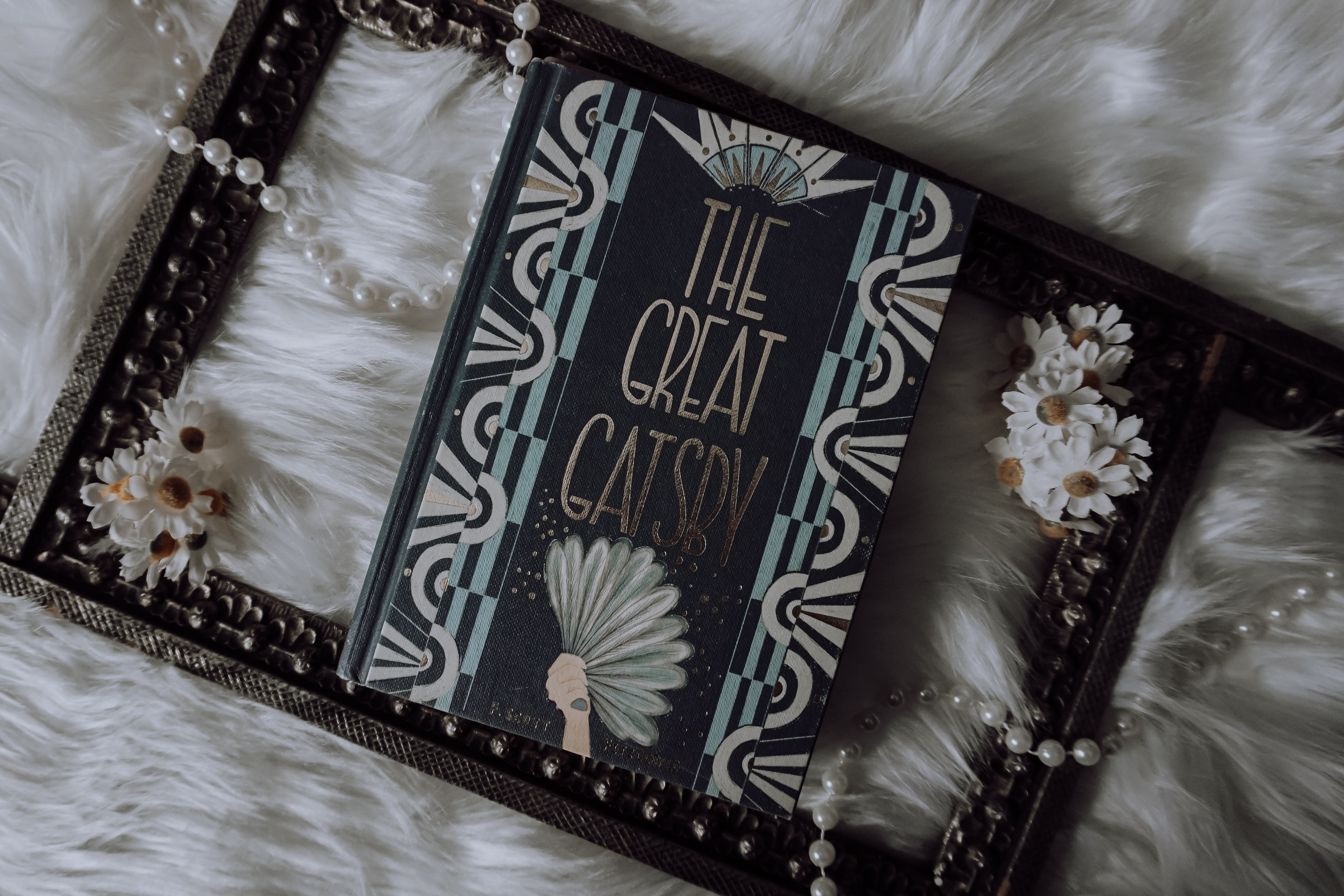
“All I kept thinking about, over and over, was ‘You can’t live forever; you can’t live forever.”
Gatsby is Gatsby.
A flawless classic, really.
I haven’t read The Great Gatsby by F. Scott Fitzgerald in its entirety since high school, and I forgot just how incredible it is. It’s such a fundamentally sound book with a perfect rise-climax-fall plot line, imagery that’s so beautiful it’s chilling, symbolism that runs so deep these characters riddled with corruption are symbols themselves, and overall a reflective piece that turns a spotlight on the very era it was written in.
I feel like everyone knows the story of Gatsby, so I’m not going to drive on about the green light and Gatsby being a reflection of the new money boom of the 1920s. Instead, I’m just going to talk a bit about three things I saw throughout this re-read that I found interesting.
Nick as a reliable (?) narrator …
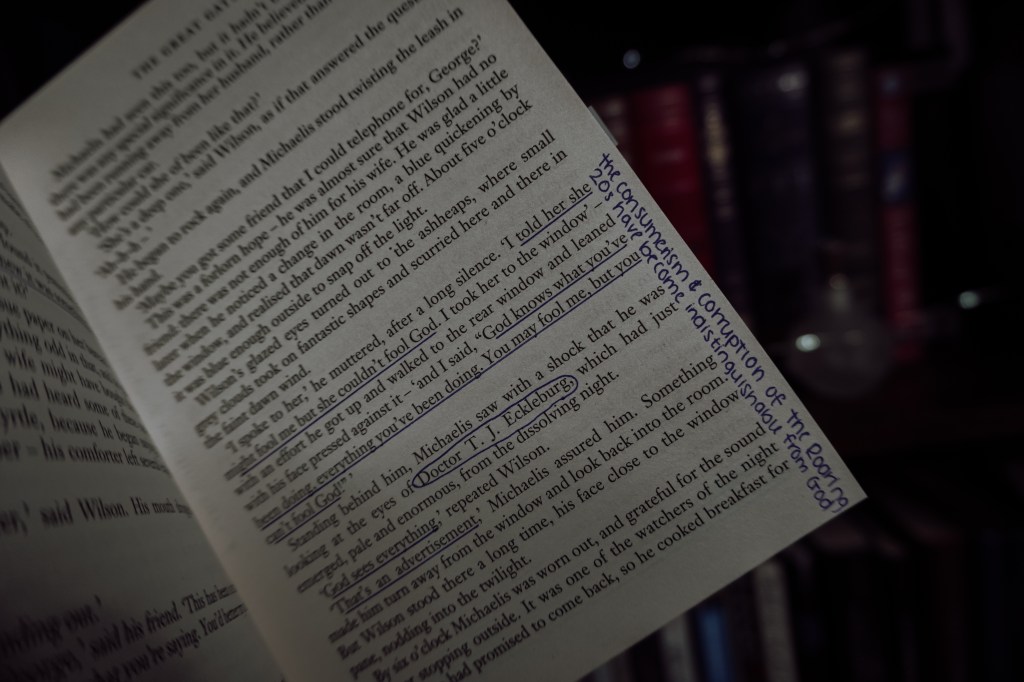
The detail I picked up on the most this read through was Nick Carraway as a narrator. Fitzgerald immediately sets Nick up to be a reliable narrator, the perfect narrator for Gatsby’s story. In chapter one, Nick establishes himself as a man born into the old money world, but who has turned away from it to head East into that new money ideal of hitting big on stocks. Yet, he criticizes Gatsby and that new money lifestyle. He turned away from that life, too. He stands as a man in the middle of the chaos, knowledgeable but not fully part of either world.
Plus, Nick has sympathy for Gatsby, despite the reprimands.
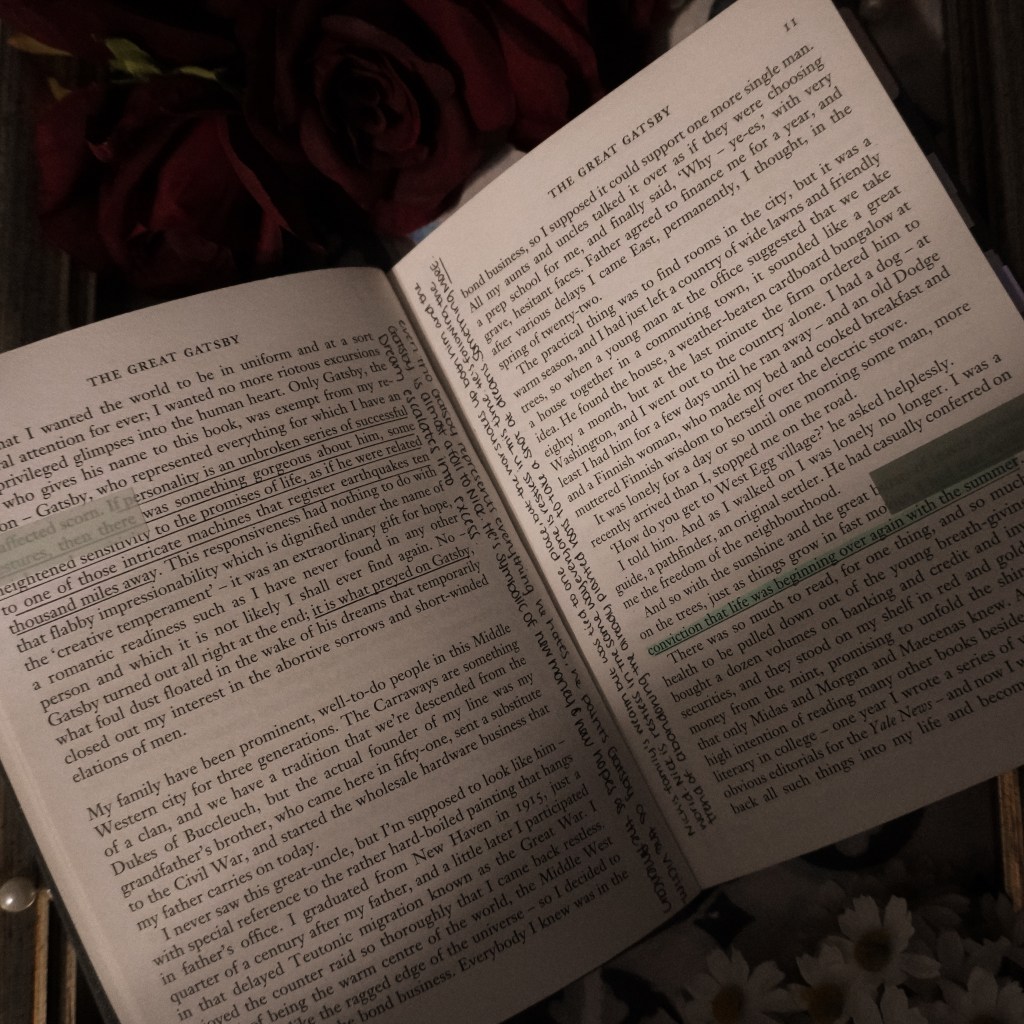
“No — Gatsby turned out all right at the end; it is what preyed on Gatsby, what foul dust floated in the wake of his dreams that temporarily closed out my interest in the abortive sorrows and short-winded elations of men.”
It adds a personal connection that makes Nick feel like the only person to tell this story, which is solidified throughout the novel as he becomes the only man left in Gatsby’s corner. Fitzgerald makes Nick not only a narrator, but as a mirror to help show the wrongs and corruption in the story he carries.
At the end of chapter 3 Nick says, “I am one of the few honest people that I have ever known.”
He sets himself above these seemingly poor values and low morals of both the old money crowds. While Married Tom Buchanan is pursuing married Myrtle Wilson and Gatsby has been trying to win over married Daisy Buchanan, but Nick won’t even flirt with Jordan Baker until he officially cuts ties with the girl in Chicago.
In this same paragraph, Nick also shows that he does care for Jordan, but in a more substantial way than Gatsby obsesses over Daisy.
He mentions that “when that certain girl played tennis, a faint mustache of perspiration appeared on her upper lip.”
Nick’s affections for Jordan are grounded in her as a real person. Unlike Gatsby’s fascination with Daisy as an image and symbol of a perfect life he sought after, Nick falls in love with Jordan not because of perfection but because she is real — sweat and all.
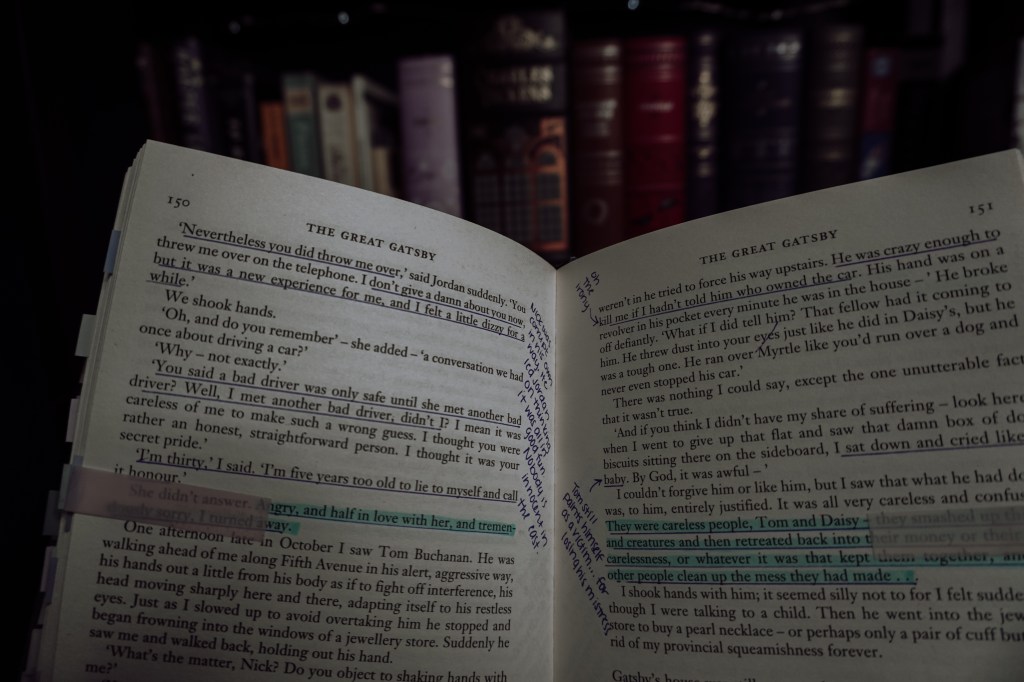
Yet, for all of Nick’s preaching against the corruption of wealth the decade, he falls into it. He’s not entirely an honest man. He does show flirtatious behavior toward Jordan by continuing to accompany her places and not define what they are, and he simply assumes that she doesn’t really care for him because of the dishonest lifestyle she has fallen into with the Roaring 20s. But Jordan did love him, and she calls him out for his assumption that she didn’t: “‘You said a bad driver was only safe until she met another bad driver? Well, I met another bad driver, didn’t I? … I thought you were rather an honest, straightforward person.’”
The novel uses driving, especially accidents, as a way to show the carelessness of the decade, and in this case Jordan is taking Nick and placing him in the driver’s seat where he has previously tried to avoid. Nick saw himself away from the corruption, but he was as guilty as everyone else of falling victim to the whims and frenzy of the Roaring 20s. He is not innocent.
That calls into question his reliability as a narrator.
Now that we know that Nick is not innocent, not entirely honest and not completely removed from the story, can we as readers accept that the narrative he delivered is truthful?
He shows sympathy for Gatsby, almost separates him from the true corruption of Wolfsheim and even Tom, and paints Gatsby as a victim to the society he became a symbol of. Perhaps this was because Nick had also fallen victim to the society he sought out for excitement and wanted to sort of clear his own conscience in the process. Or maybe he built up sympathy for Gatsby through his own personal reflection. He could understand why and how Gatsby got caught up in the dreams and rush of the East.
Personally, I still think Nick is a reliable narrator, because he doesn’t go through the effort of entirely clearing his name or anybody’s in the story — though he makes no attempt to make Tom or Daisy blameless. But it’s interesting to think about his reliability and imagine how many different ways The Great Gatsby can be told depending on the person telling the story.
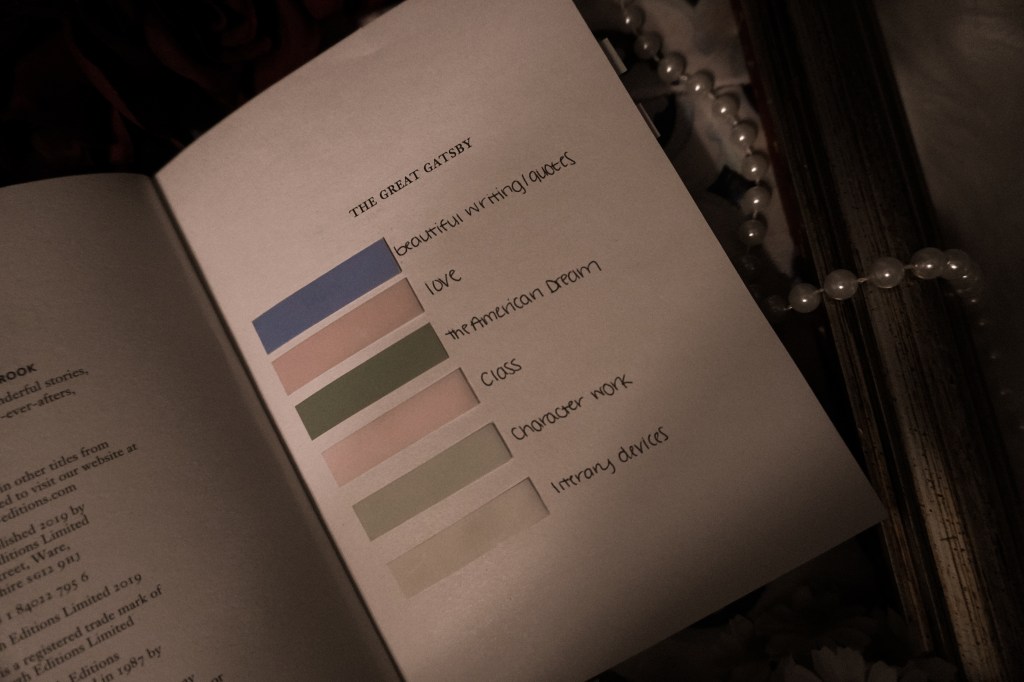
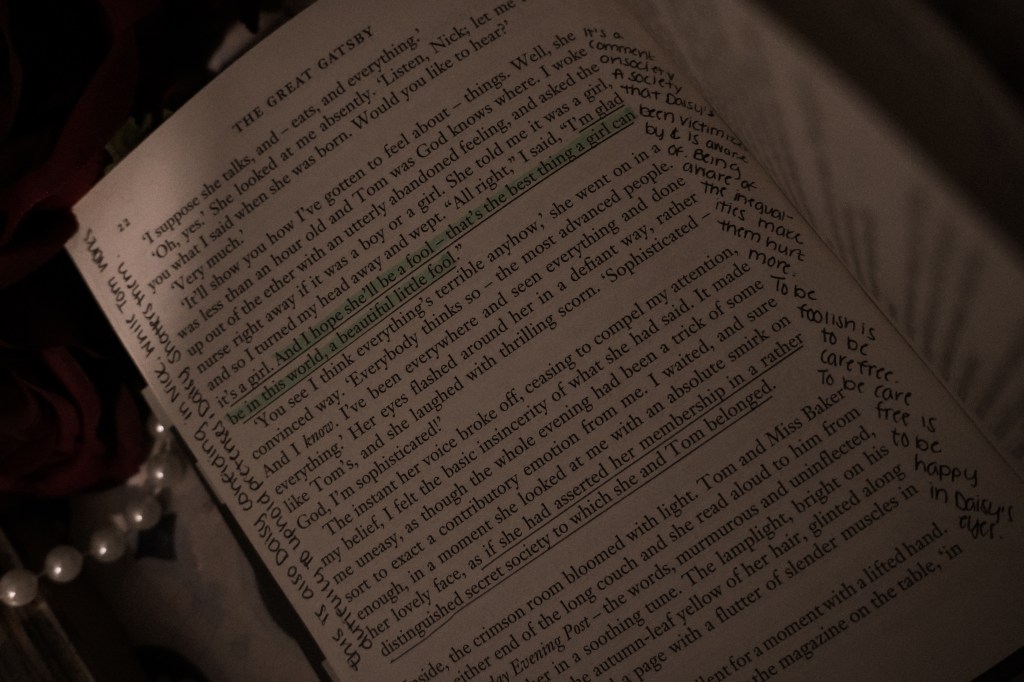
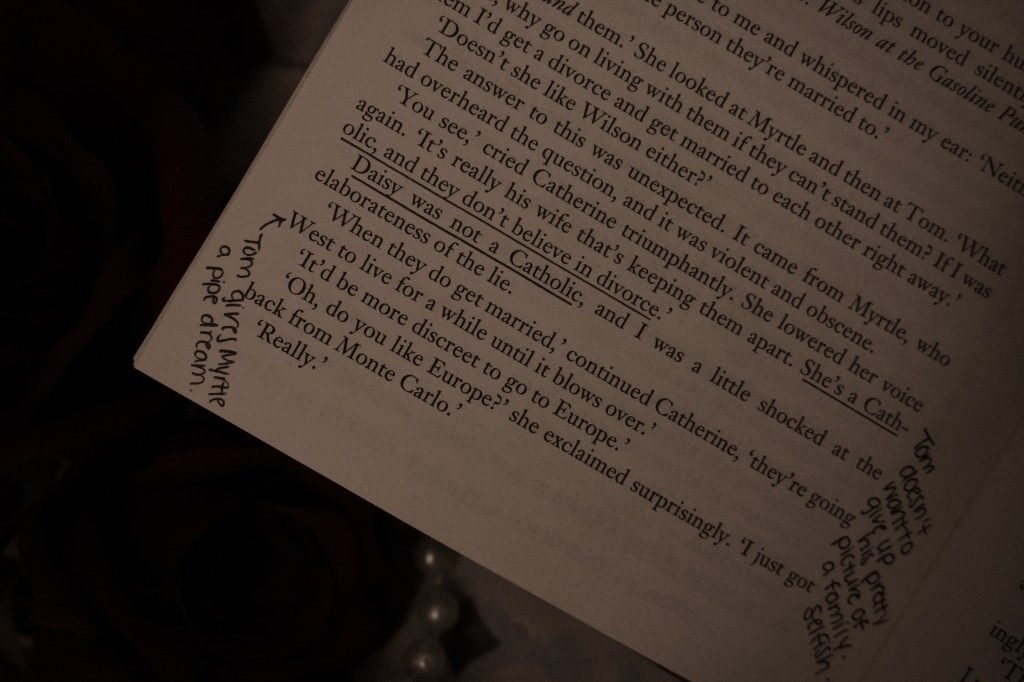
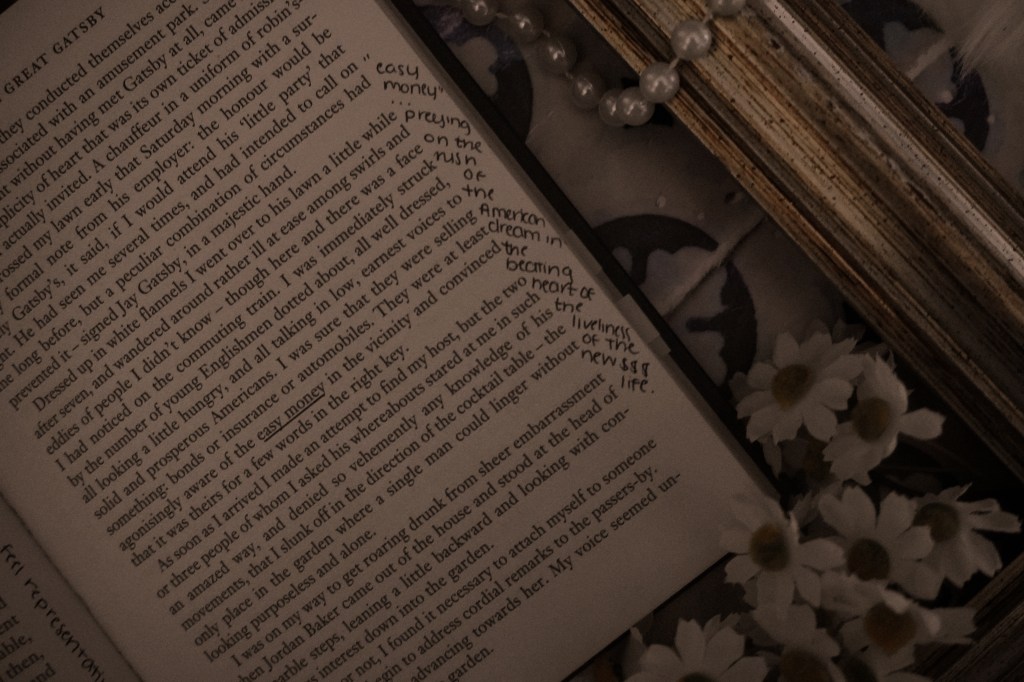
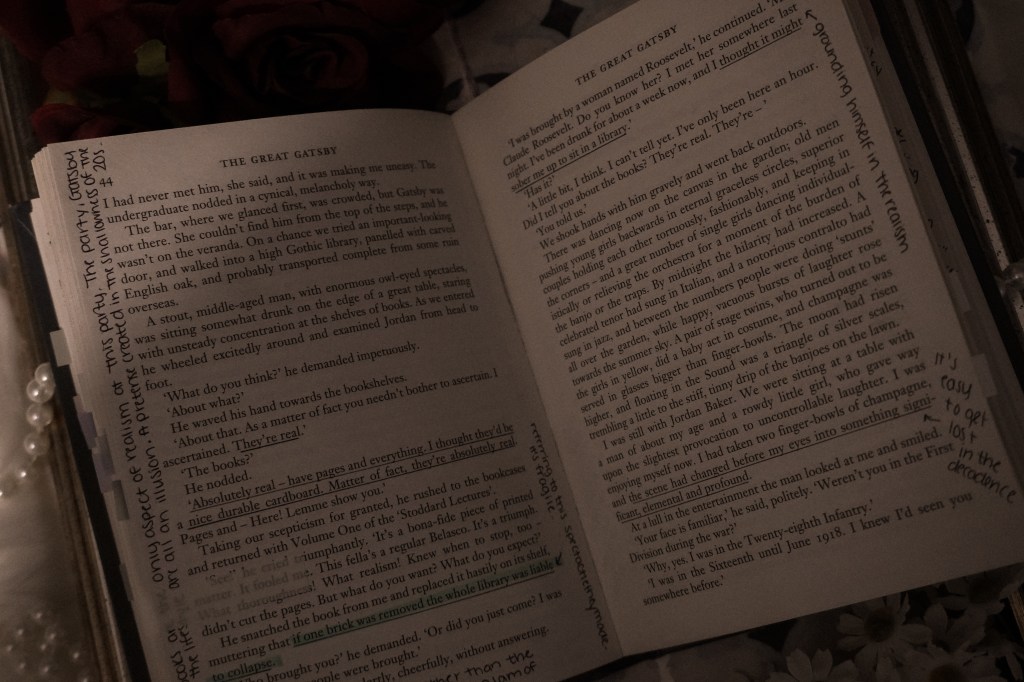
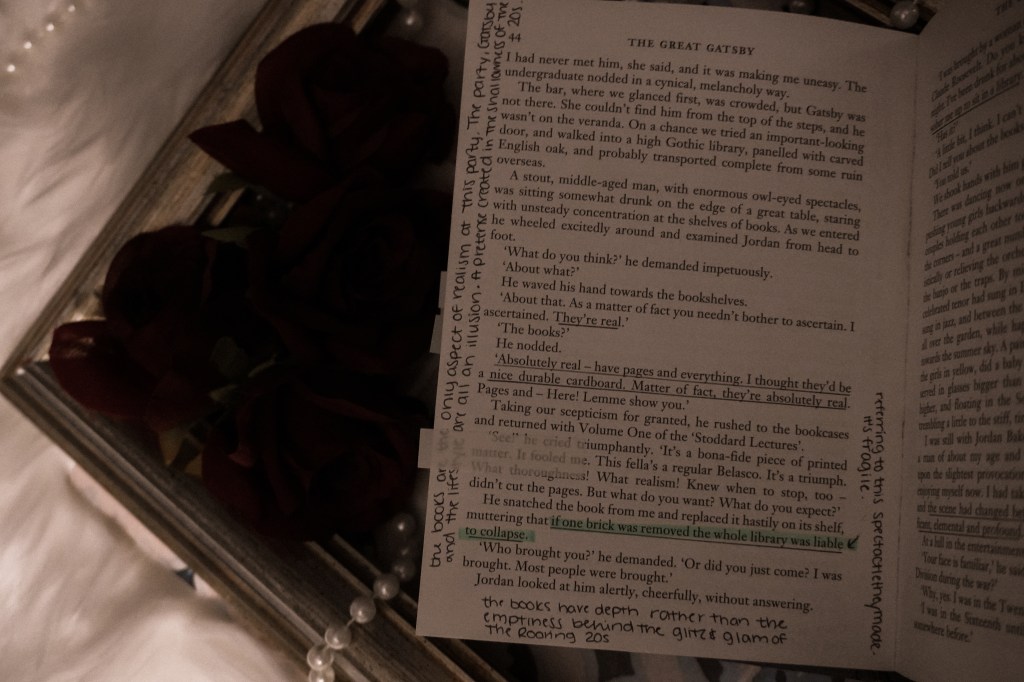
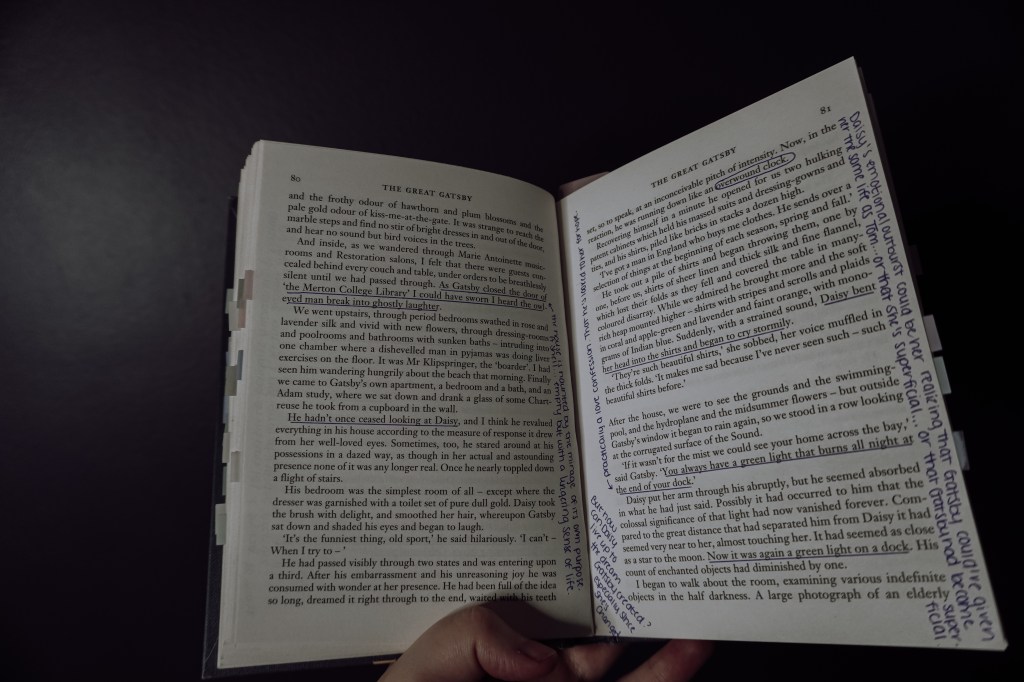
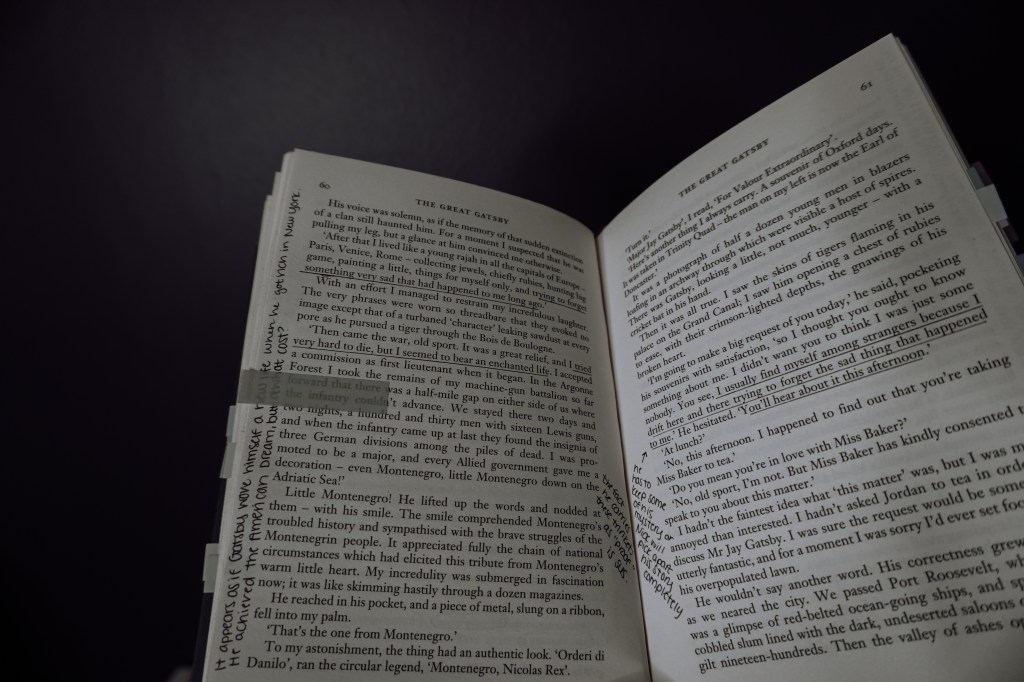
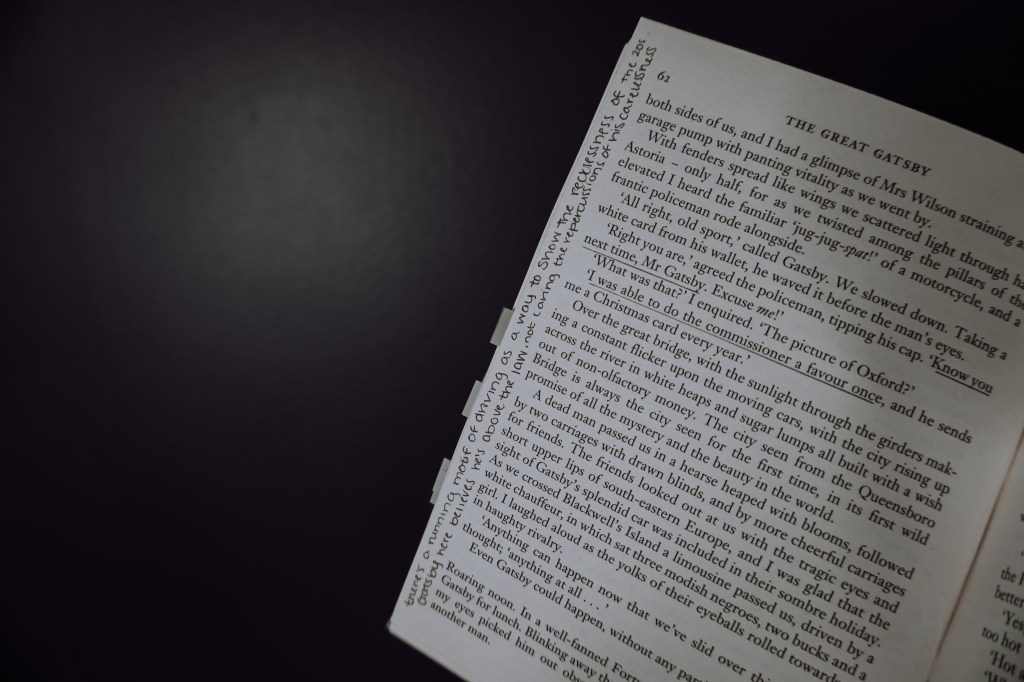
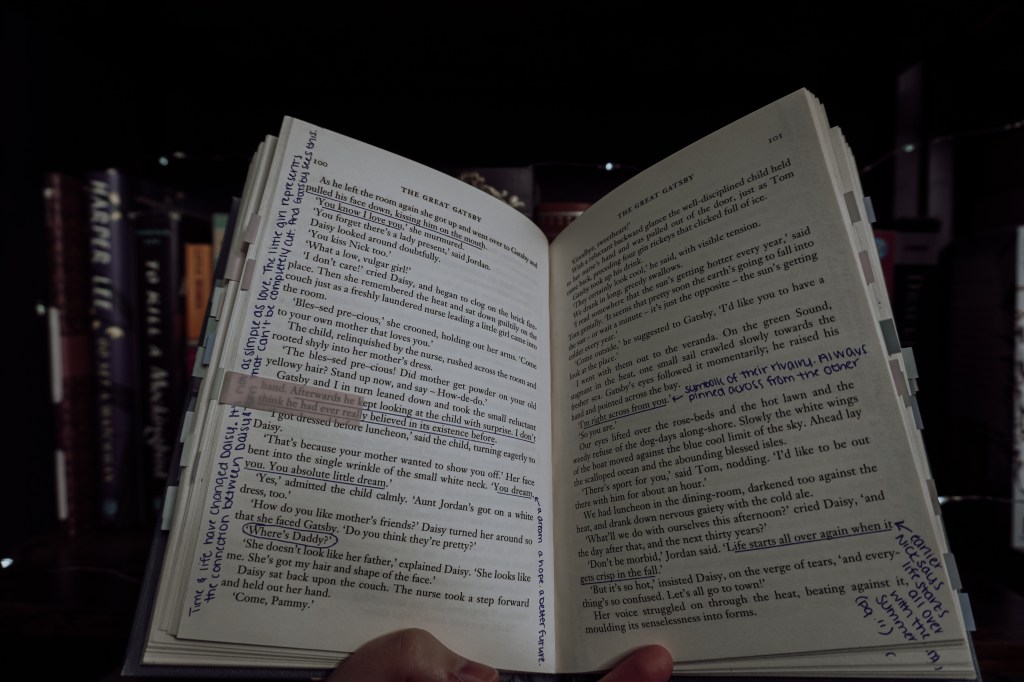
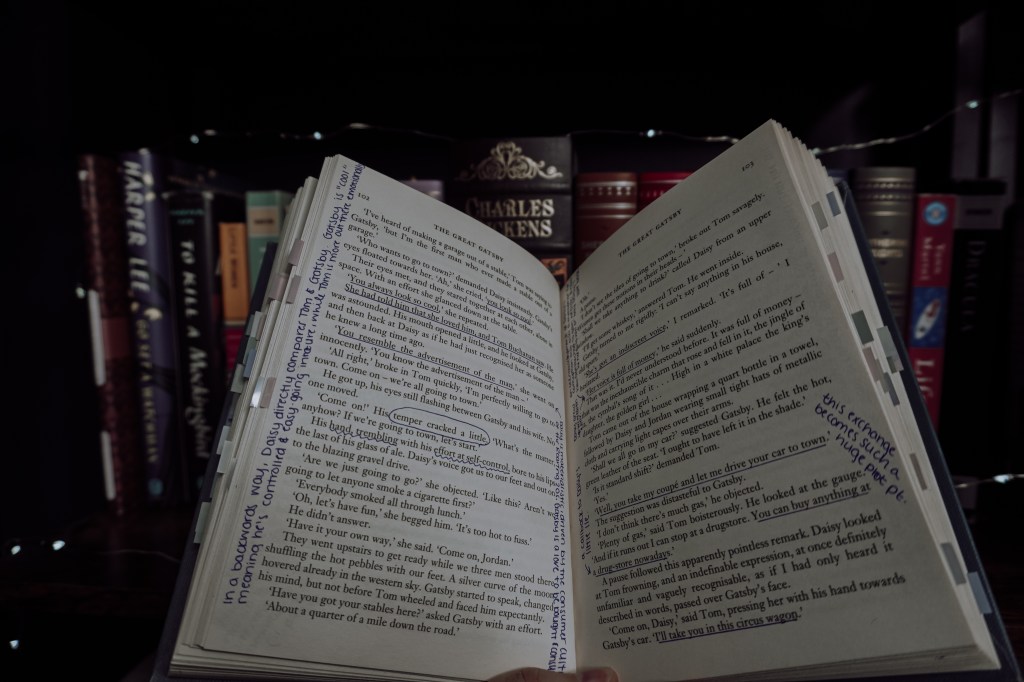
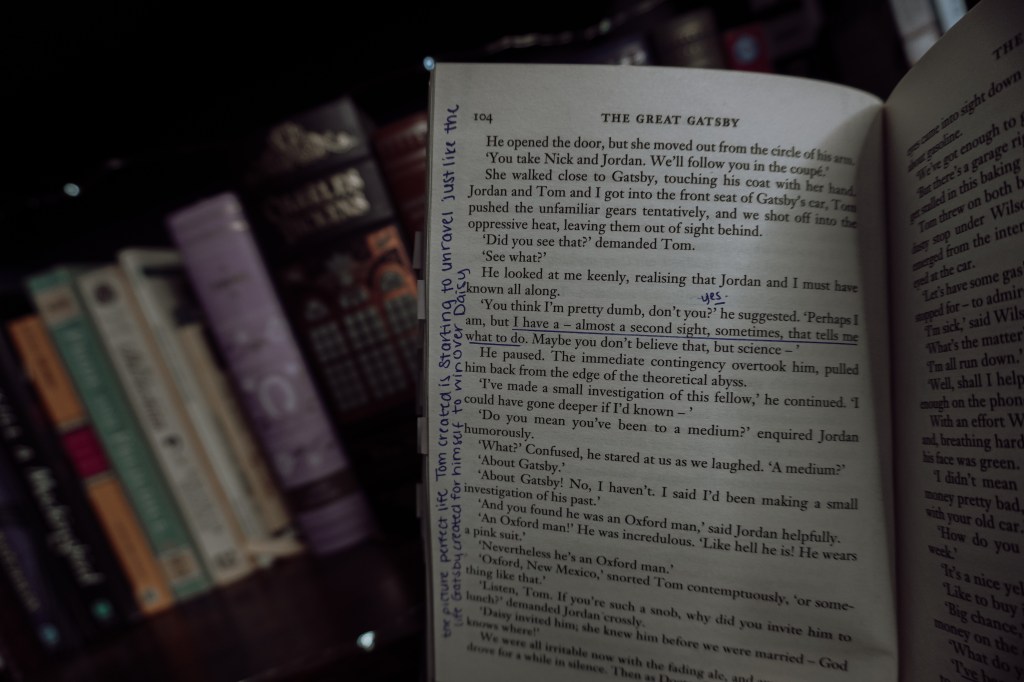
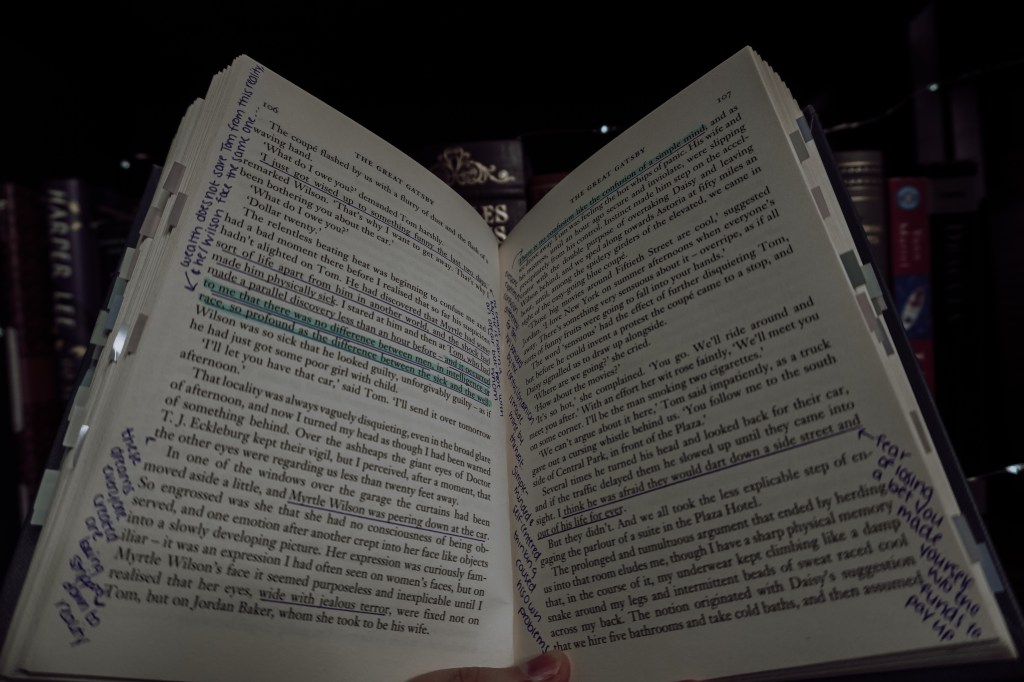
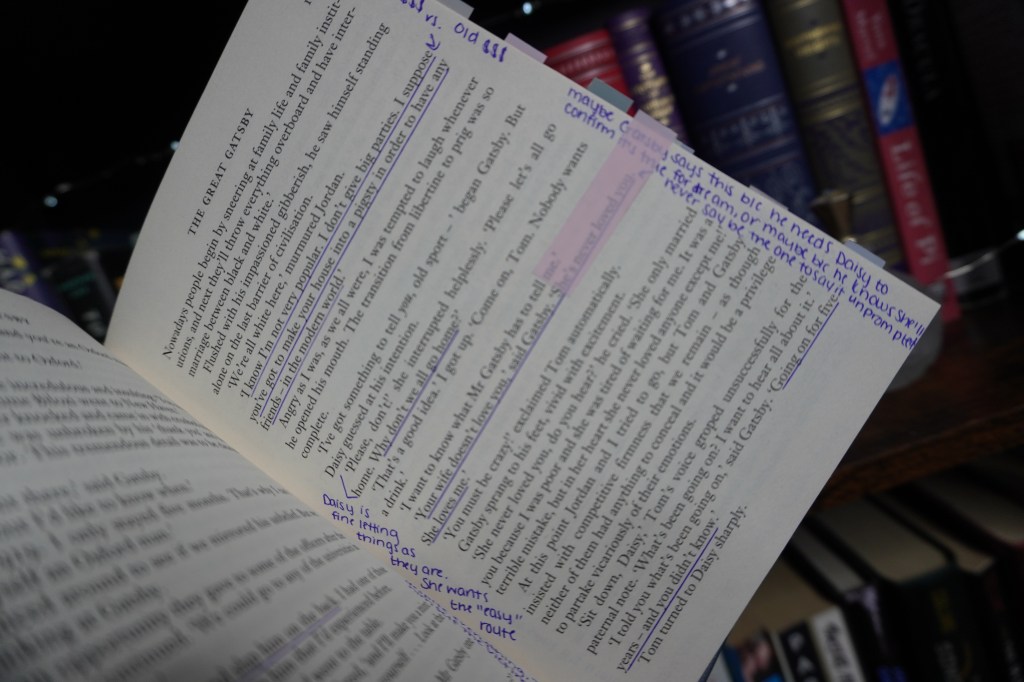
Annotations from Chapters 1-3

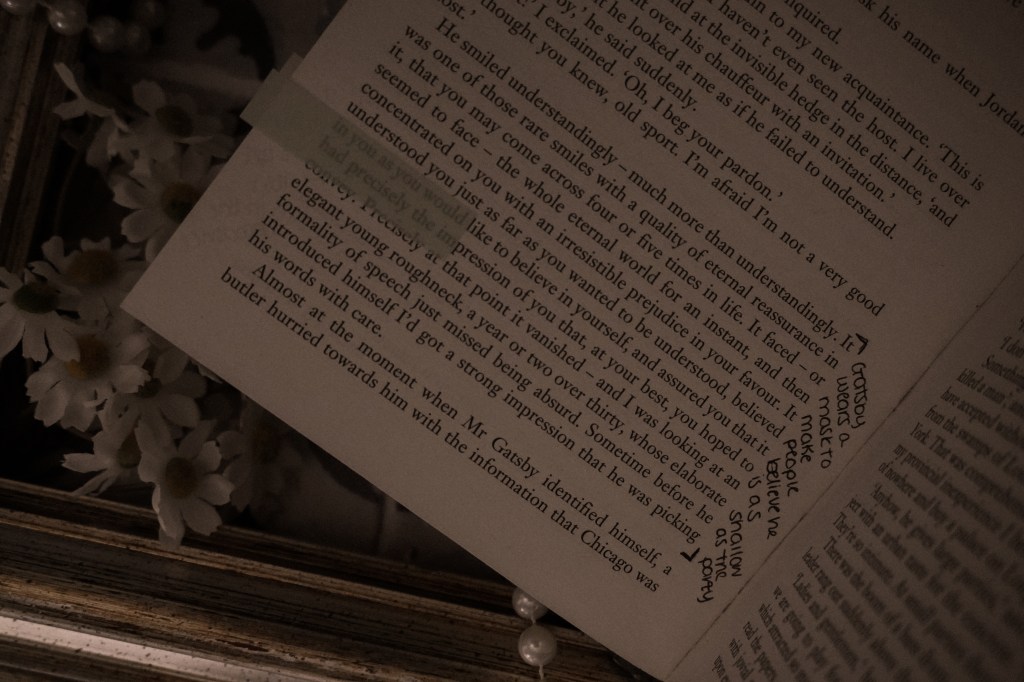
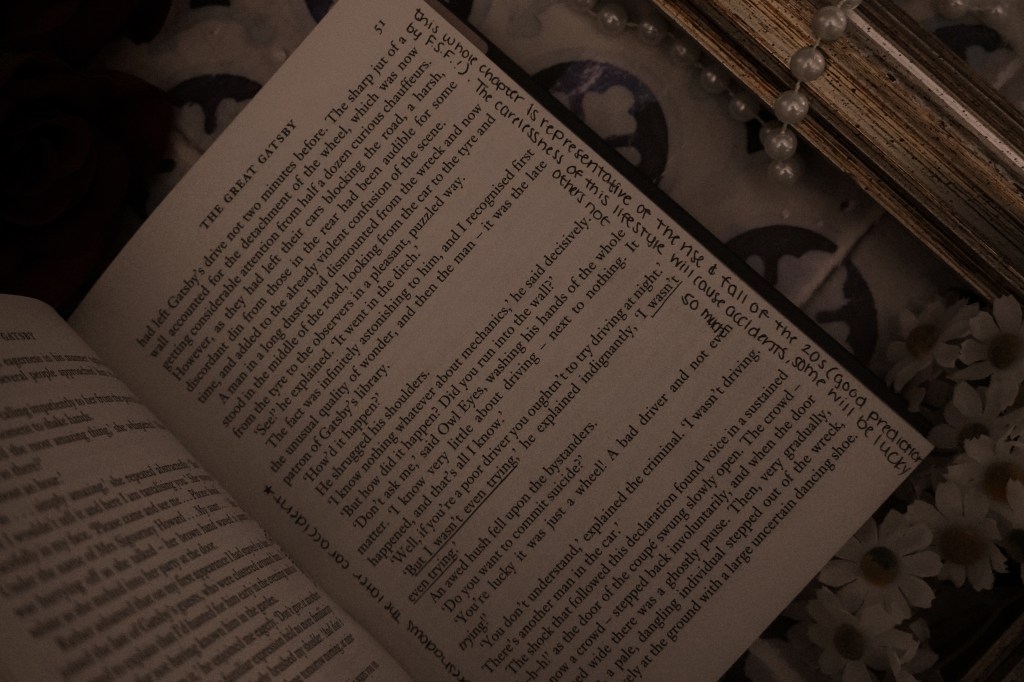

Time as a construct and some other stuff …
A major motif in Gatsby is time. Time is seemingly lurking in every line. Time in the era in which our story is set, time as a unit of measure, time as a construct. Everything is about time.
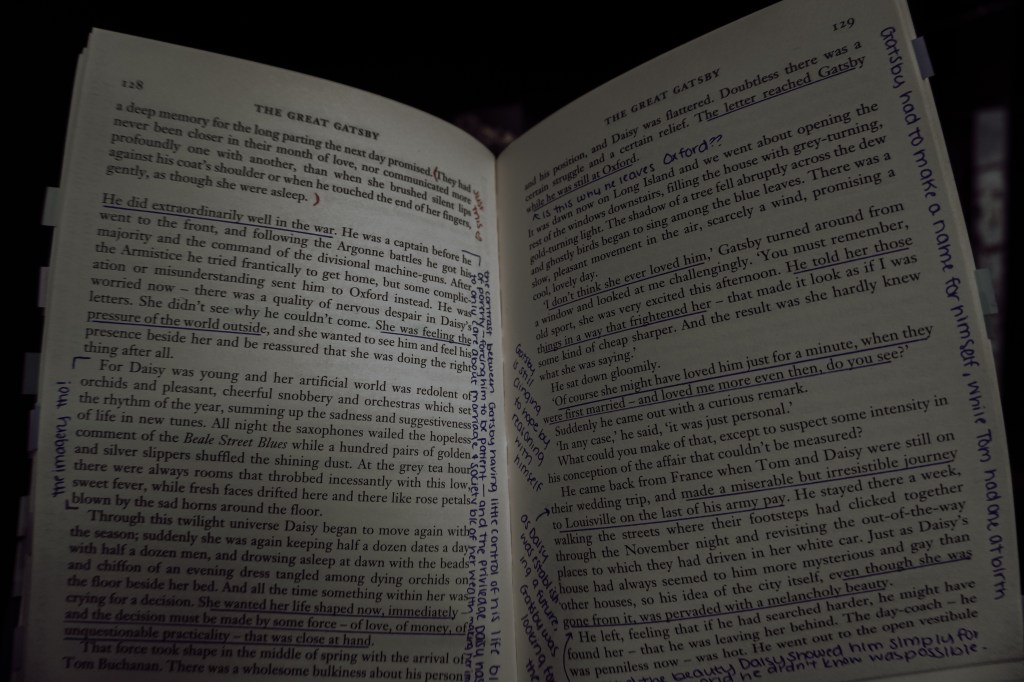
Gatsby is clinging to time, stuck in one single moment that he can never get back. When he met Daisy, she introduced him to a life he didn’t know was possible — or the one he could’ve had if his inheritance from Dan Cody hadn’t fallen through.
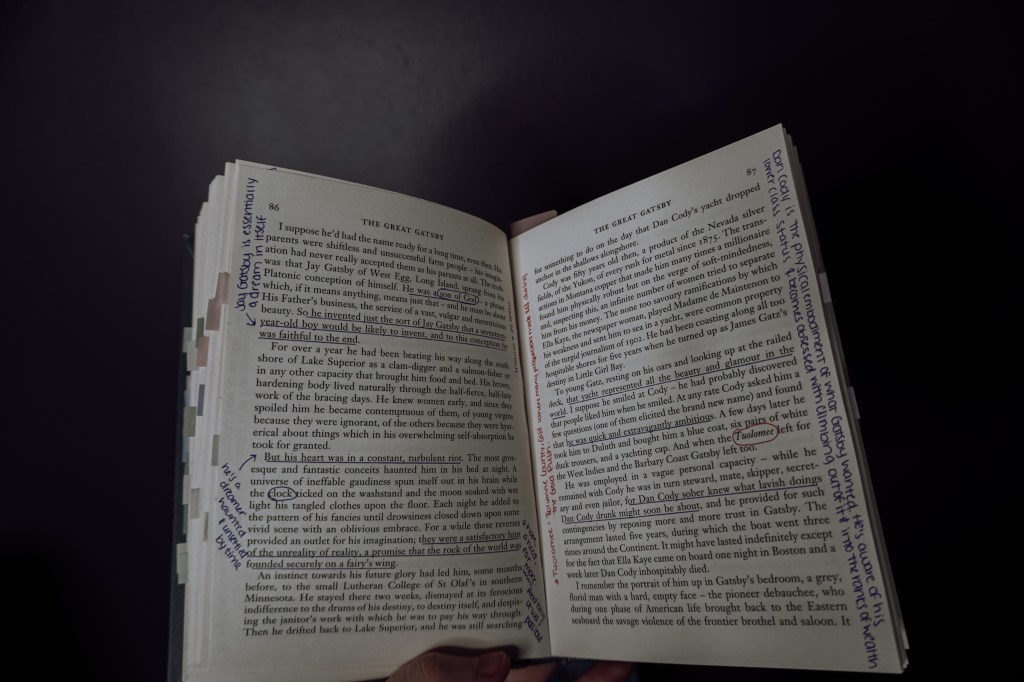
“…they were a satisfactory hint of the unreality of reality, a promise that the rock of the world was founded securely on a fairy’s wing. … To young Gatz … that yacht represented all the beauty and glamor in the world.”
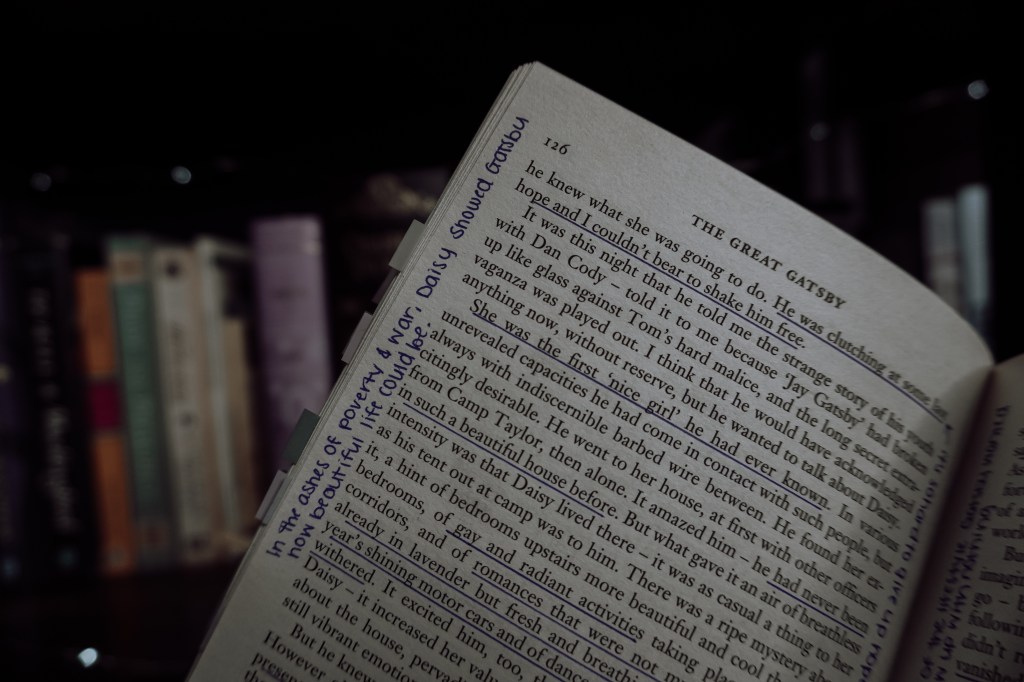
We learn from Gatsby’s father that he came from very simple means, so seeing the luxurious life that Daisy lived was another new experience. She showed him that the world could be beautiful, and he then associated that world, that lifestyle, with her. In the same way that Cody was the spark for the persona of Jay Gatsby to be born, Daisy is another accelerator. She is the lifestyle she represents; that he wants. There’s a paragraph in chapter 8 where Gatsby describes meeting Daisy, and it’s clear that she’s more than just a girl. He loves the idea she represents and not her. Here’s a couple of lines that stuck out to me:
“She was the first ‘nice girl’ he had ever known. … It amazed him — he had never been in such a beautiful house before. … of romances that were not musty and laid away already in lavender but fresh and breathing and redolent of this year’s shining motor-cars and of dances whose flowers were scarcely withered. …”
It’s very romanticized framing that somehow keeps Daisy in the background despite the claim that she is the object of Gatsby’s affection. So after losing Dan Cody and losing the possibility of that life already once, he chases after her by chasing after that lifestyle in hopes of rekindling that happiness he had in those months.
And thus, everything Gatsby does is an act of trying to rewind time to make history repeat itself with no regard to how time had changed both him and Daisy.
Gatsby achieves his wealth in an effort to win her over; to prove to her that he can bring her comfort and safety. He buys the house across the bay so she can see his success. He throws the elaborate parties to lure her in. He gives up his past to give her a future.
In chapter 5, Gatsby knocks over a clock in Nick’s house and catches it. Nick announces, “It’s an old clock.” It’s symbolic of Gatsby fumbling time. He mentions just a couple paragraphs later that it will be “five years next November” since he and Daisy last met. Gatsby caught the clock, holding onto time as he’s held onto those days, months and years since last seeing this girl that became his hopes and dreams.
But Daisy had moved on. She started a new life with Tom, no matter the troubles they’ve found. It’s shown on Gatsby’s face when he first sees their daughter. It’s a solidification that Daisy is no longer that girl he met all those years ago, but he can’t let go of the dreams she represents so easily and he wrestles still with time by continuing his pursuit.
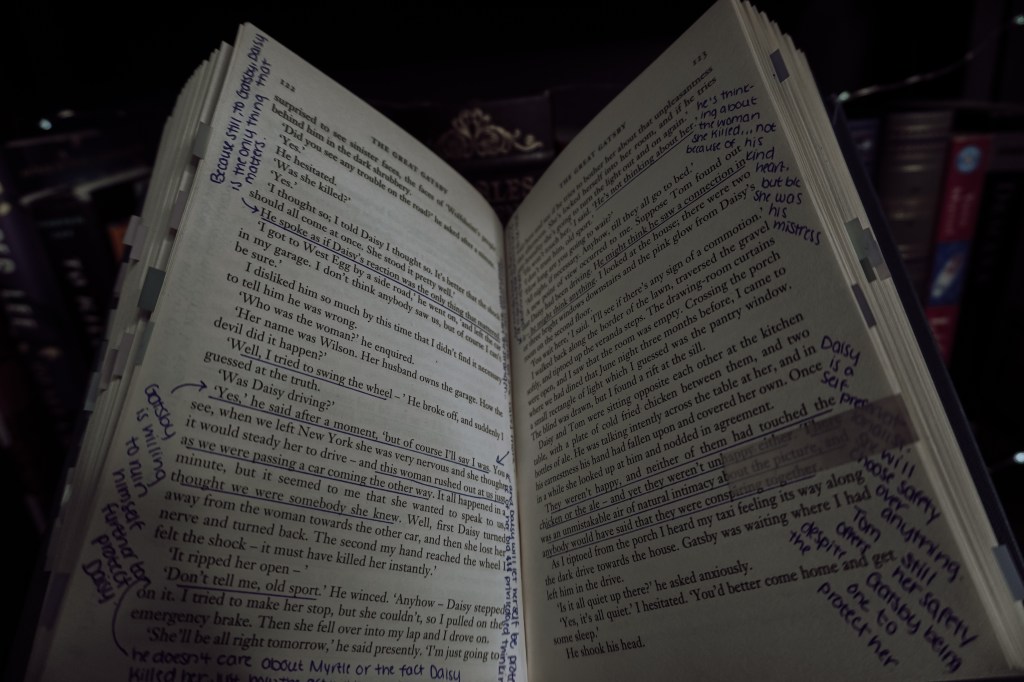
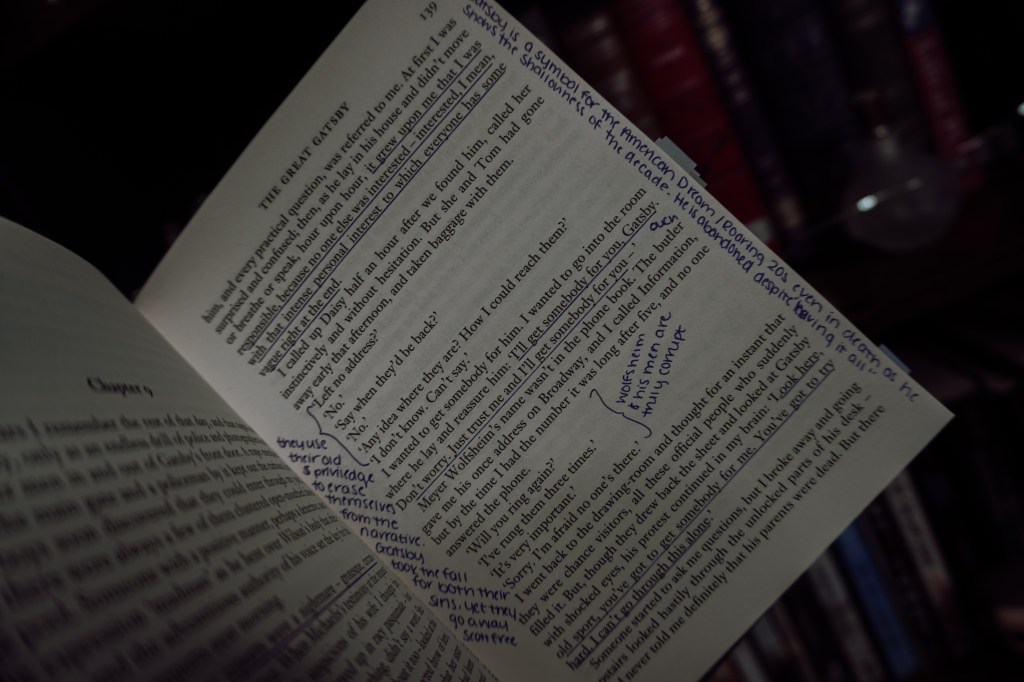
Gatsby seemingly runs out of time on the night Daisy kills Myrtle in the hit-and-run accident. Everyone’s dreams come crashing down. Because as tensions rise with the temperature and the rush of the wedding downstairs overwhelms an already overwhelmed bunch, the mirage that Gatsby falls. Tom ousts Gatsby’s sketchy business endeavors, and it scares Daisy. She once again chooses the security Tom brings over the supposed love for Gatsby. She is quickly able to let time go, and Gatsby still clings to it. He willingly takes the fall for Daisy hitting Myrtle. He watches the window to make sure Tom doesn’t hurt her.
And then his time is up when Tom tells Wilson who the car belongs to, and he kills Gatsby.
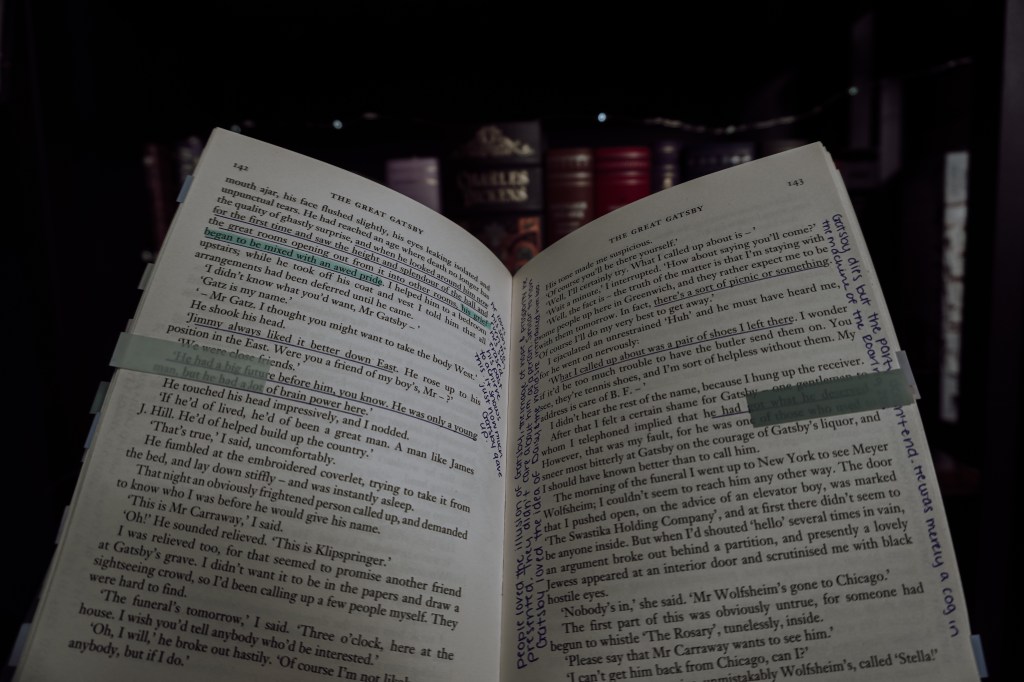
The fact that none of his ‘friends’ show up to his funeral is suggestive that Gatsby spent so long chasing the past to build a future that he forgot to live and build meaningful relationships in the present — which is sort of an overall message of the book as the rush of the Roaring 20s had people really speeding through the present in careless, reckless abandon.
Good stuff.
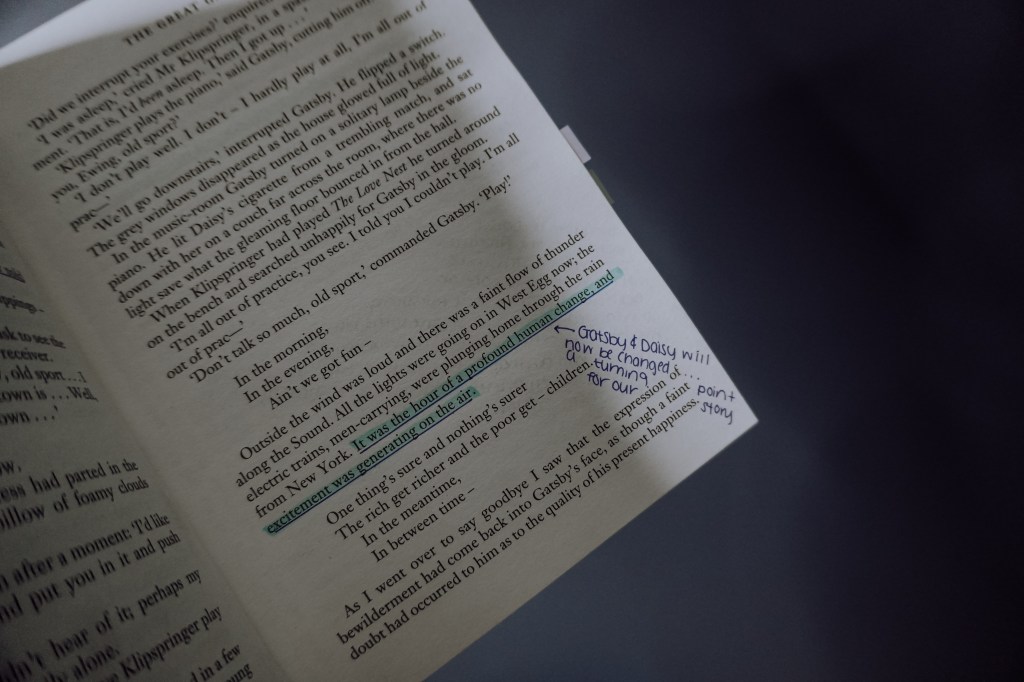
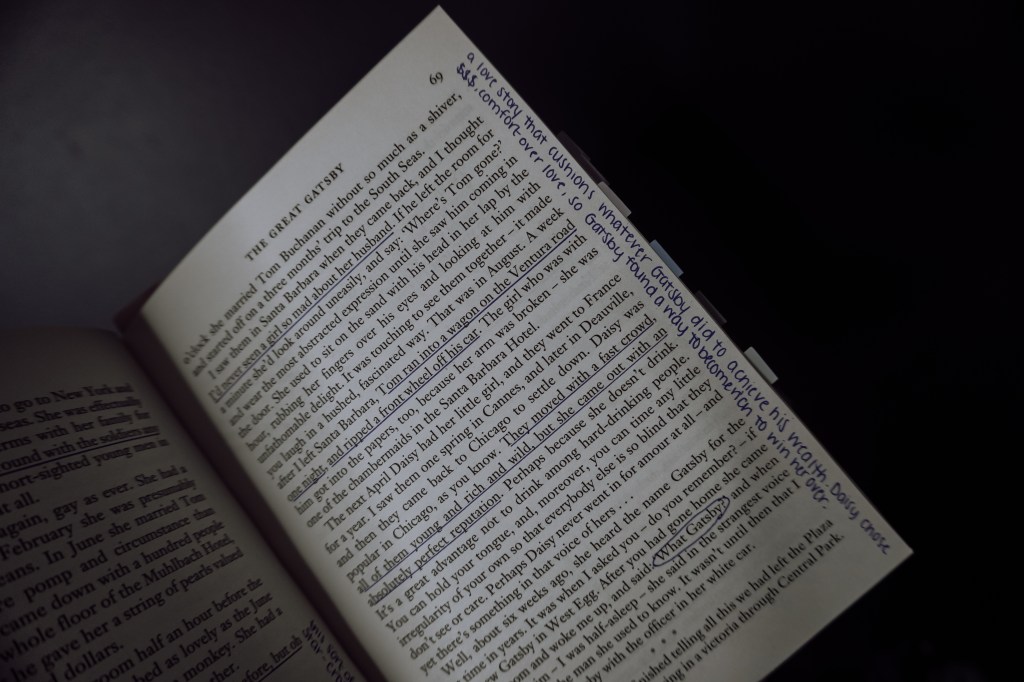
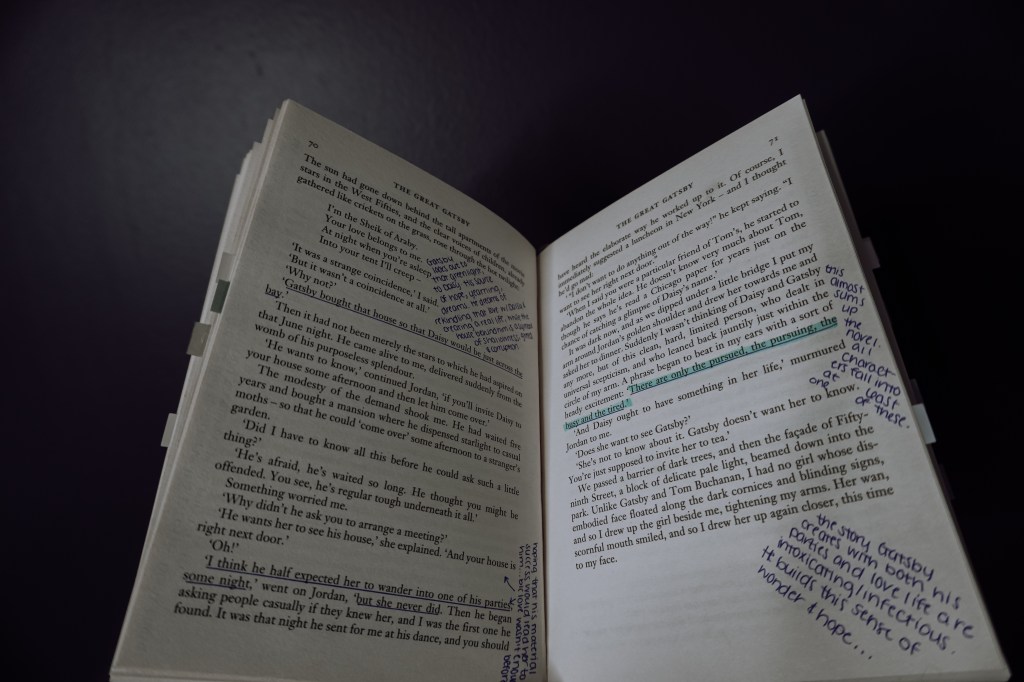
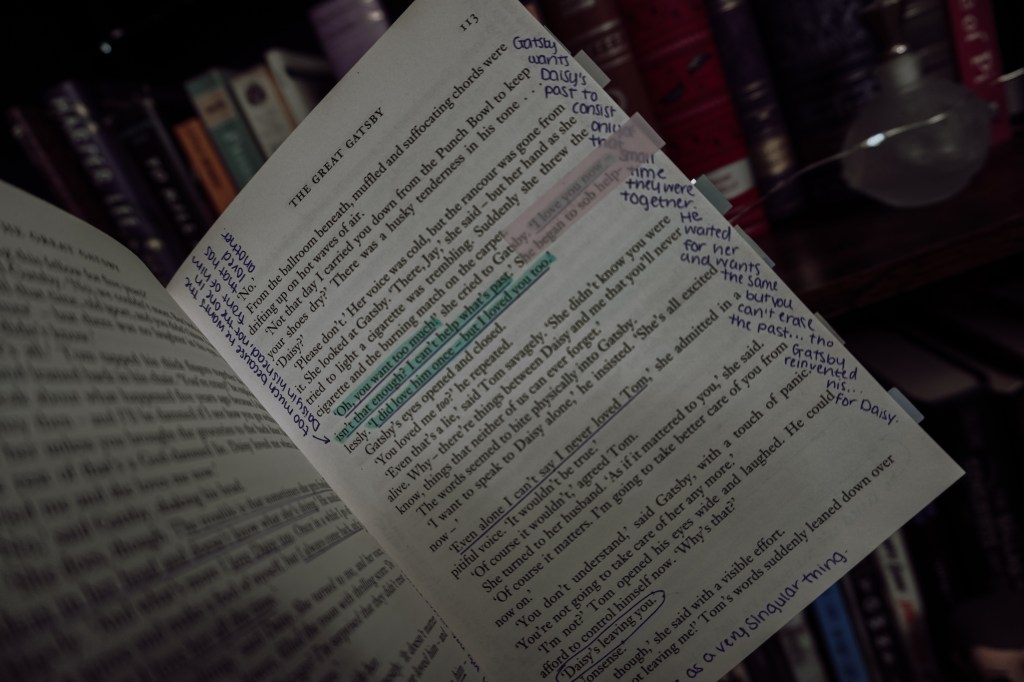
Annotations from Chapters 4-6
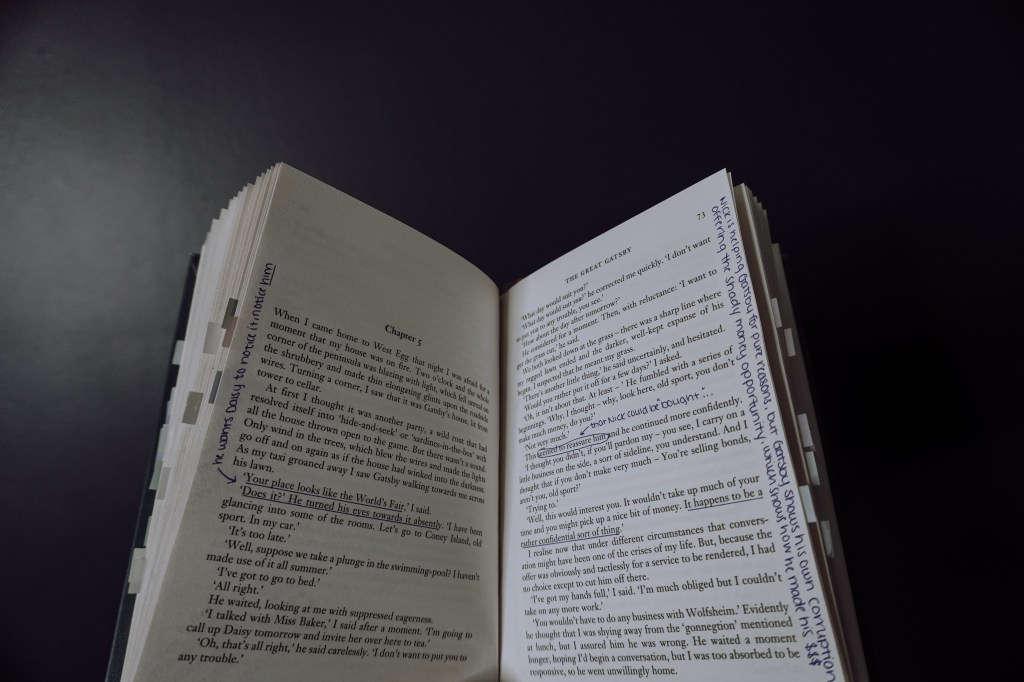
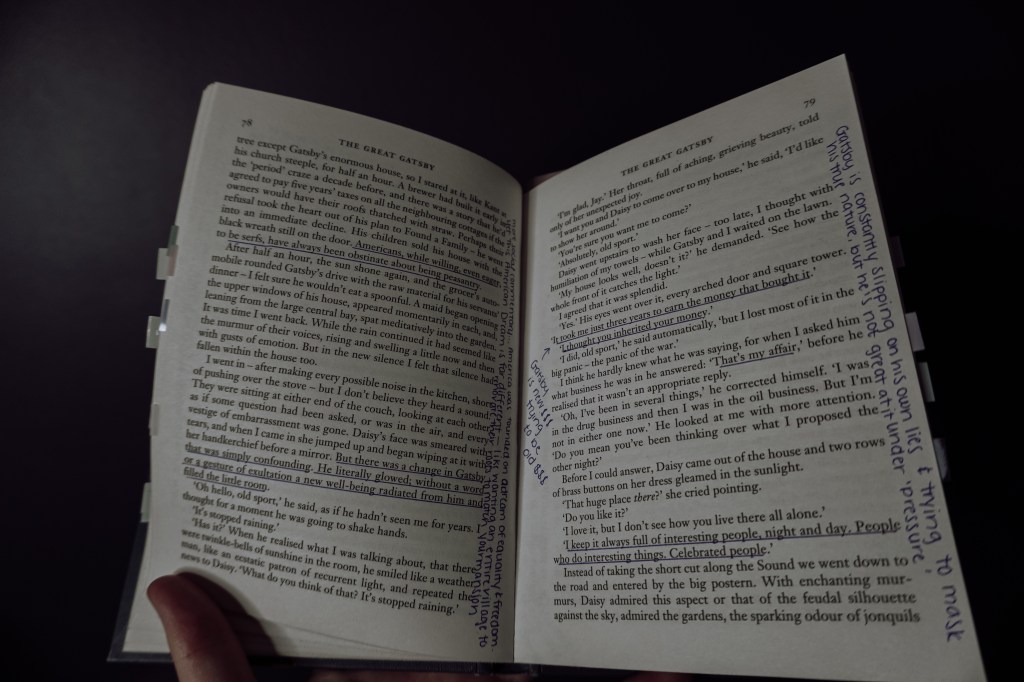

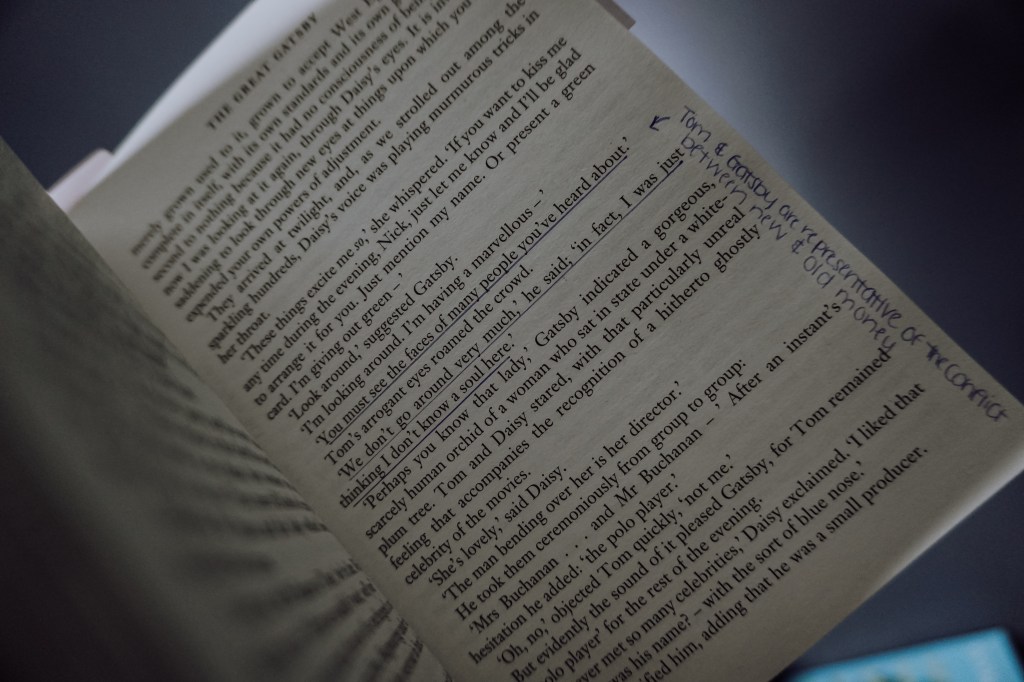

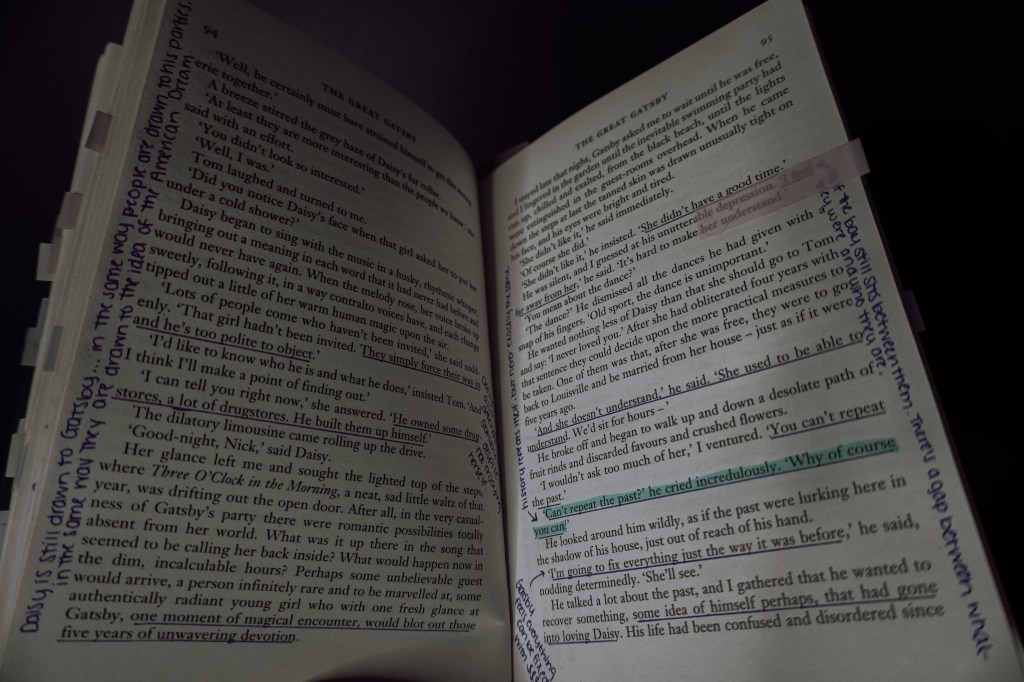
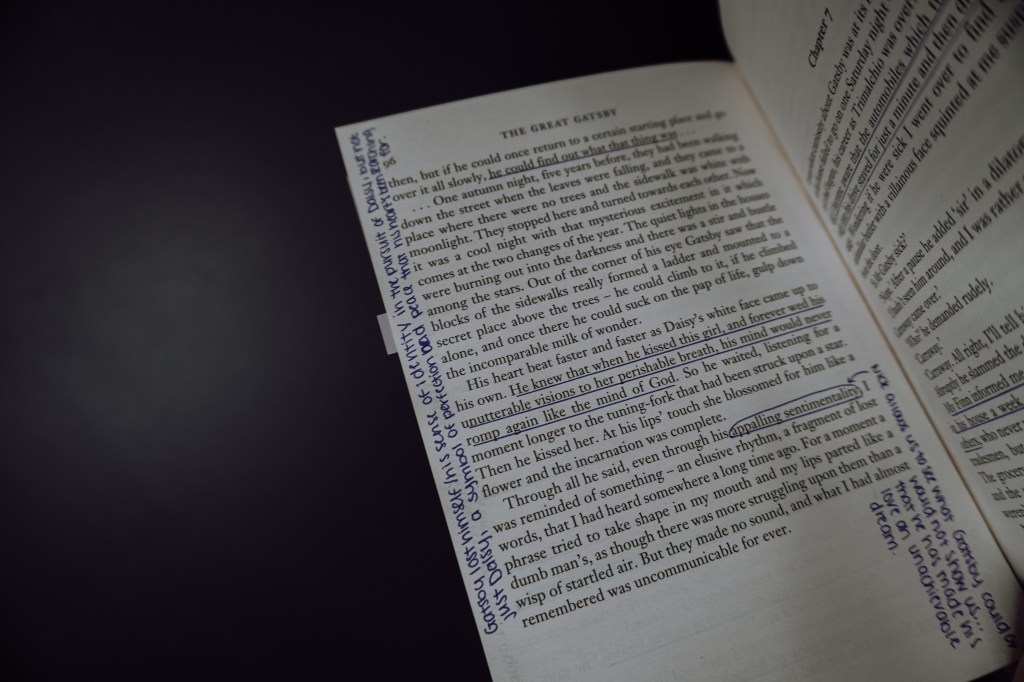
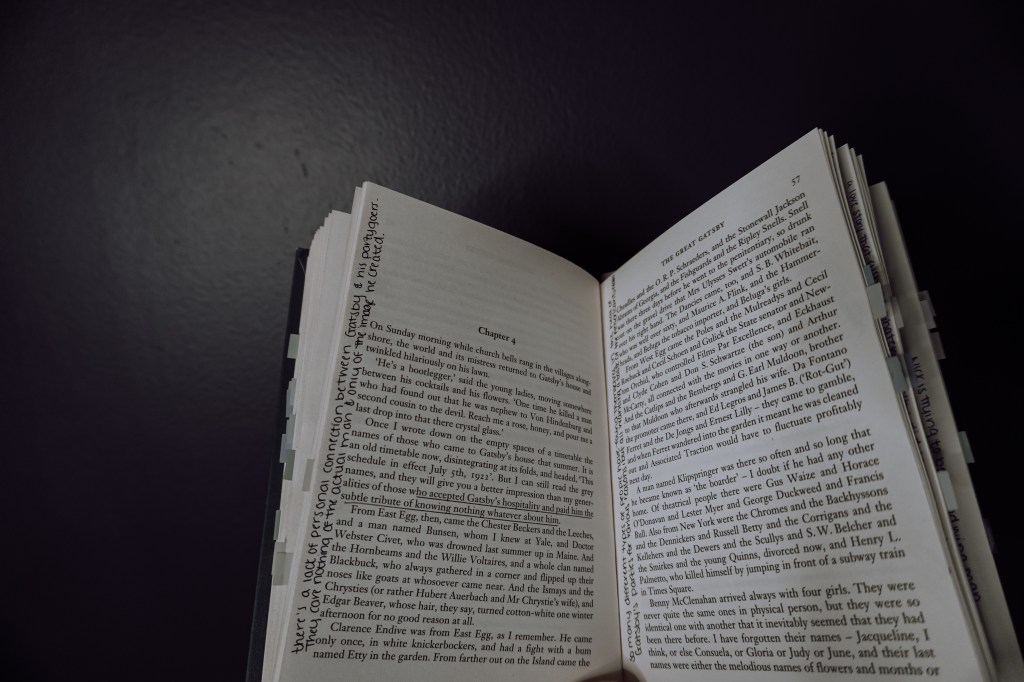


The books though …
This is a much less in-depth detail I noticed, but I caught it and it made me stop and think.
Owl eyes.
Nick first finds the owl-eyed man in the library the first time he goes to one of Gatsby’s parties.
He says, “Absolutely real — have pages and everything. I thought they’d be a nice durable cardboard. Matter of fact, they’re absolutely real.”
This mystery man calls out Gatsby, his parties and the lifestyle they preside in as shallow. He expects the books to be fake just as the parties are fake, but they also serve this purpose as a building block of the illusion Gatsby created.
“… if one brick was removed the whole library was liable to collapse.”
Gatsby needed the pretense of reality to support his unreality, and it’s a delicate balance. The spectacle is fragile.
However, I thought it was really interesting that this man finds a sort of comfort in the reality of the books. He even says, “I thought it might sober me up to sit in a library.” He’s grounding himself in realism.
Then when the car accident occurs after the party, he appears from the car, but he’s not the driver. It felt representative of how you can become collateral damage in this era. He had gotten sucked up in the life, tried to get out and yet he still ended up in the ditch.
However, Owl Eyes is the only person from this time aside from Nick that shows up for Gatsby’s funeral. To me, it really pushed the idea that this man found a way out. He saw through the glitz and glam, and he found a way out. He mourns Gatsby as he mourns the idea of the American Dream that is ambiguous and fluid.
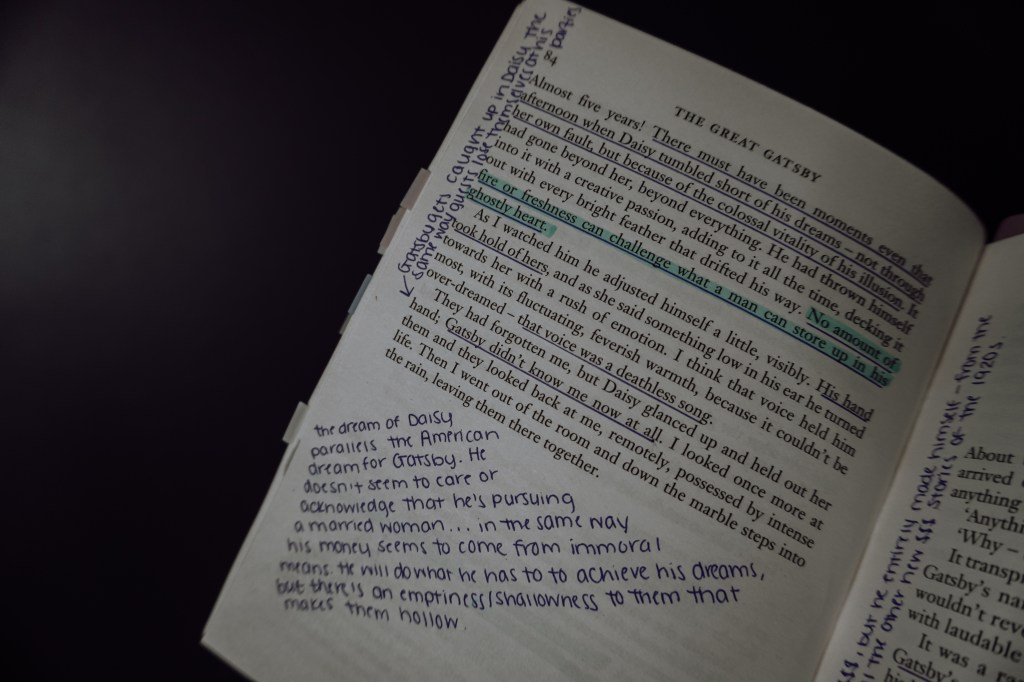
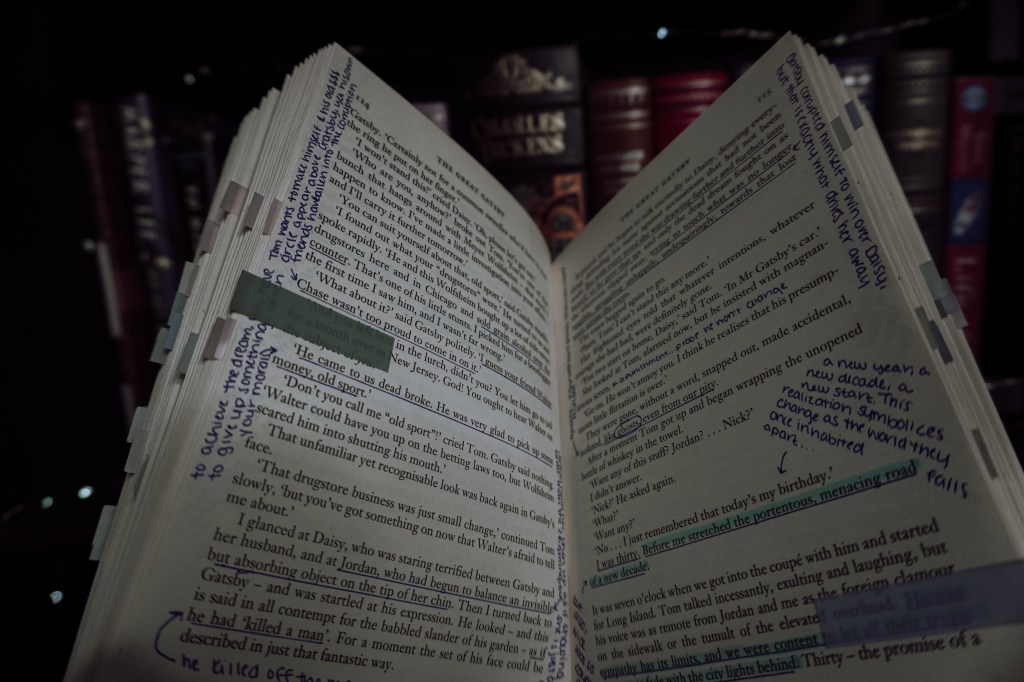
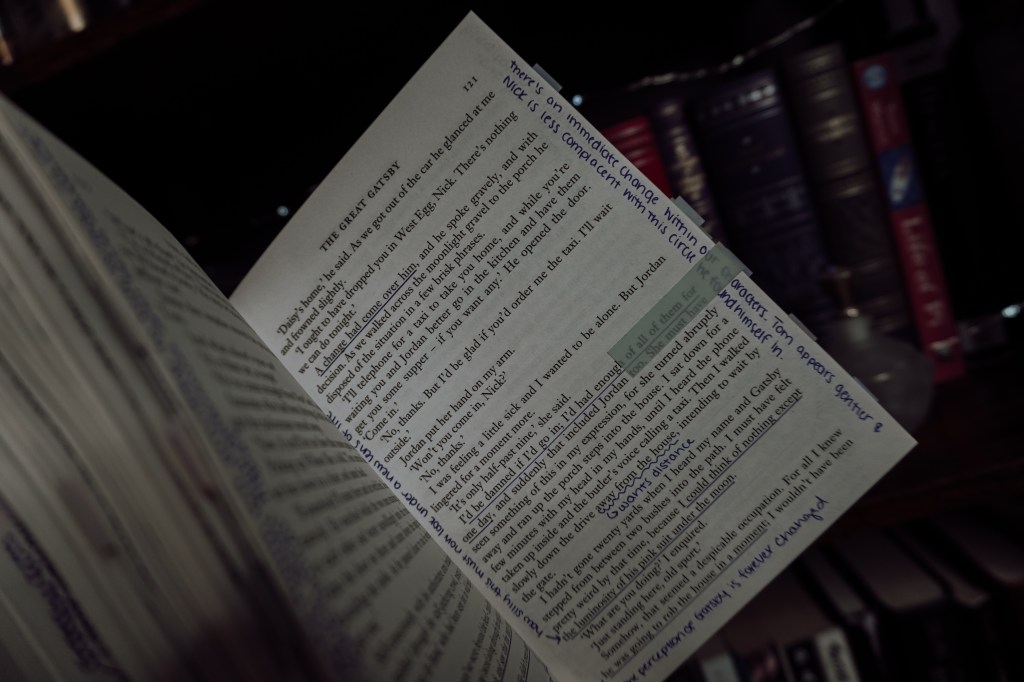
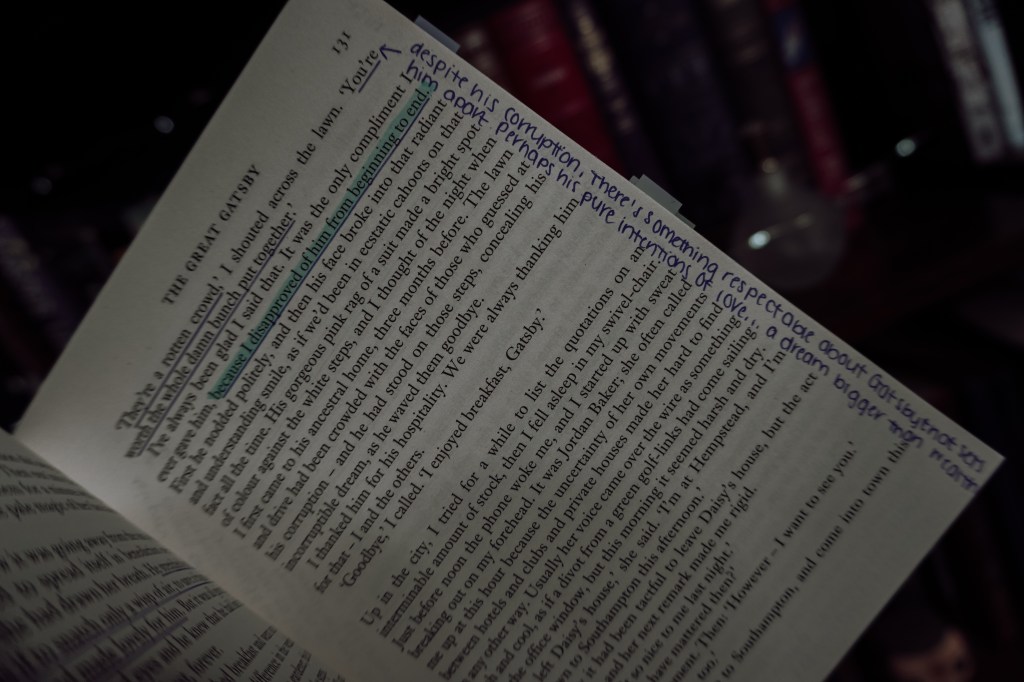
Annotations from Chapters 7-9


Rating
The Great Gatsby has to be five suspiciously yellow cars that need their front end fixed out of five.

 Life of Bry
Leave a comment