“It is a new world, and we must decide how we are to end this old one and begin it anew.”
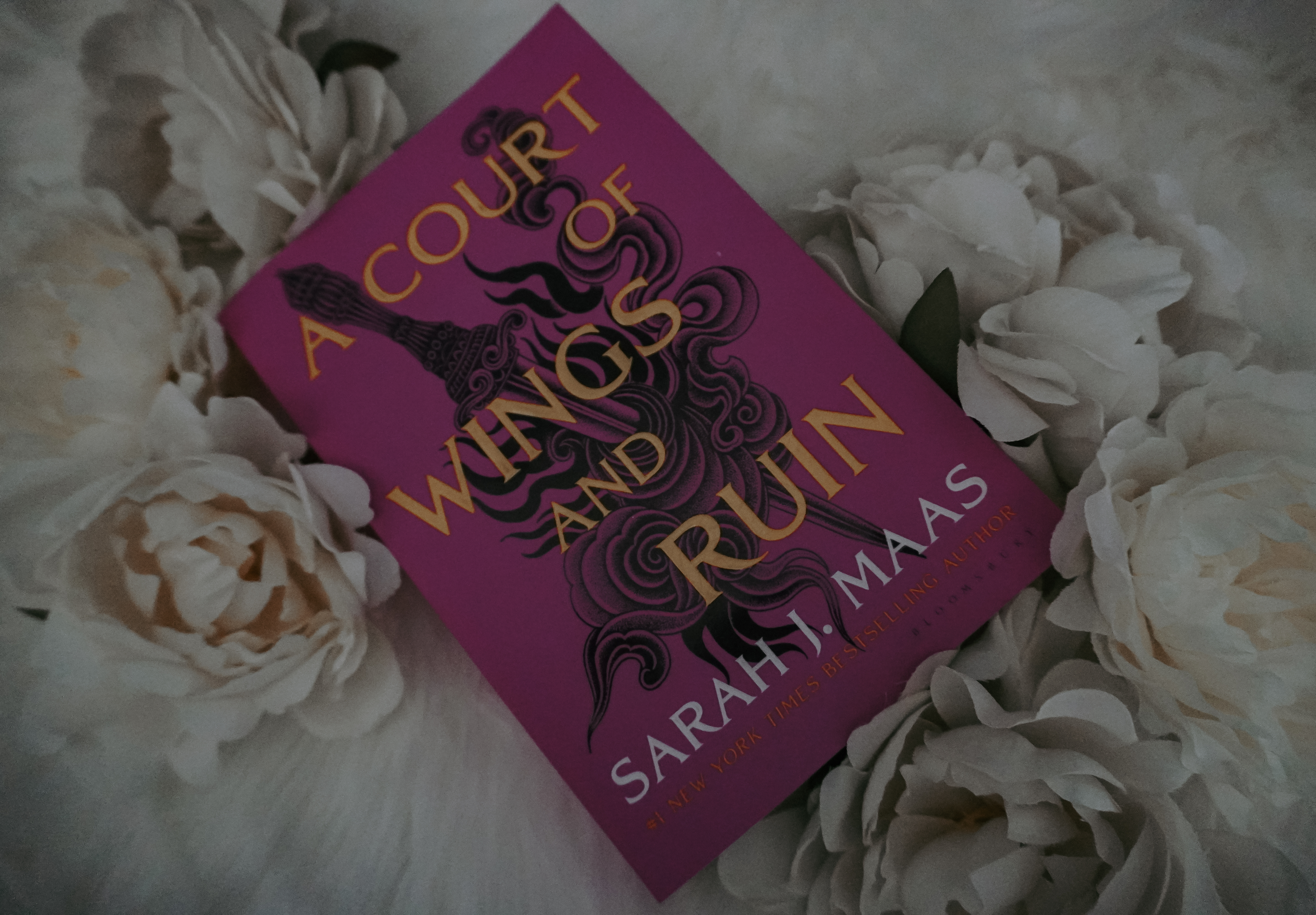
I can’t believe I’m saying this. … A Court of Wings and Ruin by Sarah J. Maas wasn’t awful. In fact, I actually really enjoyed this story compared to the first two. It felt like Maas really settled into her own narrative in this book, even though it was still a bit chaotic and the expanding set of characters does stretch the story thin at points.
I’ve also set aside my gripes about Maas’ writing and accepted the inconsistencies in world-building and general cheesy cringe that she clearly adores and has made her style. I’ve harped on those elements a lot in my first two reviews, and while a lot of them carry over to ACOWAR, I’m focusing more on the plot and character work this time around. However, there are gaps left in some of the world-building elements that interfere with the plot, and those will be brought up.
And if you haven’t read my previous two reviews, check them out here: Thorns and Roses & Mist and Fury.
OK, so as the war with Hybern draws nearer, Feyre finds herself back inside the Spring Court with a plan to extract information and bring Tamlin to his knees. Personal vendettas mingle with public service as the King of Hybern’s forces look to bring down the wall that stands between Prythian and the Mortal Lands.
Here are all my thoughts on A Court of Wings and Ruin:
(As always, spoilers ahead!)
Feyre’s revenge
Character development is extremely high up on my list of requirements for a book or series to be readable. I don’t want to see the same character at the end of the story as I did at the beginning. There needs to be noticeable change or else does it really matter what they went through? Or have them not changing be the main theme of the story. With that being said, the plotline of Feyre going back to the Spring Court does so much for her character in so many ways.
My main criticism of Feyre was that she relied too much on the men around her to be interesting and never really worked on her own. Right off the bat, readers get to see Feyre shine.
Maas shows us a more sinister side of Feyre that still holds to her previously-established tenacity. She uses her perseverance to formulate and execute her plan, not only for the sake of gaining information for the Night Court to use against Hybern, but also to get back at Tamlin for the pain he caused her. It gives her character dimension — she’s not all encompassing good, but her personal rage is something readers can rationalize and almost root for.
Also, placing Feyre back into the Spring Court in this way allows readers to see just how much she’s grown. The last time she was there, she was very helpless. She was trapped. She was being victimized by Tamlin and falling into deep pits of depression because there was just nothing else she felt she could do to escape. She was made to feel that way. She comes back as the predator, which is the connection she makes for herself. She’s a wolf rather than a sheep, and she reminds herself of that by relating her own actions to a wolf.
“I smiled at her … and wondered if Ianthe could spy the wolf grinning beneath.” and “When I looked to Ianthe and smiled again, I let a little bit of the wolf show.”
And this type of thinking makes sense for Feyre, because this is the woman we met in the very first part of A Court of Thorns and Roses. She wasn’t a meek, helpless girl. She was in the woods, aiming an arrow at a wolf with the full knowledge that it could be a member of the Fae and having enough rage and hate in her heart to let it fly to help her family. She always had a spark of anger in her — from how angry she gets at her sisters and father for allowing her to be their sole provider to how she doesn’t fully succumb to Tamlin when he first kidnaps her to how she throws her shoes at Rhysand after he rescues her from her own wedding that she was begging to be saved from.
Tamlin was trying to force Feyre to be something she is not by essentially making her a glorified housewife, while Rhysand gave her the freedom and resources to find herself and who she wants to be. This culminates in A Court of Wings and Ruin, and we see Feyre settle into herself and her powers outside of both Tamlin and Rhys. She has to really face herself in the Spring Court, decide between only terrible choices, realize that she’s also willing to do despicable things for those she loves and find her own strength.
She is the reason the Spring Court crumbles. Though, I wish somebody would tell her that she simply exploited flaws in Tamlin’s reign that already existed. It feels symbolic that Tamlin’s court is the one that resides along the wall. There’s holes and cracks in the wall before Feyre ever shows up, just like there’s holes and cracks in the system of the Spring Court that make its people disgruntled. You could say that Spring would’ve fallen anyway, just like the wall.
While I think the majority of Feyre’s development is done in this plot point, Maas does expand on it throughout ACOWAR. Feyre essentially saves Lucien by taking him away from the Spring Court and fighting off his brothers, which is a bit of a mix up from the men having to save Feyre all the time. She also is a very active participant in the battle at the Summer Court. We see her fight with her powers, but there’s still that underlying shock of not being used to war — which I thought was a nice touch to show that she’s still adjusting. Feyre makes the deal with Bryaxis, she goes to the Bone Carver, she chooses to send Ianthe into the Weaver’s cottage, she saves Elain, she looks into the mirror. It’s really important for her to stand alone, even though she is bonded with Rhysand. They are a team, but she’s still an individual.
In a way, this third book makes the first two make more sense in regards to Feyre’s character development.
Now, there are a few things that I still didn’t care for with Feyre’s arc.
The first being the fact she’s still recklessly dumb and nobody calls her out for it because she’s now High Lady — even though I personally think she should be called out for it more because of her “title”. That’s all it is, right? A title. Because it was explained in the first book how the High Lord’s have some special magic that binds them to their people, and we don’t get an indicator of that being the same case with Feyre.
Side note! Speaking of slip-ups in world-building. Not only is this detail overlooked, but Lucien tells Feyre that he stepped in for Calanmai to do the Great Rite. We were told that all High Lords had to partake in the Great Rite. Yet, it happens while Feyre is at the Night Court, and we never see Rhys participate. Does he simply pass the duty along to Cassian or Azriel like Tamlin did to Lucien? It’s a pretty important ritual apparently, so how does Rhys get out of it? And how did he do it while under Amarantha’s reign? I suppose this detail doesn’t matter that much, but it bothers me to no end. If you’re not going to be consistent, then don’t bring it up again.
And while Rhys acts as if Feyre is his equal in power, she’s obviously not. Rhys gives up his throne for her to sit upon, everyone still looks at him to give orders, nobody really listens to Feyre unless he tells them to.
She doesn’t elicit the same respect as the other High Lords. And why should she? She doesn’t exactly hold herself to the same standards. Like at the High Lords’ meeting, she lashes out at Beron for his comments on Rhys’ situation with Amarantha Under the Mountain. They both knew the other High Lords would bring it up, and it makes sense that they would. I’d bring it up, too. They don’t know the whole story, because Rhys chose to use it as a coverup for his image. Feyre’s outburst proves that she doesn’t have that type of role and is not meant to be in a position of power, especially because it was in defense of Rhys and not for the greater good of the war efforts. She could have jeopardized everything, and nobody held her accountable in the way Rhys is often scrutinized.
The same goes for when she doesn’t tell Mor or anyone else she was going to find the Suriel during battle. Her family is out on the battlefield nearly dying, and she vanishes — and nearly gets herself killed. The leaving without saying anything could be chalked up to being a trauma response; she’s afraid to ask in fear of being told no. However, it puts the others at risk. There are people that are now sworn to protect her and also just care about her, and she peaces out. It’s selfish, despite the selfless intent.
And she does apologize, but y’know what Rhys says? “You have nothing to be sorry for.” I’m sorry, Rhy, but yes she does. Accept the apology on behalf of you and your people, because they deserve that from someone that is meant to lead them. Don’t just tell her to leave a note next time. Why is she being held to a different standard than you when you are supposedly equals?
Finally, Feyre simply stands by for the majority of the final battle. She acts as a vessel for viewing the war rather than a soldier in it. She just watches her family and her people fall constantly. In a way, I understand that she’s not exactly an asset in Cassian’s ranks because of her lack of training and Rhys can’t really drag her along because he has a duty, but she has powers far greater than most of the soldiers on the field. Yet, when Hybern’s final attack comes, her only participation comes in the form of being used to activate the Cauldron for Amren. Then again, Rhys uses his powers to help her siphon her own powers to rebuild the Cauldron.
It’s disappointing to not see all her training and growth really come together in some big physical sequence. She passes her story arc to her sisters almost, which we’ll talk about later. I just felt like Maas sidelined Feyre when it mattered most, when she was primed to have a bigger and better purpose in the narrative. It negates a lot of what she’s been through, and it doesn’t help that her main solo fight where she stood fully on her own in a physical sense was way back in Mist and Fury when she defeated the Attor. This was Feyre’s opportunity, and it was squandered.
And I think that is why Feyre won’t find her way onto my list of favorite female characters; it’s less about her character and more about how Maas utilized her.
Everybody gets a bat boy
Probably my biggest issue with Mist and Fury was the decision to drag Feyre’s sisters, Nesta and Elain, further into this story by throwing them in the Cauldron. They just didn’t serve that great of a purpose in the narrative prior, because Maas didn’t give us enough as readers to understand them. The way they treated Feyre and how it was not ever really discussed, truly just made them throwaway characters to me. However, Maas redeemed her own story with Nesta and Elain in Wings and Ruin.
I honestly think she did a better job with the sisters than she did Feyre with the adjustment and reaction to being Made. It felt to me that a lot of Feyre’s adjustment was a physical one, and that could be because she was so emotionally damaged from Under the Mountain that it left no room for that mental acclimation. She also had Tamlin with her as this man she genuinely thought she loved, which softens the blow of immortality when you have somebody to live with and for.
With Nesta and Elain, they are more traditional women of whatever era Maas is going for but doesn’t reveal and have no true ideas of what to expect from Pyrthian. They had options that Feyre did not. Feyre’s “choice” was death or being Made — though she doesn’t actually get to make the choice, as we’ve discussed — and she also chooses to go after Tamlin in ACOTAR, which roots herself in this society of sorts. She didn’t really belong in the Mortal Lands, while her sisters had a decent life for them as humans. Elain was going to marry. Maybe Nesta would’ve found someone too eventually.
So of course they’d be a bit more hesitant to adapt to this life.
They don’t roll over to the ways of the Fae the way Feyre did. They challenge them. They challenge Feyre. Nesta especially holds Feyre accountable; she doesn’t allow her sister to get away with being a little shit just because she’s the curse breaker or High Lady or whatever. Which is exactly what I think Feyre needs, because the Cauldron knows Rhys isn’t going to.
So the sisters fit into the narrative in a couple ways. The first being this connection between the Fae and the Mortal Lands. Because Feyre separates herself from them, doesn’t have fond memories of it and has a strained relationship with her mortal family, the story needed a reason to care about the world beyond the wall. The sisters serve that purpose, building on the role they held in Mist and Fury.
They also allow for this narrative not to rely solely on Feyre. They take the weight off. They negate the “chosen one” trope and add dimension to the story. The power is spread among the sisters, among the High Lords and among their ranks, which is something I personally love. It makes a story more dynamic. Plus, their being Made makes it so Feyre doesn’t have to give up everything. She has her blood family alongside the found family that Rhys adopted her into. It balances things out.
In my Mist and Fury review I was pretty snarky about the possibility of Nesta and Elain having special powers, but I’m here to say I was being a hater ass bitch. Because they are thrown into the Cauldron and Made, it makes sense for them to be Other. It was interesting to pick apart the clues of exactly what they became because of it and why as the story progresses — that Nesta’s fight, the same fight that withheld her from Tamlin’s mist or whatever, allowed her to take from the Cauldron (though is it ever clarified what she took?) and Elain’s meekness as a Mortal was morphed into being a Seer rather than an alarm of sorts like her sister. It explored them as characters away from the situation with Feyre, while also beginning to mend that relationship they had as sisters.
In particular, the moment with the ravens in the library was a tipping point for Feyre and Nesta, which is where the biggest fracture lay. Feyre tells Nesta to run before bargaining with Bryaxis. She pleads for her to run. She protects her, in a different way than she always had before.
“But Nesta looked to me—and I could have sworn fear shone there, and guilt and … some other feeling.
‘You told me to run.’
‘You’re my sister,’ was all I said. She’d once tried to cross the wall to save me.”
Not gonna lie, I forgot Nesta tried to cross the wall to get Feyre back. With that information, it becomes a parallel situation. Nesta made the attempt to rescue Feyre for no other reason than she was her sister; and now Feyre does the same for her. Both are important for different reasons: for Nesta, she didn’t have to make the attempt because they no longer needed Feyre to provide for them, and for Feyre, who has always had to provide and take care of her sisters, this moment is her choosing to do this for Nesta.
The same goes for Feyre saving Elain after she was kidnapped. Feyre chooses to rescue her sister.
She could easily write off her sisters and nobody would really blame her because of their past treatment of her, but these small details finally establish the foundations of their sibling relationship and allow them to start to move past that.
We see this healing in the cute little moment that all three sisters curl up on the floor together:
“I didn’t know how long my sisters and I lay there together, just like we had once shared that carved bed in that dilapidated cottage. Then—back then, we had kicked and twisted and fought for any bit of space, any breathing room. But that morning, as the sun rose over the world, we held tight. And did not let go.”
It really brings their story full circle to move the rest of the narrative forward.
OK, away from Feyre, Nesta and Elain get the kill on the King of Hybern (does he have a name? I just call him Hybern lol). It feels weird to me that Feyre doesn’t have a true hand in the defeat of the main antagonist when she’s technically the main protagonist, but I understand why Maas chose the sisters.
They have more of a grudge against him because he stripped them of their mortality and life as they knew it. Plus, it makes them active participants in the story rather than onlookers. It’s their own revenge and their own way of accepting their fate but not without a fight. It’s a really good way to once again pull their story arc together, and it’s sealed by having their father finally do something to help them and then die to leave all three sisters on their own.
Now some things I didn’t care for regarding Nesta and Elain.
They both seemingly get a bat boy just like Feyre. I am making a bet now that Nesta and Cassian are mates, but Cassian won’t say anything because he’s focusing on the war and he also sees the shit show of Elain and Lucien. Those two definitely feel like the exact same person.
And Elain seems drawn to Azriel despite being Lucien’s mate.
Maybe Maas was playing on the symbolism of threes. Three blood sisters, three brothers bound by circumstance. The number three is often symbolic of harmony and divinity. It’s representative of birth, life and death. A beginning, a middle and an end. The body, the mind and the spirit. This could be symbolic for something moving forward that I’m just not picking up on, but for now it just feels corny.
I will say, I love the idea of Elain and Azriel. I think Azriel has stolen my heart for just his overall softness. I like his character so much. The way he really drifts through the narrative so seamlessly is really interesting. He settles into the story like a shadow. Because of this, he matches Elain’s personality really well. He’s not overbearing or too demanding. He has zero expectations from her.
The only part of this whole series that made me tear up is when Azriel handed his dagger to Elain. He knew she needed that courage and protection, and it gave her that. Just as it gave him those things for centuries.
A thing I didn’t care for was Nesta’s attitude. She was unnecessarily a bitch, and nobody is saying anything. It’s in part due to her situation, but she was like that before, too. She just uses her situation to be an asshole to literally everyone. And Feyre wants to say stuff to her, but won’t because of her own guilt. Nesta uses that against her sister and the others. It’s OK to be strong-willed and fierce and snarky, but she’s often awful for no reason to the point of it no longer being realistic and becoming annoying. There are people dying out there, Nesta. That doesn’t mean your problems are less important, but it does mean you need to turn back the bitterness and have some understanding. Just as people are understanding of her. But she seemingly only has this courtesy when it comes to Cassian. This one is a personal preference lol It makes sense that she’s this way, but I still don’t like it.
I’m just interested in how we move forward from here. It seems like the sisters’ storyline will be more focused on their romantic relationships than anything. I hope not. I hope we see them grow their powers as we’ve seen Feyre do.
I guess we’ll see.
Tamlin’s redemption?
Another issue I brought up in my past two reviews was Tamlin’s character. He didn’t have enough substance or intrigue to get me invested in his story. I still don’t care for him as a character, but Maas did manage to pull together a structurally sound rise, fall and rise story arc for him that at least gives him some depth.
At the beginning of the story, Maas allows readers to see just how broken Tamlin became after Feyre’s leaving and how he handled that rage and despair — the wrecked bedroom, the emptiness of the house, the strain between Tamlin and Lucien, the overall distance and coldness. It heightens Tamlin and Rhys as foils. In the face of adversity, Rhys was able to make terrible choices that kept his court thriving even if he was ruining himself, while Tamlin’s court fell to pieces along with him.
It’s so interesting to put Rhys and Tamlin up against each other because of this.
They both suffer from their own trauma from a bloody life and weight of power, yet Rhys always had support around him. He had Cassian and Azriel and Mor and even Amren. He had the dreams and safety of Velaris to hold him together. Yet Tamlin had none of that. He had Lucien, but even that was less of a friendship and more of service and had stipulations. Feyre was meant to be his savior, and she left him (for damn good reasons, as she should). His court didn’t have the same safety of secrecy from Amarantha’s wrath. He didn’t want to be like his father, but he didn’t know how and didn’t have the resources to make the changes to ensure that didn’t happen. He did the bare minimum to make it appear as if he was different.
Now this sure as hell doesn’t condone Tamlin’s abuse and all-around stupidity, but it helps the reader understand him; which is exactly what his storyline was lacking prior.
That being said, I didn’t care for the redemption arc itself. There’s the saying that while not all villains deserve a redemption arc, they all are capable of one; so I never question the choice to redeem a character, but rather how it’s executed, if it makes sense to the narrative and where it leads the character.
There were two major problems I had with Tamlin’s redemption storyline: he’s kind of framed as a piece of shit from beginning to end and Maas decimates his character to bolster Rhysand’s.
I said this in my Mist and Fury review, but we as readers are often manipulated by the narrator’s POV. Because we are being delivered the story through Feyre’s eyes, we see the worst version of Tamlin. She frames him as the overall villain of her life, and this is not to downplay her trauma or experiences, but it doesn’t tell the full story.
Because while I got weird vibes from Tamlin from the start and still don’t care for him one bit, he wasn’t always all terrible. In ACOTAR, he did offer to help Feyre write to her family, he restored their fortune and healed her father’s leg (which sets up Wings and Ruin) which also frees her from the debt to her mother, allows Feyre the space to paint without her previous guilt, comforts the random dying Fae and digs its grave himself, sends Feyre away three days prior to the curse ending so she doesn’t have to witness or be a part of Amarantha’s wrath, etc.
Now a lot of these things can be double-edged — they do show his controlling nature — but overall I think these portray him as at least a decent man to start. Or a man who wants to be decent.
Plus, as I said before, why should Tamlin not believe that Rhys is a danger to Feyre? I think this is the biggest hole in Maas’ own writing. She allows characters to take blame for not trusting Rhys or calling him out for the image he created himself. The Rhysand that Tamlin knows is the man that was there when his family was killed, that willingly whored himself out to Amarantha for half a century, who nearly ratted out Feyre and her family, that drugged Feyre nightly and cornered her into a bargain, etc. Tamlin doesn’t know the events of Mist and Fury, so he doesn’t know that Rhys is playing a part. Few people outside of Velaris do. Once again, Tamlin is a piece of shit in how he handles his rage, grief and trauma in a destructive and abusive way, but you have to be able to see why he’d be so convinced that Rhys and the Night Court wouldn’t have Feyre’s best interest in mind. Or that Rhys would be able to actually manipulate her. It’s the most logical conclusion. (One that Feyre even plays with during her sabotage mission, but then gets pissy when both Lucien and Tamlin make similar comments. Like you are part of the problem, ma’am.)
But as Maas has to prove to readers that Rhysand is the good guy, she has to dismantle Tamlin. There’s no longer any good to him — though he does give Feyre space and doesn’t try to impose himself intimately when she returns to the Spring Court — and he becomes a villain to Feyre and to readers. … Even though he does almost EXACTLY what Rhys did.
Tamlin aligns with the King of Hybern because he thinks that it is what’s best for Feyre and his court — it’s alluded to that he knew what powers Feyre had, so of course that makes her a weapon in the enemy’s hands. He sort of plays the role of asshole like Rhys did all those years — though his little performance at the High Lords’ meeting (I’m not sure if it was an act or if it was real tbh) doesn’t fit the characterization Maas established for him. Despite all his flaws, Tamlin never felt like the type to call Feyre a whore. I went back, and I’m pretty sure Tamlin never even called Rhysand Amarantha’s whore. It’s always Lucien who said it.
Anyways, the point is that aside from Tamlin’s abuse and rage, he genuinely thought he was doing good. He continues to work within Hybern’s ranks to help the overall cause. He helps save Feyre on her rescue mission for Elain, comes through when needed most and he gives part of his essence or whatever to save Rhys — parallel to Rhys taking the deal with Amarantha, working inside her court to find a way to destroy her, helping Feyre survive, and then breaking through the High Lords’ minds to get them to Make Feyre.
However, Tamlin is apparently dumb as hell. Because while he’s doing this, he allows himself to be manipulated by Ianthe and overall vulnerable, like with the creepy twins that would’ve wreaked even more havoc had Feyre not been able to shield minds. I think that’s Tamlin’s biggest flaw. His stupidity. He’s not as natural at being High Lord as Rhys is — this is something that Tamlin even says to Feyre in ACOTAR, that he never wanted the position — and because they are always in comparison in Feyre’s mind and she’s our narrator, he is painted as the villain rather than misunderstood.
It’s an interesting angle to take, and I honestly would’ve liked it more if we got real closure rather than the single “be happy” when Tamlin finally realizes the genuine care and love Rhys and Feyre have for each other. Personally, I wanted a bigger moment of him realizing why Feyre turned on him so quickly and an admittance of his wrongs rather than just an acknowledgement that Feyre wasn’t lying to him about her feelings for Rhys. However, because of Feyre’s hostility toward him — which is mostly rightfully placed — I don’t think she wants that from him so Maas won’t deliver it. It doesn’t feel like a satisfying way to tie up his redemption. Though there are two more books, so I suppose it could come.
Side note! Another huge difference between Tamlin and Rhys that makes Tamlin look awful is the way in which they hold Feyre. In ACOMAF, Tamlin asks Feyre if she wants a title, and she says no. He then tells her later that there’s no such thing as High Ladies. Rhys kind of scoffs at that when Feyre tells him, says there have been High Ladies and then he obviously makes her his. This makes Tamlin out to be a liar and not wanting to give Feyre that respect and power. However, every time Rhys introduces Feyre as High Lady, everyone acts surprised. Like at the High Lords’ meeting, the concept seemed so foreign to everyone in the room. Is this another plot hole by Maas or just Tamlin not knowing they exist because he’s never known of any? It’s just another way to show that Tamlin is stuck in his traditional ways, and Rhys is a progressive dreamer.
Rhys, his inner circle of fuckery and other quick hits
OK, I dragged this on for way longer than I expected, so let me get my last points out of the way fairly quickly.
Jurian — I still don’t really get him. They made him out to be some living (well, undead) legend, but he’s just some guy. His whole plotline confused me to no end, and I don’t think the story would be affected if he just didn’t exist. Or at least didn’t take up as much space in the narrative as he did. This is what I meant when I said Maas spreads the story thin. There’s almost too many cooks in the kitchen and too many moving parts, which there’s a reason. Maas’ storytelling relies on chaos to bring the shock value. It’s strategic, but I still don’t get Jurian.
Not as I expected — I made a prediction in my ACOMAF review that the antics of the Inner Circle would get old and disruptive, but I’ll admit I was wrong. I really, really loved their dynamic, and it’s such a breath of fresh air to have that foundation of love and affection and just fun at the base of a narrative that can be so heavy. It’s so important for that sense of family and belonging to linger in the story to continuously remind readers why they fight.
I do wish they were a little more professional at the High Lords’ meeting and in similar situations, because for all their talk about duty, they don’t act like they’re fully invested in living up to it. But overall, I’m enjoying this dysfunctional family. (And I’m curious how Cassian will cope after losing so many of his ranks, especially since he should’ve fallen with them if it wasn’t for Nesta. The highlight of this series for me is how Maas presents trauma responses, which is probably not what people typically look for when starting these books lol Also Mor is still a badass, even though stringing Azriel around for like 500 years is very fucked up despite her reasons.)
Rhysand — If you read my ACOMAF review, you know that I fell into the Rhysand trap. He is also heavily flawed without it being highlighted and acknowledged (like it is for Tamlin’s flaws). Yet, I have come to adore his character because he is truly my favorite type of morally gray, angsty, sad boy cringe.
Something I really enjoyed about his character in Wings and Ruin is the pull between the moral and immoral that we now get to see more of since Feyre is fully on the inside. While his ‘mask’ comes off, he doesn’t fully become this all-encompassing good guy. The terrible choices are still terrible. He makes the deal with the Court of Nightmares and Eris knowing it will hurt Mor and hating that it will, but also aware that he has to in order to better protect his people. He still puts his duty as High Lord above his personal relationships, which is something we see others like Tamlin and even Feyre not do. I just loved that while we do see this softer side of Rhysand, he keeps his bitter edge. He’s willing to be wicked for a cause.
But also, he’s not all perfect. I think in a lot of ways, Maas tried to paint him as this perfect man in Mist and Fury, because we see him through Feyre’s eyes as he saves her from the Spring Court. However, she really allows his cracks to show in War and Ruin, which makes him that much more interesting. He’s fooled by Hybern’s hologram on the ship. He’s unsure if they will have enough help to survive the war. He’s beyond concerned and fearful for Cassian and Azriel when they are injured.
It adds so much to his character that he’s not some emotionless, cold hero that saves everyone’s asses all the time. He’s just a cog in the machine he helps run. Though his whole self-sacrifice bs is getting old (me and Feyre say in unison). We get it.
Which actually brings me to his death. Or should I say supposed death? He dies. And Feyre convinces all the High Lords to do the same for him as they did for her. I suppose the message here is that Rhys earned their respect by giving all of himself for not just his people but for them and their people. For the new world that they want to build. They don’t even need a little mental shove by Feyre to do it. Yet, I can’t help but roll my eyes at this happening AGAIN. Queue the Dr. Doofenshmirtz meme:

I can see what Maas was going for, but it didn’t have any impact on me as a reader. I knew she wouldn’t kill Rhysand in Book No. 3. He feels like her meat and potatoes character — y’know, the one character that authors know will sell books and thus holds most of the plot together. I never feared for him. It just annoyed me that we had to go through this weird ritual for a second time. How does it work?! That’s all.
Final battle — The culmination of the many monsters we see throughout the first three books of this series was very cool. I really liked that element and how it brought all the events together. It gave everything an extra layer of meaning, as if all those little side quests were actually necessary. It also allows for that line between hero and monster to be blurred, which is sort of an overarching theme of this series — that not everyone/everything is what it seems.
However!!! My biggest criticism of this book is that there’s no true consequences for any of it at the moment. We have this massive all out war, and the only death on Team Good is the Archeon sisters’ father, who just wasn’t even that big of a hit for it to really be considered a blow despite what the emotional impact it will have on his daughters. Amren simply sacrificed her … monstrosity? … idk what really happened with her … but she returns as something else in the similar way as Feyre, Nesta and Elain. Rhysand sacrifices himself and we get the same exact resurrection plot point again to bring him back. The Inner Circle remains intact and even grows as the sisters and Lucien are woven messily in. While they will certainly be affected by this war, they all come out of it alive just as they did in the first war.
I always have the mindset that if a plot is high stakes, the risk should be paid for in some way to prove it so. Maas distances the carnage with a degree of separation from the reader and those that die by having the price be paid by very minor characters that we only care about because the main characters care about them — like the father and Cassian’s soldiers and the Weaver/Bone Carver. It makes the pay off fall flat and the war feel less weighted than it was made out to be, which ultimately leaves the narrative feeling unsatisfactory. Amren would’ve been the perfect death by dying for the cause, because while I hate that we had to go through a second reviving scene with Rhys, it doesn’t make sense story-wise for him to die. Though that would’ve been a wild plot twist that I might’ve liked better, if we’re being honest.
There’s no consequences for our Inner Circle, which is simply unrealistic in a war of this size.
What next? — I’m honestly really confused about where this story goes from here while still holding the same weight. The Hybern storyline is wrapped up and the threat gone. Now it’s all about negotiating peace and creating the “New World”. It doesn’t necessarily seem like it will be all that interesting. It makes me believe we’ll be focusing more on fluffy stuff like relationships and Feysand domestication and adjusting to a new life. I know that A Court of Frost and Starlight is less of an actual “book” and more of a bridger between ACOWAR and the last book, so I’m not going to fault it for being exactly what it’s meant to be, but I am genuinely curious what Silver Flames could cover. It feels weird to bring in a new bad guy and start a whole new major plotline for the final book. I think it’s the final book. I’m trying not to run into spoilers, so I’m not looking it up. Pretty much, I’m setting my expectations low and hoping I’ll be surprised.
Final side note! The randomness of the smut in this book makes me laugh so hard. Like people are fucking dying, and Feyre is sucking off Rhys in their tent. Girl, now is not the time. Let’s get our priorities together. It’s war. (Feyre, there’s people that are dying.)
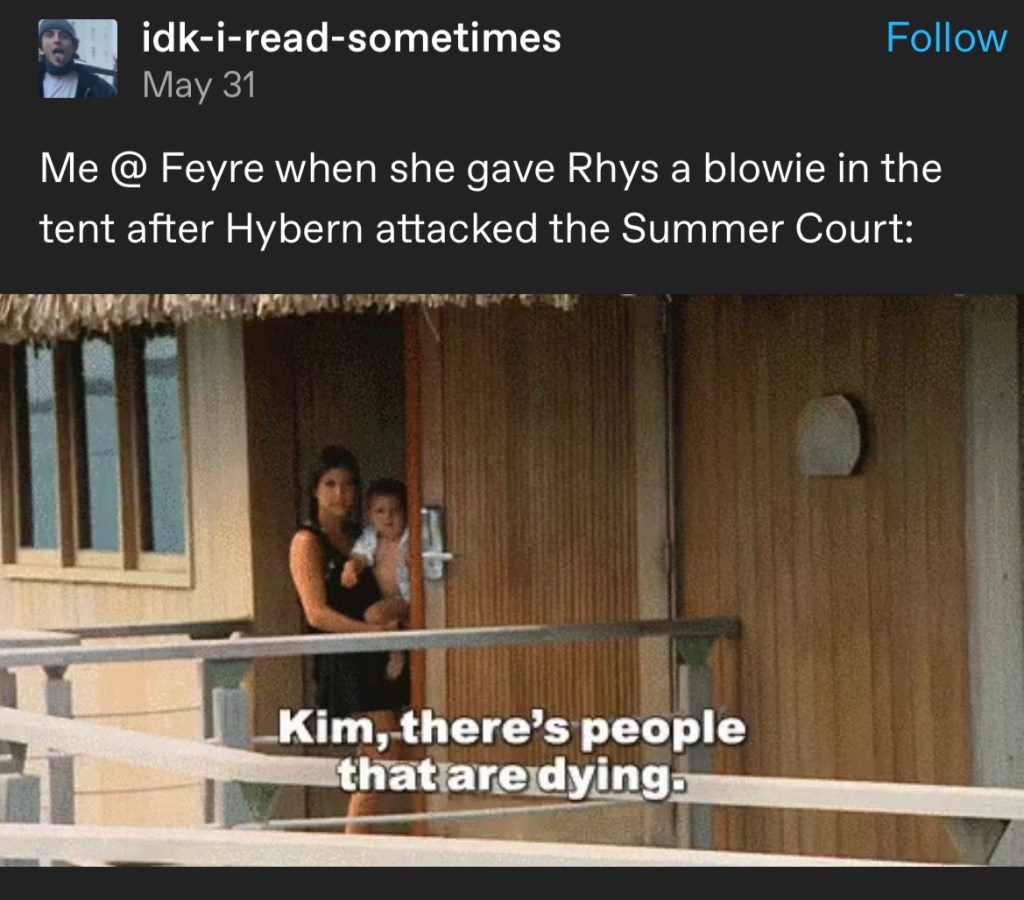
Three ‘kim, there’s people that are dying’ memes out of five.



 Life of Bry
Leave a comment