“To the stars who listen—and the dreams that are answered.”
Rhysand, A Court of Mist and Fury
I finished A Court of Mist and Fury by Sarah J. Maas, and I have several questions:
- Why was this book 600 pages?
- How did the writing not get any better?
- Can someone tell me when this all takes place? Give me an era, please.
- Why is every other character more interesting than Feyre?
- How did so much happen, and it still manages to be boring as all hell?
- Why am I invested?
I will say, ACOMAF is a stronger book than ACOTAR, but that’s not saying much. It’s as if the trash from book No. 1 was swept up in a store-brand garbage bag. Maybe in the next book we’ll upgrade to Hefty bags. We’ll have to wait and see!
The story itself is better, though definitely still cringe, and some of the characters finally had personality, but the pacing was once again entirely off balance and inconsistent. Writing continued to be flat and repetitive, Feyre remained fairly bland despite me enjoying some of her arc, and overall it felt like really cheap drama cocaine.
I did like it, despite the long list of flaws I’m about to go into. And it pains me to say that.
And I meant to explain this in my review of ACOTAR, but when I say a book is trash, I’m not telling you not to read it or people shouldn’t like it. I’m practically begging you TO read it. Trash books are fun to read. They allow you to see just how amazing the really good books can be. Read terrible books and love them to pieces. But also, I’m admittedly a hater.
OK, here are all my thoughts on A Court of Mist and Fury:

BEFORE I BEGIN
I realized that if I want to enjoy these garbage heaps to the fullest, I have to become super cool with a lot of stuff super quickly.
First being Maas’ weird use of the words male and female as if she’s the author version of some Andrew Tate-loving incel. It makes me grit my teeth every time. I just don’t like it. That might be what she intended, but it’s not used as only an insult or with negative connotations. It’s a style choice for the book’s voice. I have to grit my teeth through it.
Along the same line, the mating bond and Maas’ possessive kink. It’s not my thing. I always hate the ‘mate’ trope. It ties into possessiveness. I’ll talk more about it later, but I just always find it cheap and especially in the case of Rhys and Feyre, who would’ve been better off with just the spin of fate storyline without the extra shove.
Finally, for the moment, unnecessary smut. I think that’s a big selling point of this series, but I genuinely think this would be a better story without it. I’ve always been a reader that thought intimate scenes should serve a purpose. A good 90 percent of the smut thus far serves no purpose and slows the already crawling pace of the narrative. Sex should turn the tides.
But this is fantasy romance and why Maas sells so many books, so I will roll my eyes, laugh and turn the pages as I hope for something better on the next. It won’t factor into my review, because it’s a personal preference thing.
And just because it kind of goes with this, but Maas did deliver the one-bed trope. Because of course we couldn’t get through this boring slow burn without it. That was my least favorite part. It’s just so dumb. Tropes can be executed extremely well, even the most cringe ones. I bring it up a lot, but The Dark Artifices trilogy by Cassandra Clare is a really good example of the one bed trope done well. Three times in the final book Clare plays with the same trope, yet it works because it’s done with a purpose to serve — the Seelie Queen does it to taunt and try to manipulate/sabotage Emma and Julian and then in Thule it’s used to show in another world how they would’ve been together. It’s a tactic.
But one bed out of coincidence just doesn’t get me. Sorry, Maas. You tried.
CHARACTERS
I’m going to start with a positive. Fantasy books so rarely tackle the mental health aspects of being a hero. I appreciated and enjoyed Feyre’s character development in the sense that Maas allowed her to start to work through the long process of healing, of learning to cope with what she’d done and who she was after everything that happened Under the Mountain, and not having her be ‘cured’ after a quiet afternoon painting in a field or some bullshit.
And y’know what, kudos to Maas for having the men face that, as well. War affects all. Everyone came out of there a bit shattered. And the story leaned into that as a theme, especially how people react to that brokenness — i.e. Tamlin’s rage and paranoia, Rhysand’s guilt and hope.
Particularly with Feyre, I liked seeing the darkness she fell into, how Tamlin held her in that darkness out of fear, and that Rhysand pulled her out by simply giving her choices.
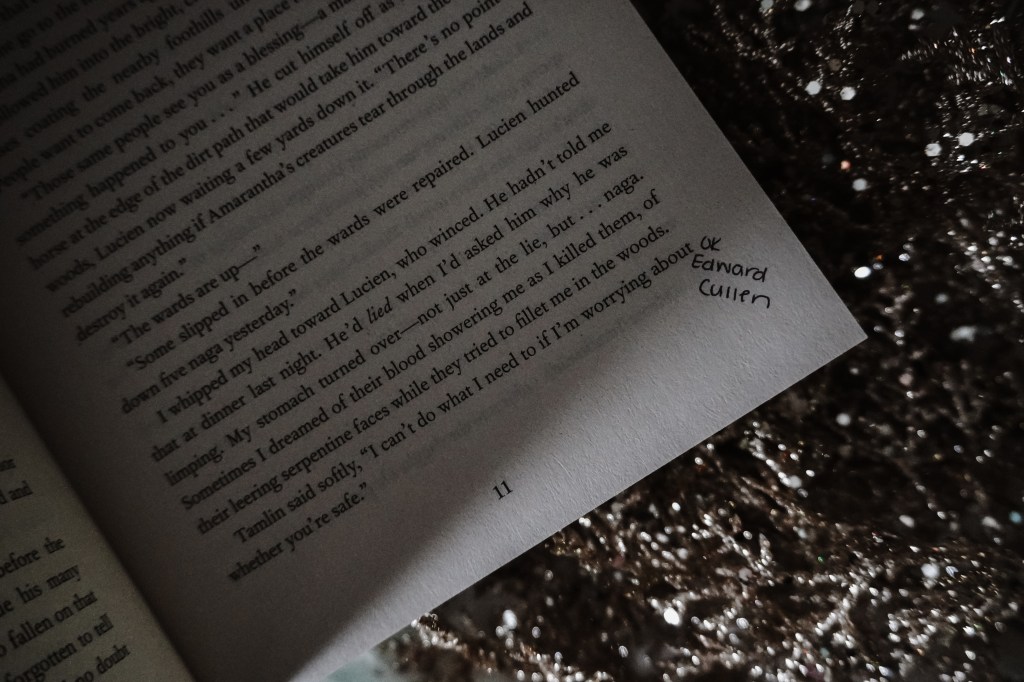
But, and I heard this gripe a lot about Maas’ books, I think Feyre’s character is made interesting by the men around her. In fact, she’s given her special powers against her will by seven men. Seven men who watched as she was traumatized and tortured. And they didn’t even do so out of their own free will — Rhysand used his power to manipulate them.
I rest my case. Not the time.
It’s a trap a lot of writers fall into when writing love triangles and female characters in general. The female protagonist obliviously uses the men as crutches to hold her own. Especially in the case where the female protagonist is new to the mythical world the men fighting over her were born into.
Feyre doesn’t have much personality unless it’s triggered by the anger and love she feels for both Rhysand and Tamlin. Outside of that, her only personality traits are painting and perhaps her human tenacity — which really falters until Rhys reignites the spark.
It’s a weird hole Maas fell into, because by choosing to have Feyre become so numb after Book 1, she almost has to have Rhys or someone else make her feel again. She set Feyre up for that, which is an injustice to that very strong-willed character foundation she built in ACOTAR, in my opinion. I wish we saw a bit more pushback from Feyre on her own in the Spring Court. Just enough for her character development to not solely rely on Rhys’ poking and flirting.
Though the poking and flirting was fun. It was subtle. It allowed Feyre to have a choice. Repeatedly, she was given choices with Rhys. However, the biggest HOWEVER, with war brewing and her family across the wall, does she really have much of a choice on most things?
She has choices about where to stay, but she really has no choice but to help Rhys if she wants her family to live. Plus, the mating bond thing doesn’t seem like something you have much of a choice over either. It seems to pull at the bond already between Rhys and Feyre because of the bargain.
Two side notes: The first is that I hated that plot point by the way. For me as a reader, it sort of nulled some of that natural progress they made as a couple. Maas seems to love to force physicality, and this was another example. She gave us the most boring slow burn ever just to imply it was driven by that bond before they even met, which also makes every nice thing Rhys has done for Feyre feel more self-service than kindness. Also the idea of mating bonds is just so gross to me anyway. I hate that so much. Possessiveness is not my thing.
The second is that I criticized the choice to make Feyre immortal in the first book, and I think it’s important for me to come back and say I understand now why it has to be done. It still feels a bit cheap to make her immortal that early, but as she struggles to find footing in her own self and her own choices, it helps that she doesn’t have just 60 years to plan a future but an eternity to fight for. It adds weight when you have an eternity to stew in your own head. Plus, her powers from being Made are important to the story. I get it. Still hate it a bit, but I understand.
One more positive with Feyre also has to do with choices, and that’s the fact she chooses to fight and kill. She kills the soldiers to save Rhys, and she defends the Rainbow because she believes in Rhys and the dreams of Velaris. It’s her choice to hide or fight. It’s her choice to shed blood, unlike with the innocent faeries Under the Mountain. She chose to be a warrior rather than hide, which made sense with who she was before everything happened and really shows the difference between the two instances and her own character development. This world is bloody and cruel, but her hands are now stained because she’s fighting for something better.
I think we’ll see more of Rhysand’s grayness trickle into Feyre as she sabotages the Spring Court in the next book, and I can’t wait. I love a good morally gray baddie. Bring that court to their knees and stomp on them, Feyre. You deserve it. (But don’t turn her into a carbon copy of Rhysand either! Find balance to make her wholly unique!)
A solid A on that part. Keep working on it. Feyre has potential, though she still seems recklessly and selfishly dumb.
OK, so quickly with some side characters. Azriel and Cassian had interesting enough backstories. Same goes for Mor. Those three and the family they formed with Rhys and Amren was another bright point for me. I’m a sucker for a found family, and these five found each other under the cruelest of circumstances and somehow built this family full of love, laughter and dreams. They’re fun. They’re real. They’re individuals, despite also feeling like Rhysand was laid on a copier and they all came out almost identical but like the ink was also running low so it has a few smears and smudges. I like that they all could relate and understand each other, and Feyre, but I think they were almost too similar and it lacks that creativity in making them something more than just someone to relate to for Feyre. You could lose one and not feel like something’s missing because the other two fill in the space. It loses the novelty and impact for me.
The Night Court inner circle is also so different from the structure and formality of the Spring Court, which I’m sure is the point. I do think that’s going to get old in later books as Maas tries too hard to show their playfulness and it interferes with the plot. She has the too much gene.
I also don’t have any real emotional attachment to them, though I may have the beginnings of a soft spot for Mor. (The Morrigan is just such a badass name, I can’t help but love her.) They more so act as a train to make Rhys more likable by showing he doesn’t treat them like servants in the way Tamlin treats Lucien — they’re trusted friends that happen to work for him.
Speaking of Tamlin, I would like to say I told you so.
I knew that man was a walking red flag. We didn’t see much of him in this book — thank God — but I don’t think Maas did much to his character development even when we did see him. She quickly turned him into a villain by wanting to keep Feyre locked up in the house and then hunting her down. Obviously, he’s a foil to Rhys. He must be worse to show the true goodness of Rhysand. I just didn’t care to even see Tamlin because his character was so disgustingly bland in not even a fun way. I see the flicker of him just genuinely being this man blinded and broken by love, but it’s not done well enough for me to care. We don’t see enough of this brokenness or love as readers to have a firm attachment. Even when he has Feyre in his house, he’s still so distant that I never felt an actual love. That’s partially because Feyre pretty much removes him from her own narrative.
I thought for a while that we would learn that Tamlin didn’t even love her and that he simply manipulated her into loving him to break the curse and save his people, which would probably have hit a bit harder honestly. If he’s going to be a dick, make him a dick for a reason.
Maas put all her effort into building up Rhysand that she forgot to add any spice to Tamlin. He doesn’t scare me. He doesn’t make me feel for him. He doesn’t incite anger or sadness. He’s just a bitch boy. That’s it.
And nothing really got added to Lucien’s character either except he’s practically a slave to Tamlin. He only defies or pushes back on his High Lord, because (I almost said imprinted lol) he felt the mating bond with Elain. A girl HE NEVER MET. So this time around he’s going to help Feyre, not because he’s her friend, but because he wants to fuck her sister.
Love to see it.
But the sisters. The fucking sisters. I’m so incredibly annoyed at the choice to throw those sisters into that Cauldron to force them into this story. The distant and strained relationship between Feyre and her sisters is just not explored enough for this to make sense. I think Maas just needed that mortal connection strengthened as the war gets closer, so we had to literally drag these boring ass sisters backs into this narrative. I’m sure they’re now going to be super special and make amends with Feyre and be super important moving forward. I’m just not interested, because there’s never been any true conversation or reconciliation between the three sisters. I guarantee they end up with sexy High Fae men of their own.
Finally … Rhysand.
I hate that I’m saying it.
I’m kind of obsessed with him.
I continued reading this trash heap because of him. Because I’m a whore for morally gray characters, and because Maas seemed to pour any amount of character-making skills she had into him and him alone.
He’s fleshed out. He has an intriguing backstory. He has demons. He has motive. He has dreams for the future. He has personality. Multiple personalities even!
And all of this might just be because we see Rhysand through Feyre’s eyes. Tamlin was her captor and Rhys was her savior. I spent way too much time thinking about whether I liked Rhys because he was actually an interesting character or if I was being manipulated by the narrative to like him.
I think it’s the first one. I’m going with it.
What Maas failed to do with Tamlin, she did exceptionally well with Rhysand. She made him a sympathetic villain that actually a hero. He did heinous things — like everyone in this story — but he is open with what he’s done for the most part and knows that it was for the purpose of protecting his people. He presents this to Feyre and allows her to decide for herself if she still wants to be his ally, his friend, his lover.
As I mentioned before, Rhys and Tamlin are foils. Tamlin has done awful things, as well, but he hides them from Feyre. He doesn’t let her see past the image of perfection he tried to paint for himself and his court, which could be because he was desperate to win over Feyre to break the curse for his people. But if that was the case, it’s no longer an excuse because SHE BROKE THE CURSE. He’s just scared now to lose her by showing her what he is and thus shows her and the readers nothing.
How did I get back to Tamlin?
Rhysand.
He’s this very tragic, dark, fallen prince sort of figure. Which is great on its own. You got me. But what I liked most about his character is that nothing is told to us, everything is shown. His sacrifice and generosity and hope is shown in the city of Velaris. He was willing to give up himself and run his conscience and reputation through the mud for his people to thrive. And yes, that means allowing the Court of Nightmares to remain, but for a slice of hope and peace, it’s worth it. Because the slice shows that change is possible. I think that ideal really grounds Rhysand’s character. It gives him a foundation to build on, and allows the reader to connect with him because they have seen the cruelty of this world and also wish better for these people that have suffered. (So opposite of Tamlin being willing for his people to still hurt while preaching about saving his court and him being unwilling to make changes to make sure they don’t suffer.)
Plus, he’s just a great guy, and it’s shown not only through his actions but how his friends and allies respect him. He helps Feyre through the nightmares that Tamlin forced her to endure herself, he works with her to hone the powers at her pace, he keeps her invested in life without being overbearing. He also doesn’t white knight his friends. He offers them a rank they rightfully earned but wouldn’t gain because of prejudices. And with Mor, he’s given her the green light to handle her parents and the Court of Nightmares how she wishes. He allows them to have the power that was stripped of them and to use it as they see fit.
A bit of a devil’s advocate’s take is that Rhys is part of Feyre’s trauma as much as he empowers her, and it’s not addressed fully. While he may have drugged her to save her from remembering the horrors Under the Mountain, he still drugged her and assaulted her. He baited her into a bargain. Touched her against her will. He stood by Amarantha’s side as she did horrible things to Feyre and to others. He’s been abused, but he’s also an abuser. You don’t get to use your own trauma as an excuse for continuing the cycle, and he made sure that he’d have to be the one to repeatedly save Feyre. Yet everything is swept under the rug under the pretense that he did what he had to for his people. There are nothing but terrible choices.
With that being said, is there really a change from the man we saw Under the Mountain and the man we see in Velaris? He’s still willing to do awful things if it means protecting his family and people. So no matter how much Maas shoves it down our throats that Rhysand is the good guy now, he is still despicable in his own ways. Just like Tamlin. If anything, I almost think that trying to pretend or push that Rhysand is entirely good is a disservice to his character. I like that he’s a bit despicable. It makes you weigh what is worth being despicable for and when to be despicable. Don’t make him entirely a pathetic wife guy. Don’t boil down his character. But also don’t act as if he’s all self-sacrifice when he literally allowed so many people to die and be hurt to protect only his own. Or that he didn’t teach Feyre to read and use her powers to help his cause just as much as he did it to help her feel less helpless.
A final note, the dark tragic High Lord with a big ego and snarky attitude being sad and angsty and having a big heart is pretty cringe. I will accept this cringe though. This is my favorite cringe.
STORY
The story. I’m not sure what to even say. The way I described it to my husband was that it’s like a car crash you can’t look away from, but not a terrible accident. More like a fender bender on the highway where you linger just to see if maybe the drivers will fight. I was expecting more.
I almost feel as if Maas just info-dumped on me for 600 pages straight. Somehow it was both overwhelming but not entirely enough. The stories of the Night Court’s history and the first war were really interesting. It’s terrible to say but I liked learning about the brutality of the camps and the horrors that were endured, as it helps build the reasons why they defend Velaris so devotedly. I think that there was probably a way to execute relaying that info more efficiently rather than info dumping. Despite its intrigue, it stalled an already fairly slow story.
My guess is it feels that way because the story jerks around a lot. We’re moving from location to location so quickly, but nothing too exciting happens except this avalanche of information. Info from 500 years ago. From 50 years ago. From a few weeks ago. There’s a lot of bouncing around.
It’s whiplash as a reader.
Which is a shame because once again Maas does a really good job at world-building. It’s honestly the biggest asset of this series so far. The creatures that are all so different and terrifying in their own ways with little stories of what made them monstrous — which blends the idea of what line we draw between those that are good and those that are evil — and the different courts and the niche societies within them are unique and fascinating in all their horrors.
I have to say the world-building is a bit inconsistent though. I suppose I like the world Maas created, but that her building isn’t strong enough for the concept. She drew the plans up but isn’t the right architect for the job.
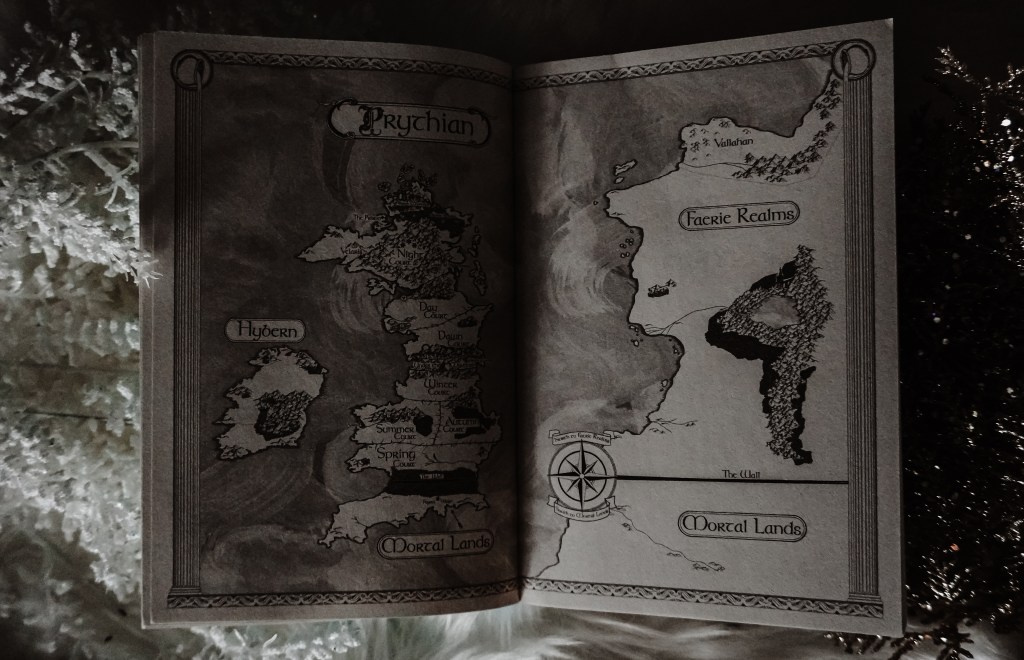
I can’t pinpoint where to place this story. The mortal world feels like it’s somewhere in the mid-to-late 1800s or early-1900s, but then Feyre is wearing like leggings and sherpa boots living her best basic bitch life in the mountains and there’s modern-seeming toilets and Velaris feels way more advanced than anywhere else. And when Cassian, Azriel and Mor go dancing, are they clubbing with like EDM or swinging to some jazz or is it more like the waltz? I need to know. I’m just so lost.
It adds to the chaos of an already sporadic narrative.
King Hybern’s intentions aren’t made entirely clear nor his full backstory despite him being the ultimate big bad. I went to the Wiki to fully understand his story, which I’ll admit, I might’ve just not picked up on because I read this book very fast and not with a lot of attention. I’m still wondering why he couldn’t have shattered the wall while Amarantha was in power. Wouldn’t it have been easier even if she did sort of rebel against him for more power? Couldn’t they have struck a deal? Is Jurian that important to this plan? They had similar ideas about humans. Why even conquer the Mortal Lands? Just for power and conquest?
This very much could all be solved in the next book, but for the moment, we need to be more invested. We need to know more of the motives and the consequences. We got some insights into the last war, but not nearly enough for us to understand the weight of the carnage.
When your series relies on wanting to stop or win a war, you need to give damn convincing reasons. Powerful reasons other than just ‘war is bad and so is he.’
So the war is the bigger picture, but for now it’s all about the lead up to that war and preparing. The major point of this book was to get the Book of Breathing, which is where the bouncing around gets bad. We have Rhysand testing Feyre’s powers, the training, a few days in the Summer Court, a few days in a camp, some time in the mortal world waiting for queens, a day of disaster in Velaris. It’s a lot of stuff. … I wouldn’t even call it action, because there’s way more waiting for like three pages of action.
Maas would benefit by finding a way to condense her story. Filter and prioritize. Focus more on the war that’s coming and less on the one that happened. Less on the past and more on the future. There has to be a way to blend these two without bogging down the story so much. I was thinking that a prequel series, book or novella collection would be so cool in filling in gaps and taking some of the less-needed information away from this series to make the pacing flow better.
A part of the story I liked was that this turned out not to be a ‘chosen one’ series. While Feyre is definitely unique; she is not the only person with power in this fleet of characters. Everyone has power in their own way, and it’s fairly balanced. Especially the balance between Feyre and Rhysand, they’re pretty equal on all fronts except control, which makes the 500-plus-year-old High Lord falling for a 20-something mortal feel less predatory. (Side note: Is it ever explained why Rhys is the ‘most powerful’ High Lord? Y’know what, I don’t even care. Don’t give me a 30-page explanation, because it’s all or nothing with Maas.)
Oh, and we have a bit of a Romeo and Juliet moment at the end where Rhys and Feyre sneak off and get married? Mated? Idk. But it’s just some cringey whipped cream for our cringe cake.
WRITING
I figured it out. There’s a reason these books are so bingable despite being glorified garbage: Maas has mastered the art of cliffhangers. Much like The Hunger Games, nearly every chapter ends in a cliffhanger that almost guarantees you will turn the page. It’s clever writing, and it’s hard to do it that often. Kudos given where they are do for that.
On another note, Maas has a new favorite phrase, and I’m so glad that it’s not ‘watery bowels’.
Nope, she’s moved on to ‘vulgar gesture’.
I’m not a stickler for the rule of not using the same word in the same paragraph or same sentence even, but this phrase was used so often that I really just wanted to give Maas options. Mix it up. There’s different ways to say you flipped someone off. Especially between Feyre and Rhysand where their relationship has always been darkly playful. Be creative.
I know that’s nitpicking, but I think it says a lot about the way Maas writes. It’s very repetitive.
I enjoy repetitiveness in literature when it comes to symbols or themes or phrasing, but it has to be done right and for a reason.
Maybe this doesn’t even apply to all the vulgar gestures, but it can be applied to other aspects. Stars, for one. I actually loved that we had a bit of foreshadowing with the stars that Feyre painted on her dresser drawer back home as this symbol that she was meant to find Rhys and the Night Court. Still cringe, but cringe for a purpose.
I would’ve liked if that symbolism wasn’t shoved down my throat so viciously. It was brought up maybe three or four times. I think it would’ve been way more impactful if it wasn’t mentioned until Rhys explained his dream or only when Feyre nurses him back to health after the arrows. For me, symbolism falls flat when you overdo it.
Instead, use that established symbol of moon and stars and mold it into something new that reoccurs that presents this sense of hope or fate. Have stars on the cave wall. Stars on the floor or ceiling of Feyre’s prison when she was Under the Mountain. Stars painted on canvases in the Spring Court.
But Maas has this thing where she just takes one thing and runs it into the ground until it’s completely buried.
That’s probably my top issue with her writing. It’s not diverse enough. Every page, every chapter feels the same. That’s partially to do with her cliffhangers. There’s a formula. Not in a consistent way, but in a boring way that makes reading it almost feel robotic. There’s no fluctuation of emotion or voice. It’s flat. When it does spike, she rides the peak and flat lines again.
Maas included a Rhysand point of view at the end of ACOMAF, and there was almost no shift in voice between him and Feyre. There should be. Despite their similarities, he’s endured hundreds and hundreds of years of immortal suffering, and she is like 20 years old and dealing with different types of trauma brought on by her own trials and life experiences. They should have two distinct perspectives and voices.
I’m hoping if there’s more of this dual POV in the next book that the voice is more distinguished and the writing becomes less one-dimensional as a whole.
END NOTE
I wrote this the day I finished Mist and Fury, which was a few days ago now. I have since finished A Court of Wings and Ruin, because clearly I have a problem, and some of my above opinions have changed. But in the essence of sharing my thoughts as I read, I didn’t change anything when I proofread this. Just know that I have plenty more thoughts to build on. Also, I’m taking a break from these books for two reasons: I’m on a self-imposed book-buying ban until after the holidays, and I need to step away because I’ve been thinking way too much about these books and why I don’t think they’re good in the least but still have to read them. It’s a problem. I need to read an actually good book to ground myself.
For now, I give ACOMAF 2.5 painted stars on a dresser drawer out of five.


 Life of Bry
Leave a comment