“Human nature is so well-disposed towards those who are in interesting situations, that a young person who either marries or dies, is sure of being kindly spoken of.”
Volume II, Chapter 4 (22)
Hey everyone 🙂
We are continuing on with annotating Emma by Jane Austen, and oh boy am I fully invested in the drama. … Even though it’s taking me much longer than expected to get through this book. That’s for many reasons, most of them being life; however, Austen novels just tend to be disastrously slow. I mentioned in my chapters 11-20 notes that I loved the pacing, but I am taking it back. This book is over 400 pages and for what?
The thing about Austen that I’ve learned is that the majority of her books revolve around visiting other people’s houses as a way to portray society. It’s a bit tiresome after a while. Because Emma is a romance novel, there’s not a ton of action in the sense that the points moving the plot forward aren’t as ‘in your face’ as a fantasy story. As someone who tends to drift toward fantasy and more action-heavy novels, it’s hard to adjust to something so subtle, light and slow. It’s less about Austen’s actual writing and more about my personal preference in genre. This is why I don’t typically pick up romance books.
However, I do still enjoy Emma way more than I did Pride and Prejudice and Persuasion. It’s comedic and fun in a very messy way, along with its deep take on the notion of class and society. I am enjoying it, just also ready for it to be over.
You can check out my notes and annotations on chapters 1-10 here (x) and 11-20 here (x).
With all that being said, let’s take a look at chapters 21-30 of Emma.

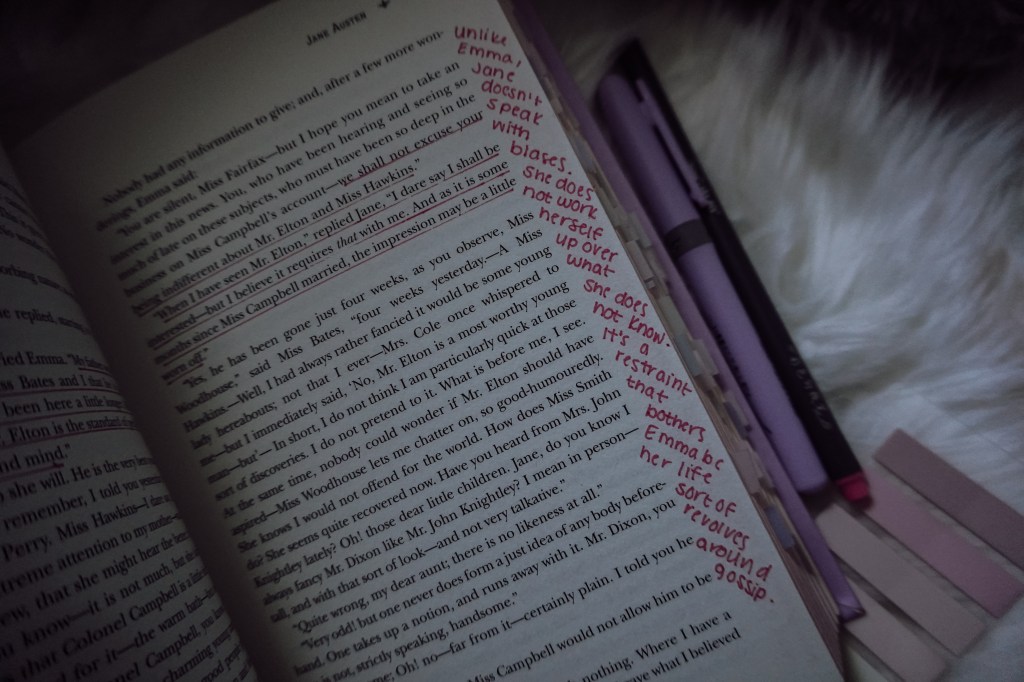
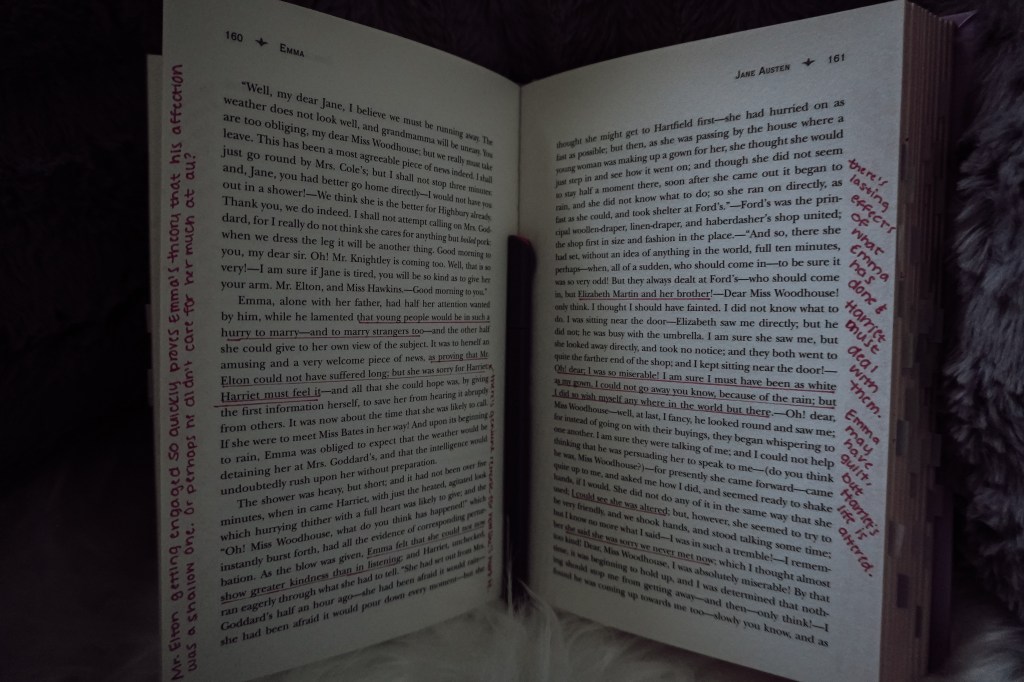
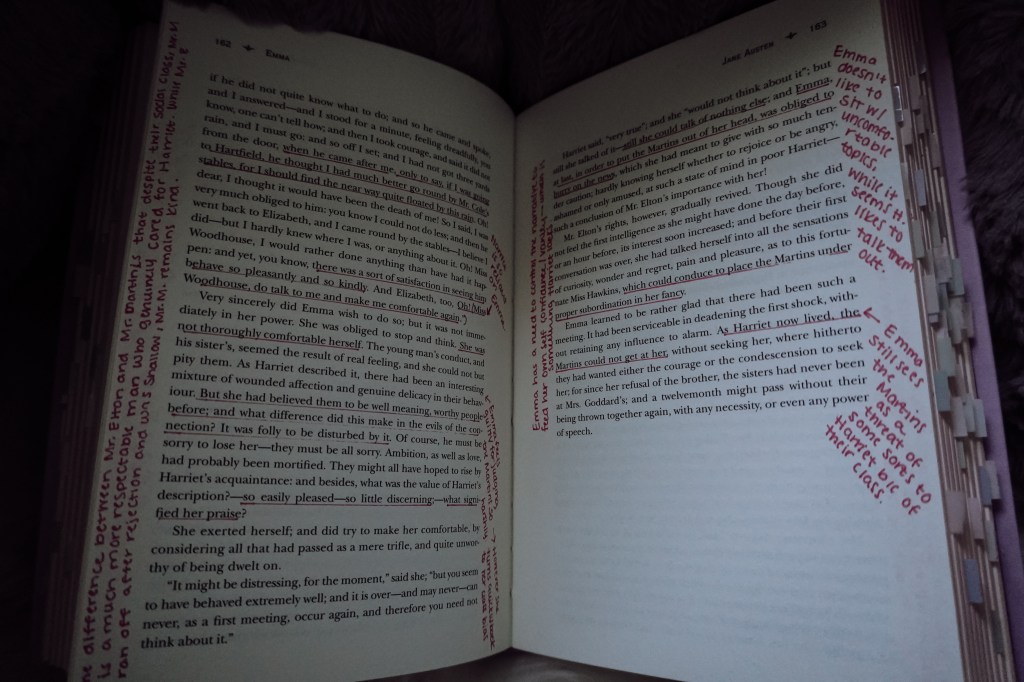
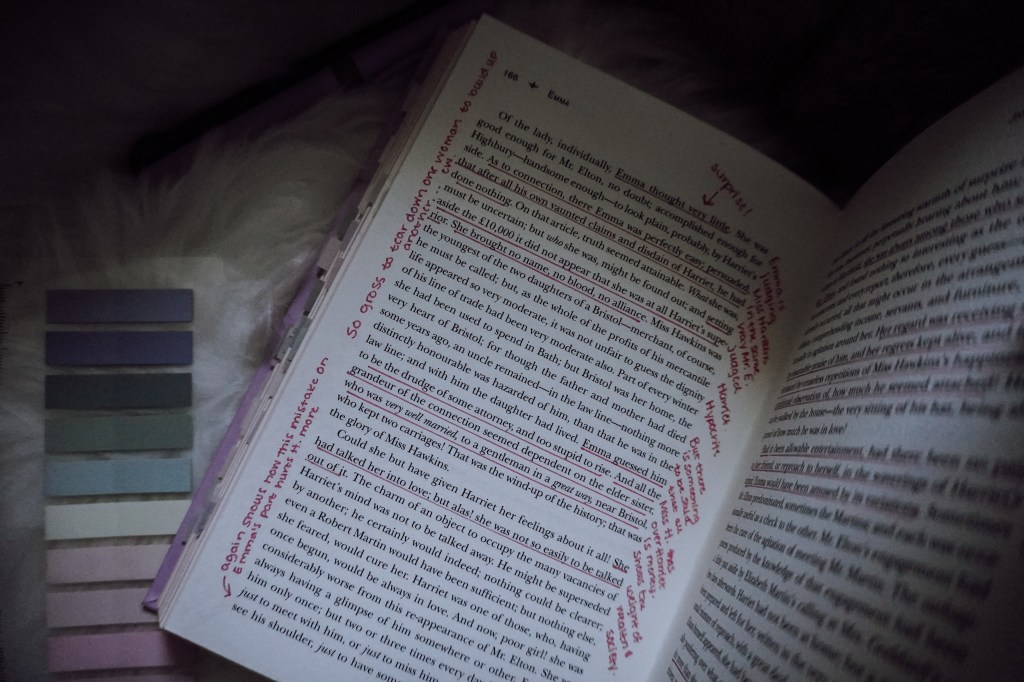
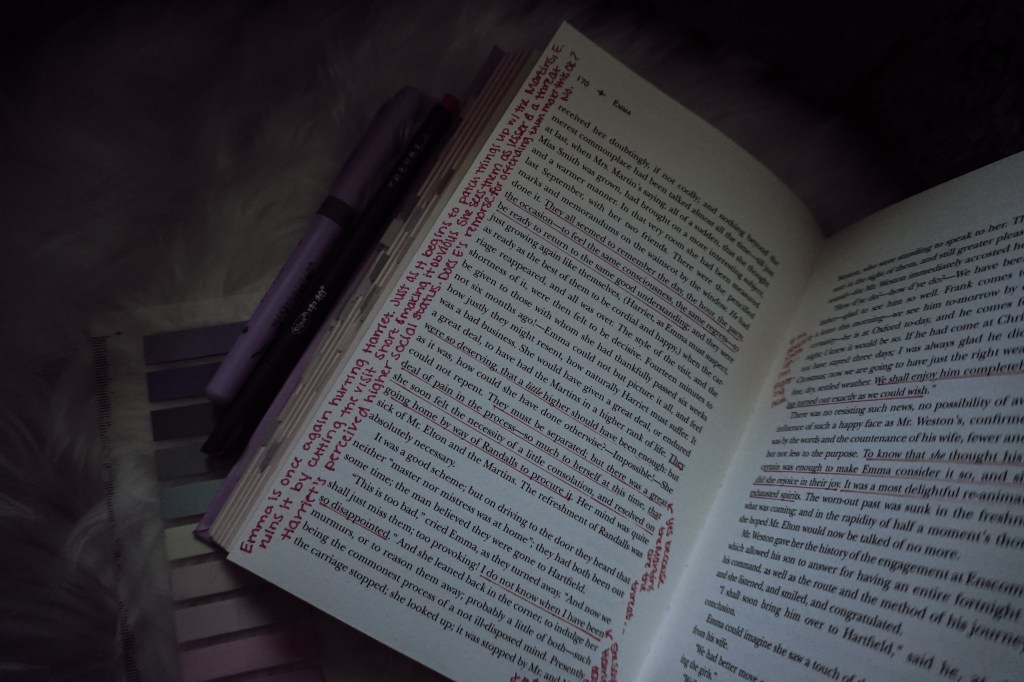
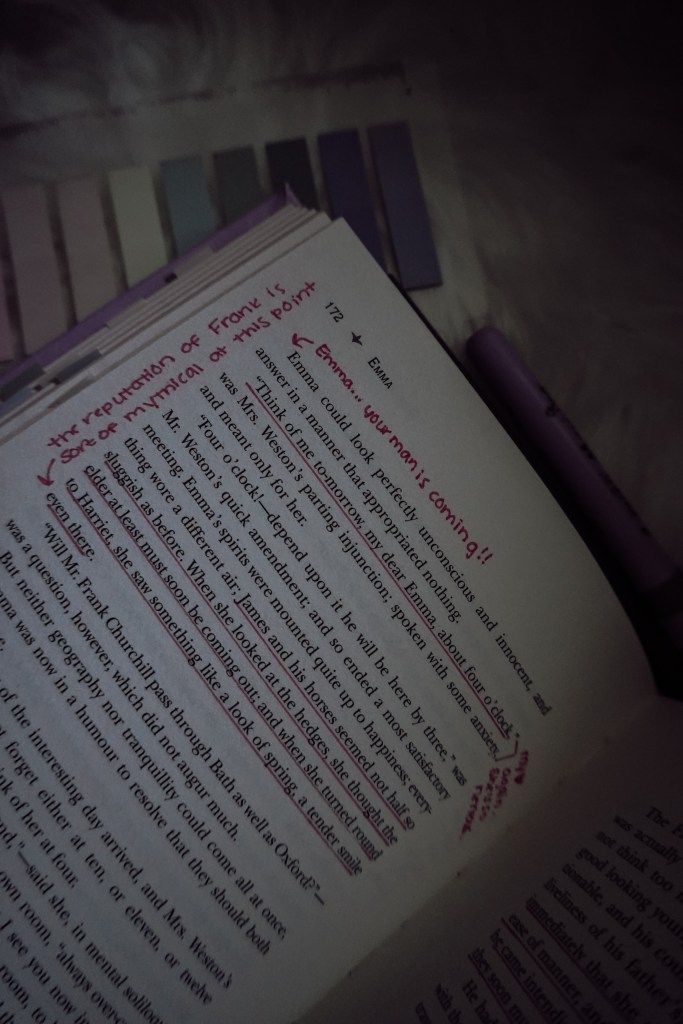
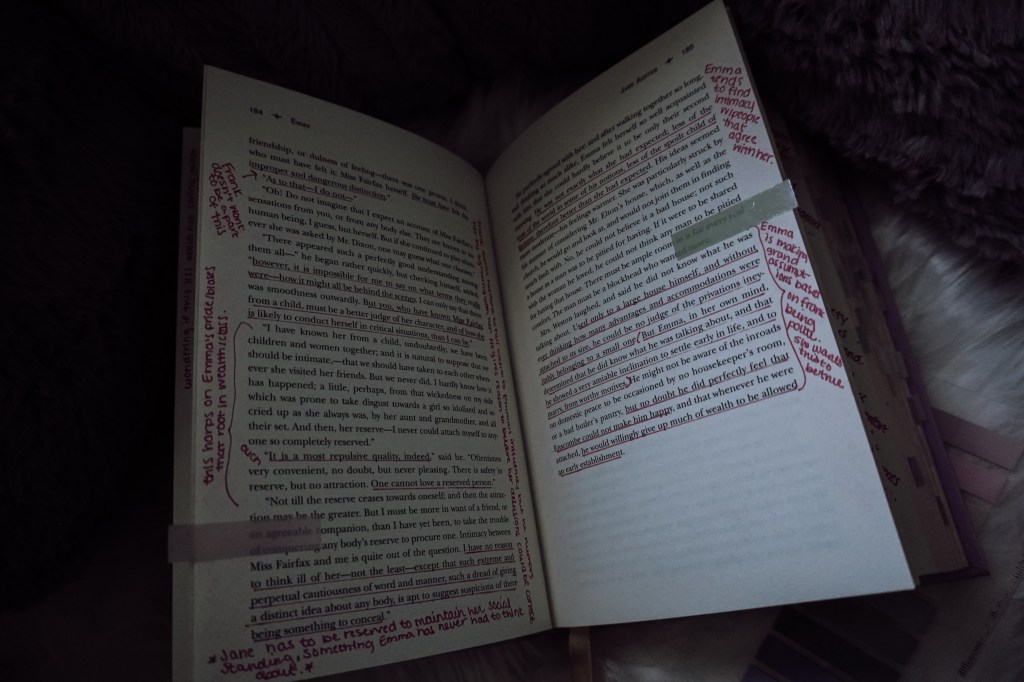
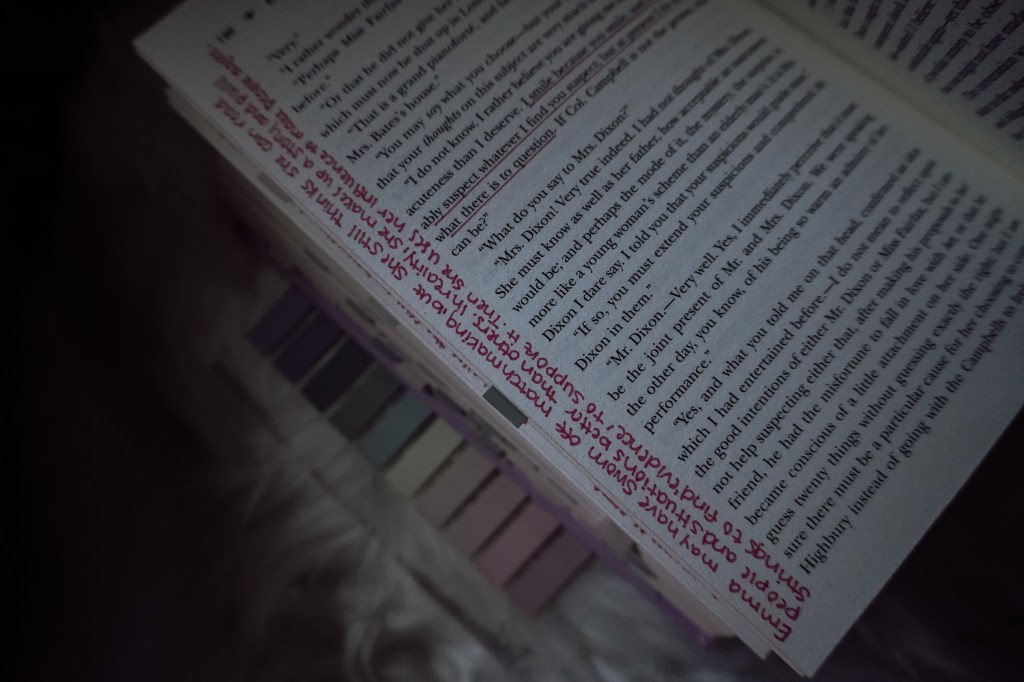
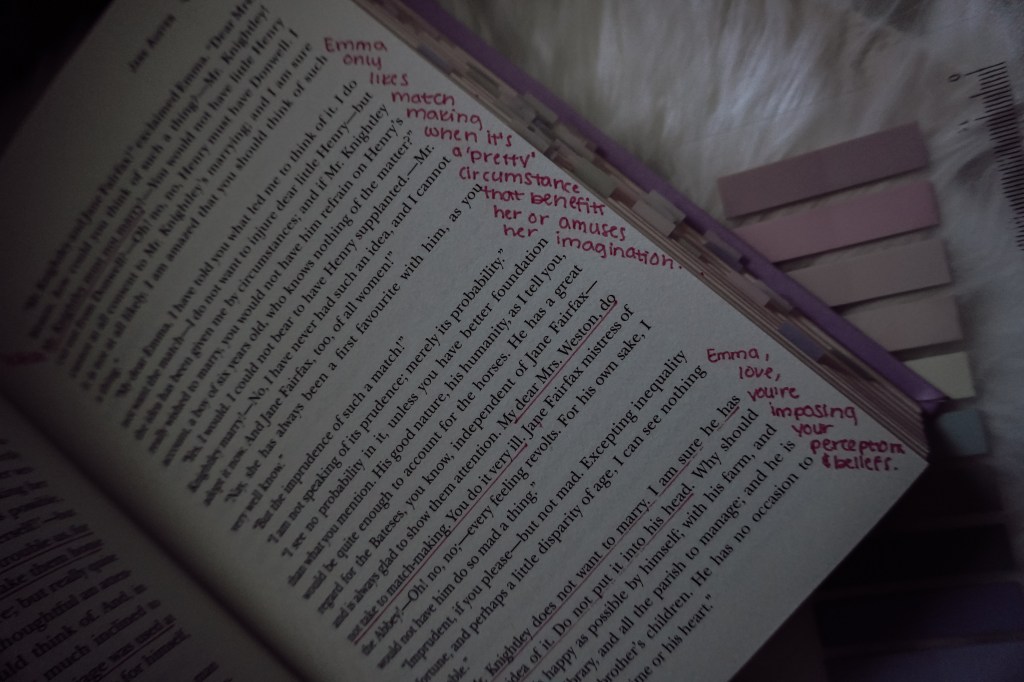

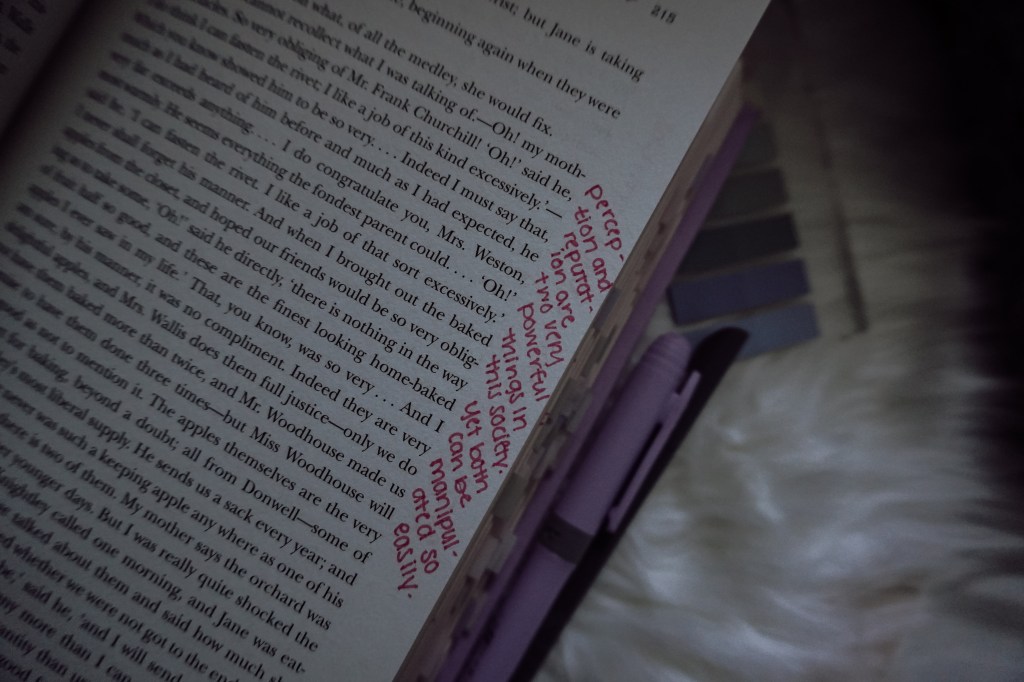
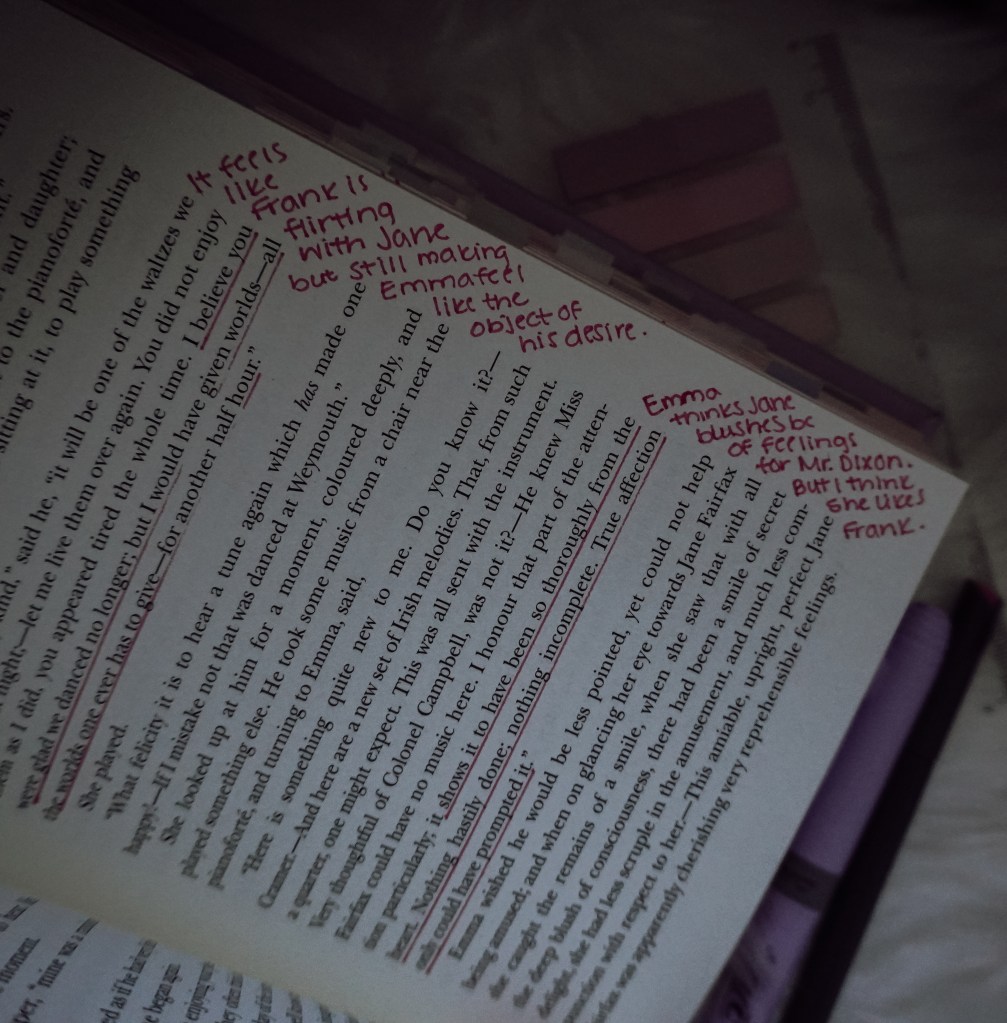
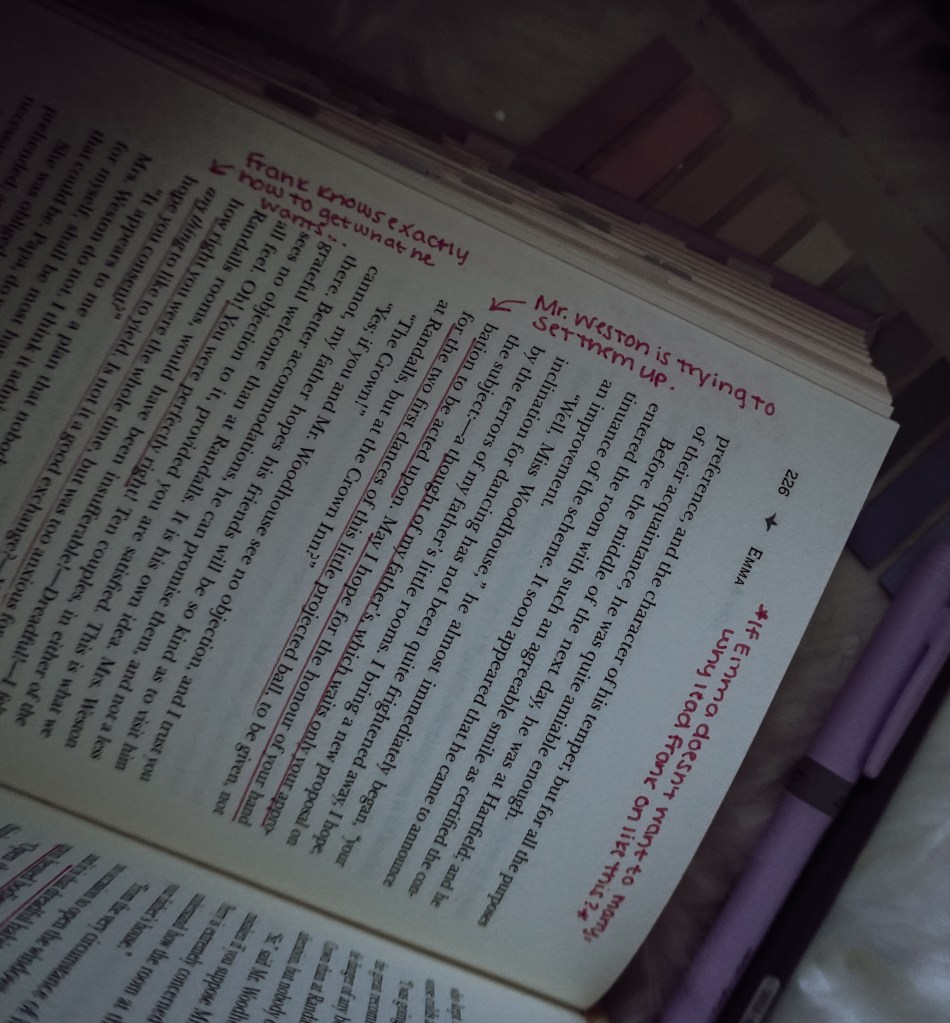
A warning: I don’t want to fall too far behind in posting thoughts and annotations, so I’m going to do bullet points, instead of a put-together essay. (Spoiler alert … I fell behind.)
- Writing wise, I think it’s so fun the way Austen has set this novel up so that readers almost have to trust Emma’s perception, despite knowing she’s biased toward her own imagination. We don’t see anybody else’s perspective. We focus on Emma, who even when presented with a perception different from her own, holds true with her previous conceptions of reality. As readers, you have to really think about each opinion Emma has and decipher whether or not it’s correct or a product of her own imagination. I love a good unreliable narrator, and Emma is very much unreliable based on her privilege.
- In these chapters, Austen focuses a lot on building characters that compliment and contrast Emma, including Jane Fairfax … She’s a foil to Emma. She had to work for and earn her position in life, which has made her Emma’s arch nemesis — though she’s much too polite to say that.
More so in these chapters, we see how the two girls differ despite their similarities. Emma’s biggest criticism of Jane is her reserve. She doesn’t understand that because she was not born or married into wealth and high social standing, she can’t be as bold. Emma has freedoms and control that Jane does not, which we see in the way in which both girls conduct themselves. Emma is more critical in public, she decides where she’ll go and for how long, she is opinionated and stubborn in her ways. Jane can’t do that or she risks a social faux pas that destroys all the work she’s done to get her in higher standing.
What I really like about this contrast, is that it shows how Emma, for all her wit and knowledge, is very closed off in her world (much like how Highbury itself is closed off). She doesn’t truly know or understand the ways her own society operates.
- Frank Churchill. … This son of a bitch. This was where Austen trapped me with Emma’s way of thinking. I wanted him to be perfect. I wanted to love him. However, he was a tool bag, and I’m a hypocrite for thinking that way.
I like Emma as a character, despite all her flaws and her making me want to scream at every turn, and Frank is very similar to Emma. They are both blinded and bound by a certain level of privilege, they manipulate to fit their perceptions and they know what needs to be said and done to maintain a level of respect.
Immediately, I knew Frank was playing a game (though I wasn’t sure what the goal of his game was at first). He was saying exactly what everyone at Highbury wanted to hear in order to get on their good side — much like what Mr. Knightley suspected with the letters. He played into Emma’s vanity by complimenting her and agreeing even on subjects he didn’t think similarly on, he seemed to get close to Emma to appease his father, etc. Especially when it came down to planning the ball, he knew the exact steps to take to get what he wanted. He got Emma on board, warmed Mr. Woodhouse up to the idea by establishing safety and comfort, agreed to dance with Emma at his father’s request.
Emma doesn’t judge Frank as unfairly as she did Mr. Elton. She doesn’t pick him apart even though there’s plenty to pick at. She has already written a pretty little narrative in her head of Frank being the utmost gentleman who’s in love with her, which means she can quickly shoo away any inadequate qualities that make him less. (I was about to mention how frivolous it was for him to take a day to get his hair cut in London, but now I think he was ordering the piano for Jane. OMG I figured it out.)
Frank hides his manipulation under the perception of good manners, just like Emma, who hides hers under the pretense of good-intentions and friendship. |
I think the difference for me is that Emma’s misdoings always feel unintended or with good intentions at heart. She shows real remorse in her mistakes. Frank feels as if he’s using his influence as a tool knowing the power he has over the people of Highbury. I can’t stand him.
- To bring an update on the Harriet front, I’ve never wanted to smack a character more than when Emma only “allows” Harriet 15 minutes with the Martins. Emma doesn’t understand fully that the reason she has so much influence and power over Harriet is not because she has genuine good sense, but because of her class standing. She’s ignorantly hurting Harriet at every turn, and Harriet allows it because this woman of wealth and society must know what’s best for her — even more so than herself.
- Also, we get the setup of Mr. Elton’s soon-to-be wife. He moved on super quickly, which leads me to believe either he’s very superficial or never really liked Emma all that much to begin with. Maybe both. He was so slighted by Emma that he needed to find someone quickly, so he finds this woman, who kind of sounds a lot like Emma, and puts her on this immense pedestal. I’m excited to see what she’s really like.
A NOTE FROM BRY: I actually finished Emma already. I had these thoughts typed up in my phone while reading, so I figured I’d still share them. The next batch will be the rest of the book, so chapters 31-55.

 Life of Bry
Leave a comment