
“In this life and the next, for however long our souls remain,
mine will always find yours.”
You know that special feeling where you simply can’t put a book down even after you turned the last page? You sort of just hold it close to your chest, still open, and breathe in the words you just read?
Our Violent Ends by Chloe Gong gave me that feeling and more.
I feel positively gutted.
It’s been so long since I last felt this feral over a book, and it’s such a relief after climbing out of a reading slump. I cannot wait to share all my thoughts with yinz.
But first, a little about this book.
Our Violent Ends is the sequel to Gong’s debut novel These Violent Delights, where Roma Montagov and Juliette Cai believe they have killed the monster ravaging their city with madness. However there’s more monsters waiting in the shadows — both mythical and political. Shanghai is still being torn apart by the foreigners, by the Communists, by the Nationalists, and by the blood feud that is seething with new hatred.
Roma and Juliette seem adamant to choose the other’s safety over everything as their city burns around them, but what carnage will they leave in their wake?
Here are all my thoughts on Our Violent Ends by Chloe Gong.
A Note
Before I truly get into the nitty gritty, I want to start by saying this book is what I consider “lovable trash”. It’s YA trash. It’s a reflection of William Shakespeare’s Romeo and Juliet with a new-age YA twist full of tropes and cringe.
That being said, I loved every page of it.
Yes, OVE made me roll my eyes every time another person showed up after being perceived as dead, I laughed out loud at some of the cringiest love confessions I’ve ever read, and I screamed into the void when our main characters finally realized the harsh truths I did within the first couple chapters of book No. 1. But, mostly, I sobbed as Gong crafted a predictable love story that still somehow caught me off guard and destroyed my heart.
If this is trash, then I’m a raccoon digging through the bags to find treasure.
This is such an important thing that I’ve learned to recognize. A book isn’t inherently bad just because you’re not the target demographic, and you should critique and analyze the text with that in mind. Love or hate a book for what it is, not what you wanted it to be.
Onto the spoiler-y stuff …
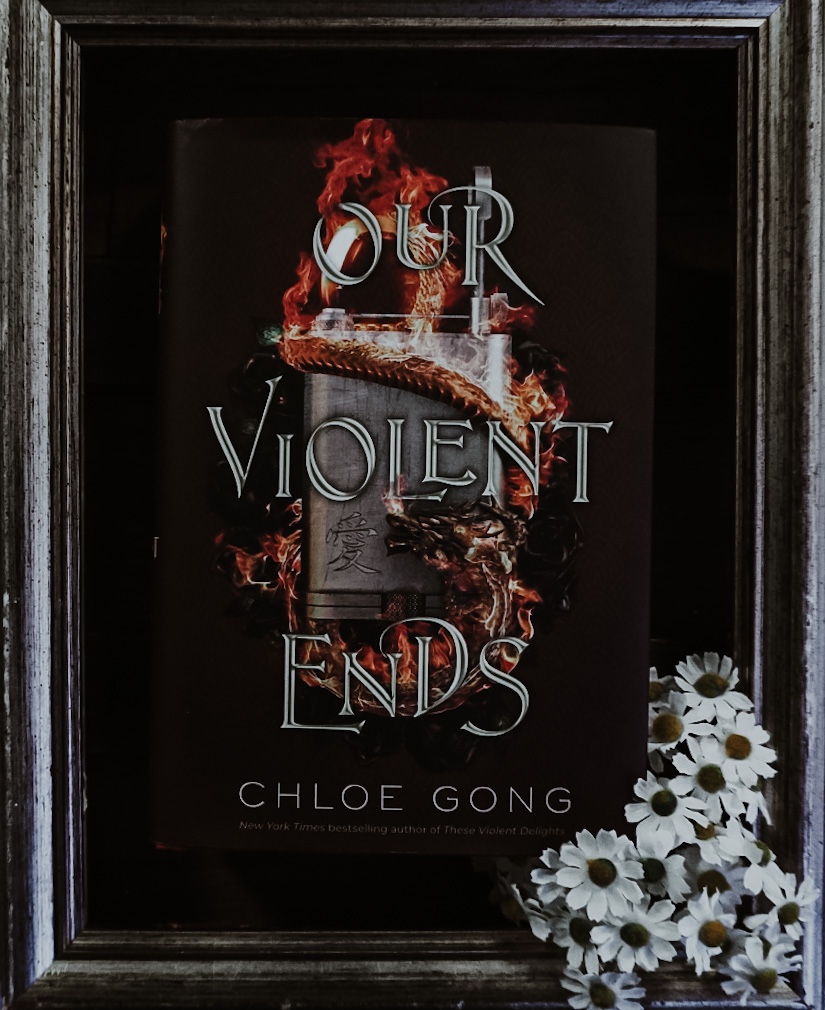
Loyalty is fickle, safety is subjective and power means nothing
Let’s kick things off with what I felt were the biggest themes of the book, which are conveniently intertwined: power, safety and loyalty.
“Once, she had wanted power. But beneath it all, maybe it was never power she wanted. Maybe it was safety.” (Juliette, 329)
Throughout both These Violent Delights and Our Violent Ends, power is often equated to safety.
Roma and Juliette remain as heirs because they have safety in their positions. Their respective gangs have protected them, given them reputations they hadn’t fully earned and pledged their loyalty to them only because of their last names. Those gang members did all this because Roma and Juliette held power over them and they found protection of their own among the ranks of the Scarlet Gang and White Flowers in a violent city.
Rosalind and Kathleen (Celia) Lang were in the inner circle and devoted themselves to Juliette because that brought them safety when their own last names did not. The same goes for Marshall, who left one safety net with his Nationalist father for another with Roma and Benedikt — or Benedikt himself who sticks close to Roma because he believes in him and his good heart.
The Scarlets align themselves with the Nationalists and the White Flowers find ins with the Communists, all because they’re searching for safety in a power higher than themselves.
However, like Lady Cai has repeatedly told her daughter, “loyalty is a fickle, ever-changing thing.”
These characters shift their loyalty as they see fit. It follows safety, because that is what everyone seeks when violence is imminent.
Even in TVD, Rosalind was at her breaking point within the gang. She never felt gung-ho on diligently following Juliette as Celia was. I guessed she was the mole immediately. However, she’s smart enough to know she still needed protection in the city, and she found it with Dimitri. At least she thought she did. She put her loyalty and trust in him to take her away from the city because she believed he loved her.
For Celia, she remains loyal until the moment she realizes that it’s not enough to keep her safe. She joins the workers against the Scarlets and Nationalists. She risks her life for a cause she believes in without regard to safety.
Marshall and Benedikt both were raised within the ranks of the White Flowers, yet Marshall puts his trust in Juliette for saving his life and later Benedikt does the same. Juliette gave them enough good faith to earn that trust and they each bypass the blood feud lines because of that.
Of course, the biggest example of fickle loyalty is Roma and Juliette.
They are heirs and meant to be the embodiment of their respective gangs. They should be wholeheartedly involved in the blood feud’s cause for power over the city. Yet, both choose each other over the city, over their gangs, over their own safety.
Their loyalties lie with the other, even when they don’t want them to.
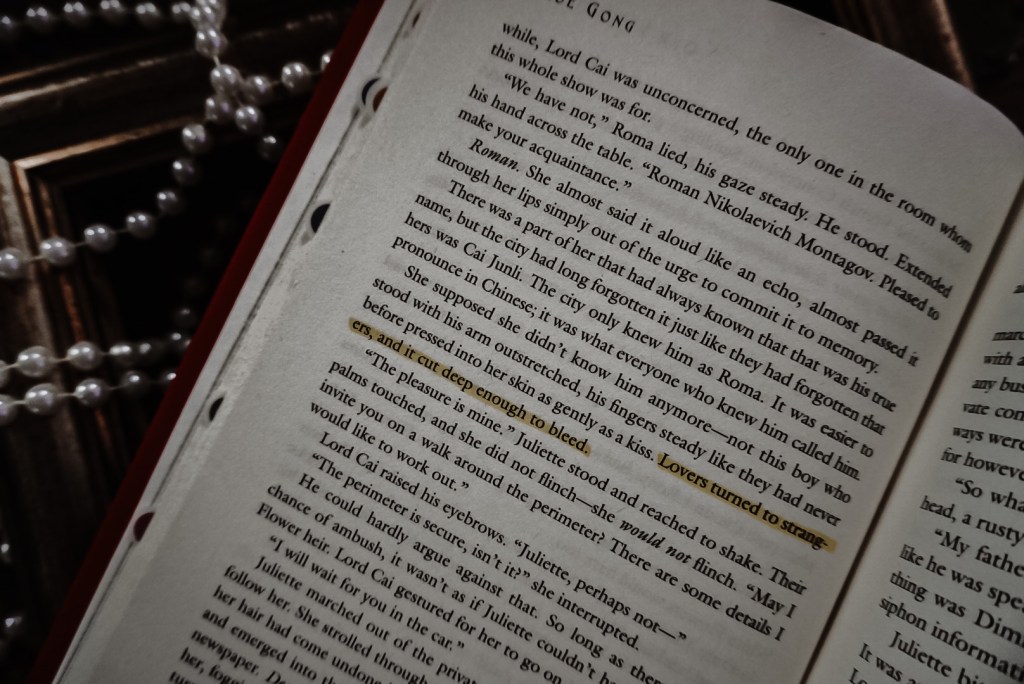
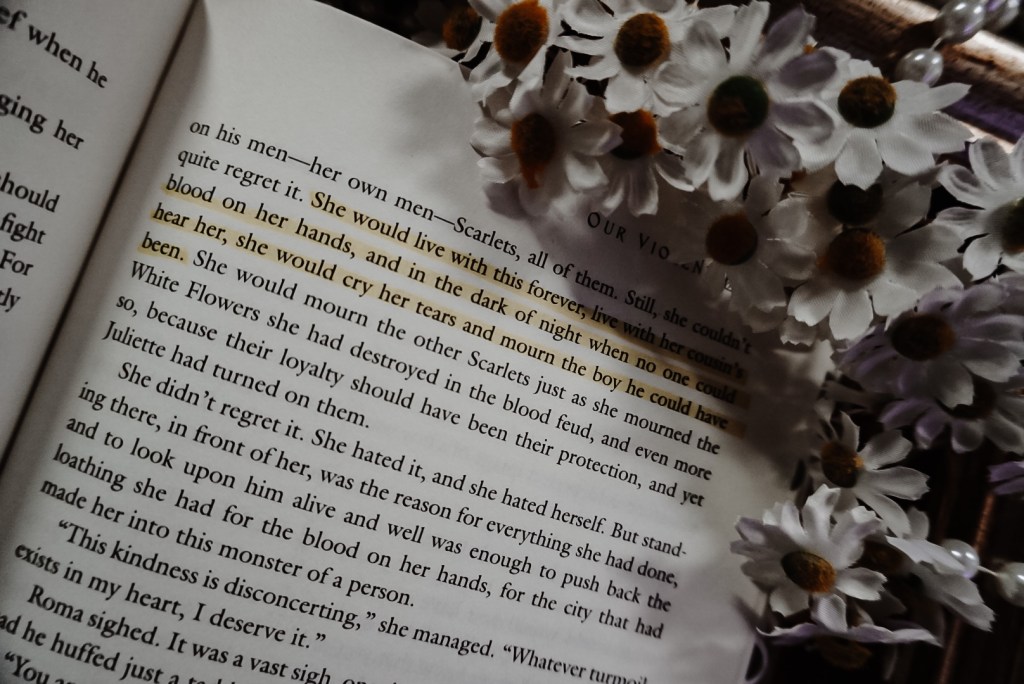
I think the peak example of this would be when Juliette shoots Tyler during the duel to save Roma’s life. This is the absolute turning point for Juliette’s loyalty. She had been allowing her loyalty to trickle through up to this point, but the floodgates opened with killing her own cousin to save the boy who should’ve been her enemy.
Roma had his moment already — the second he chose to save Juliette’s life by refusing to kill her as a child by planning the attack on the Cai house. However, his willingness and weakness to work with Juliette even when he’s trying to hate him, is also a sign of his loyalty swaying like a pendulum. Plus, he stitches her back up when he knifes her and allows her to escape.
Both Roma and Juliette were supposed to find safety within their gangs based on their loyalty to the cause, but instead they find safety within each other in choosing their own destiny.
Powerful stuff, guys.
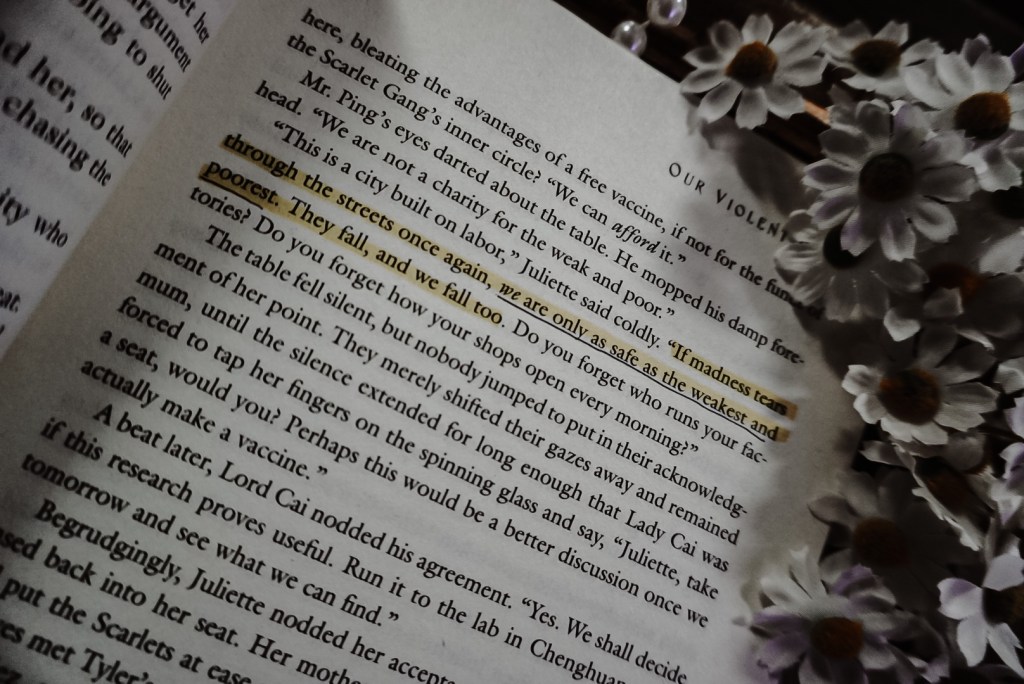
Love me, hate me
This goes along with my previous point, but I want to dig into Roma and Juliette a little further.
What I absolutely loved in this book was the role reversal of these two main characters.
At the end of These Violent Delights, Juliette made the same decision Roma had to when they were just kids. She chose to fake kill Marshall and claim to be using Roma in front of Tyler in order to save the White Flower heir’s life. She let him believe she was a monster after all the work he’d done to prove to her she wasn’t.
In return, we see Roma harden, just as Juliette hardened during her time in the U.S.
It’s such a fun dynamic shift to the story, because Roma was always characterized as the softer of the two protagonists. He is the one who convinced Juliette that they could write their own destinies and end the blood feud. We see the change right away with the novel opening with Roma attempting to take a shot at Juliette, establishing the tone moving forward.
Because of this shift, we see a struggle between the two that’s really interesting. It’s as if they’re both equally pulling for power while being held back by their previous feelings.
“So long as he hates me, we are safe. If we love again … this city may just kill us both for daring to hope.” (Juliette, 288)
Both of these characters have been hurt by the other in pursuit of something better. Because of this, they retreat into what they know — safety in their position as heirs and enemies.
When I tell you I was feral for all of the fight scenes, I mean it. I loved, loved, loved watching Roma — my sweet, lovable Roma — consistently go for Juliette’s throat but not being able to actually carry out the kill. In the same breath, I loved that Juliette had to find a way to both keep up her charade of indifference and keep herself and Roma alive.
They’re both convincing themselves that the other is not the person they see in front of them.
We get this moment of Juliette begging silently for Roma not to be so cold when they agree to work together again for the sake of the city: “Do not do this to me. I cannot stand seeing you like this. It will break me faster than the city ever could if it tried to cut us down together.” (Juliette, 108)
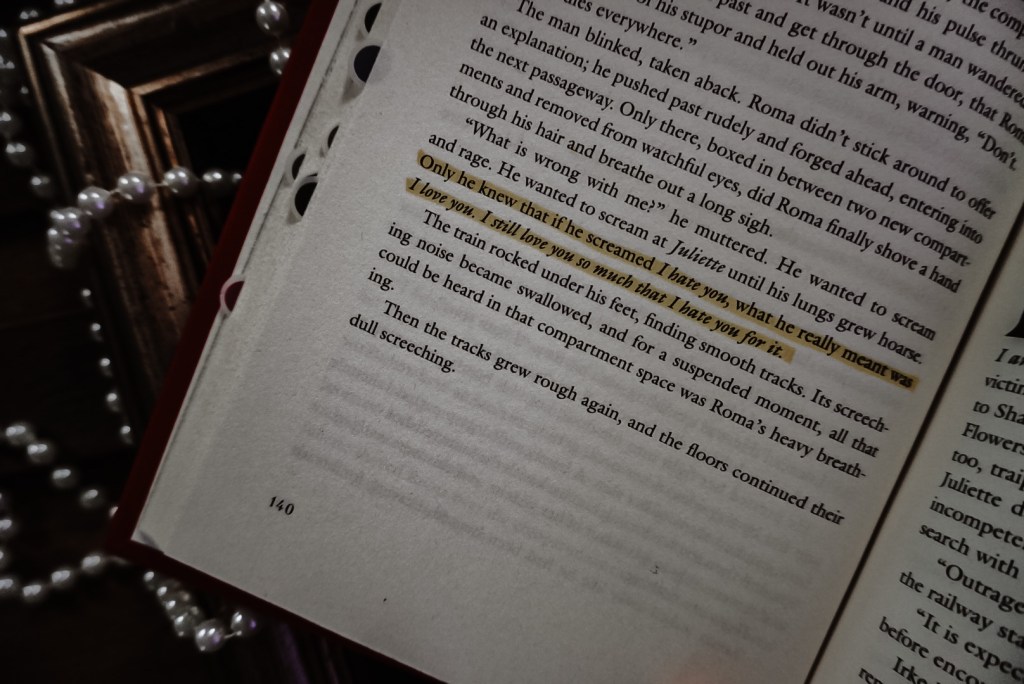
Meanwhile, Roma is repeatedly telling himself that Juliette, despite not making an attempt to hurt him, has actually gone cold with blood and hate.
“No matter how brightly she shone, Juliette’s heart had turned as charred as coal.” (53) and “He didn’t want the girl without the heart. He didn’t want Juliette without the love — love that wouldn’t cut. Love that wouldn’t destroy.” (163)
It’s tiring for both to uphold these images of themselves. It wears on them, chips at their facades until there’s nothing left. Within 10 pages of each other, both Roma and Juliette begin to crack.
First, Gong presents readers with this moment where Roma sees Rosalind and lets her go unharmed. He thinks that he should kill her to get back at Juliette, but can’t. He wants to get his revenge in a more honorable way — the duel.
“He had washed his hands with enough blood. He was tired of it. Tired of the smell that permeated into his sleep, tired of hating so deeply that it burned him from the inside out.” (293)
After Juliette shoots Tyler, she has this moment of trying to keep up her charade but also recognizing this is what she’s done for her entire life and it’s all for nothing.
“She lifted her chin and faked bravery, faked it like she faked every damn thing in her life — all to survive, and for what? To piece together some pathetic excuse of living surrounded by material goods and not a single shred of happiness.” (302)
This is the tipping point for the couple. It swings the dynamic back to what we saw before Juliette pulled the trigger on Marshall. The scales even out again as Roma strips down his exterior to remind Juliette why they fell in love in the first place.
“We live with the consequences of our choices. I know that better than anyone, Juliette. I am the only one in the entire damn city who feels exactly as you do.” (312)
There’s also a really cool moment where Juliette claims that she wishes they had been “born as other people” into “ordinary lives, untouched by a blood feud,” and Roma tells her that he does not because then they would not have met. It parallels the flashback Gong delivers in TVD where Juliette asks Roma if he ever wished to have a different name and he says yes, but she is hesitant because she could not imagine not being a Cai.
With that scene, the clock is reset. These two are now back at the beginning, but they are no longer kids looking to end the feud. They are adults looking to fight the fates chosen for them.
“I will fight this war to love you, Juliette Cai. I will fight this feud to have you, because it was this feud that gave you to me, twisted as it is, and now I will take you away from it.”
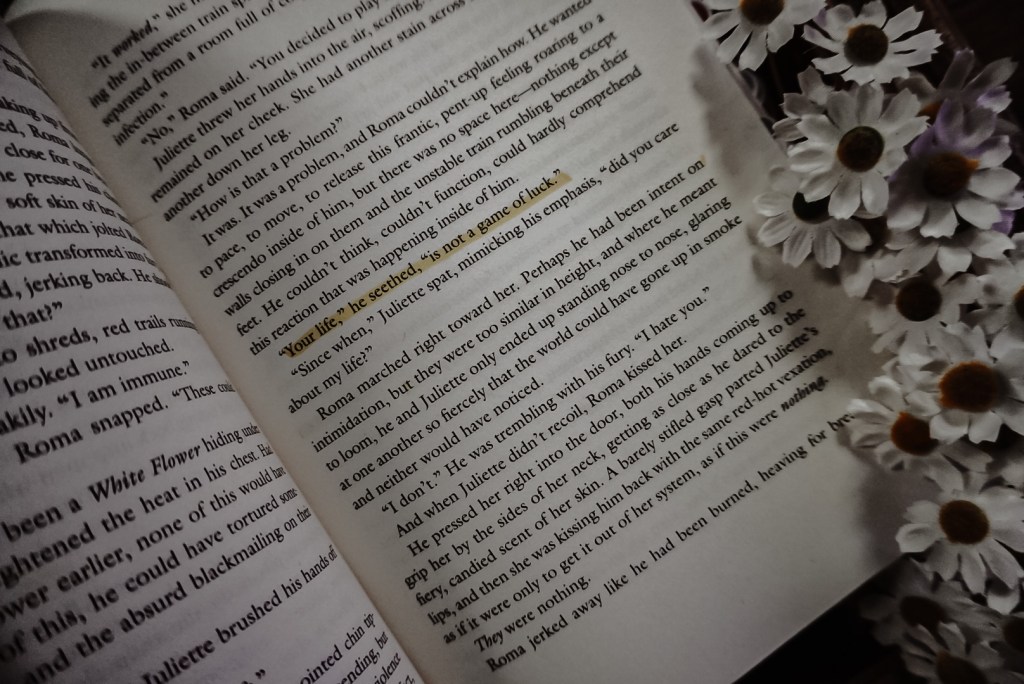
That ending though
This leads us to the ending that crushed my heart and soul into a fine powder.
Like every other person on the planet, I know how Romeo and Juliet ends. I know it’s a tragedy. I braced myself for tragedy, and, yet, this ending tore me to pieces.
Let’s kick off this sobbing fest with a very interesting quote from sweet Benedikt: “I would rather the two of you not burn the world down each time you choose each other.” (364)
Benedikt is right in his wish.
When Roma chooses to protect Juliette when they were 15 by giving the plan to bomb the servants’ house, not only do so many more Scarlet Gang members die, but Lady Montagov is murdered and the blood feud was ignited to a higher temperature.
Then again, after Juliette pulls the trigger on Marshall and lies through her teeth to protect Roma at the end of TVD, the feud gets bloodier and more serious as the city’s poison seeps deeper into the cracks they made.
Roma and Juliette had a dream of uniting their city and protecting their people, but they have repeatedly chosen to save the other no matter the cost.
It’s like the infamous trolley problem. Both our protagonists refuse to pull the lever, sacrificing many to save one. These two push and pull against this notion — of saving the city, their people and themselves. It’s a constant tug-of-war.
In TVD and at the beginning of the OVD, I felt as if Roma and Juliette realized that their city’s problems expanded past the blood feud. They both knew they needed to defeat the monster to stop the madness, and Juliette even wanted to disperse the vaccine to all of Shanghai rather than just to Scarlets. There’s even the underlying wariness of the Nationalists that walk into and out of the house and the Communists that Celia had been keeping tabs on.
But that falls away as the other problems get more intense. It’s like Roma and Juliette could only focus on what was specifically keeping them apart as their love intensified.
Even in Roma’s proposal, he mentions the blood feud when there’s way more pressing problems for them to deal with.
“Marry me, Juliette. Marry me so we can erase the blood feud between us and start utterly anew.” (Roma, 404)
What I was picking up was that the Nationalists, much like the Communists, just wanted the gangs gone. They worked with the Scarlets, because the Cais were willing to do so and it gave them numbers and a way into the city. Even during the ending, the Scarlet Gang members are the ones hiding within crowds to do the dirty work of the Nationalists.
If the White Flowers had taken up any offers from the Nationalists, the kill order would have been for the Cais instead of the Montagovs.
It was never about blood feuds. It was about power. Yet, it takes our protagonists 400 pages to see that, and by then it’s too late.
Gong even gives readers a version of the iconic, “A rose by any other name would smell as sweet,” moment from Romeo and Juliet to show the shifting of Roma and Juliette’s destructive tendencies.
“It is not as though my name is any better. … You can call a rose something else, but it remains yet a rose. … A rose is a rose, even by another name. But we choose together whether we will offer beauty to the world, or if we will use our thorns to sting.” (Roma, 406)
Unlike the other two examples I gave earlier, from this moment, Roma and Juliette decide how to protect themselves together rather than on their own. They acknowledge that they have blood on their hands and have made terrible choices, but they can move forward in a new direction as a united front.
Side note! There’s two more circumstances where Roma and Juliette’s judgement is clouded by love and anger and they almost do something stupid. When Roma believed Juliette died, he fled his house and was ready to blow up the Scarlet Mansion for revenge. Then, when Roma and Alisa are captured, Juliette nearly blows up herself and the mansion to punish her family and the Nationalists. I guess they didn’t fully learn.
This of course leads us to the destruction of my heart.
In the midst of blood and chaos, Roma and Juliette make their final decision. They have a choice to escape and live happily ever after on the run or to fight for the city they dreamed of bringing peace to. It’s at this moment that Juliette realizes she had been selfish in her wish to flee in the name of love after everything.
“But this was their love — violent and bloody. This city was their love. They couldn’t deny their upbringing as the heirs of Shanghai, as two pieces of a throne. What was left of their love if they rejected that? How could they live with themselves, look at each other, knowing they had been presented a choice and gone against who they were at their core?” (484)
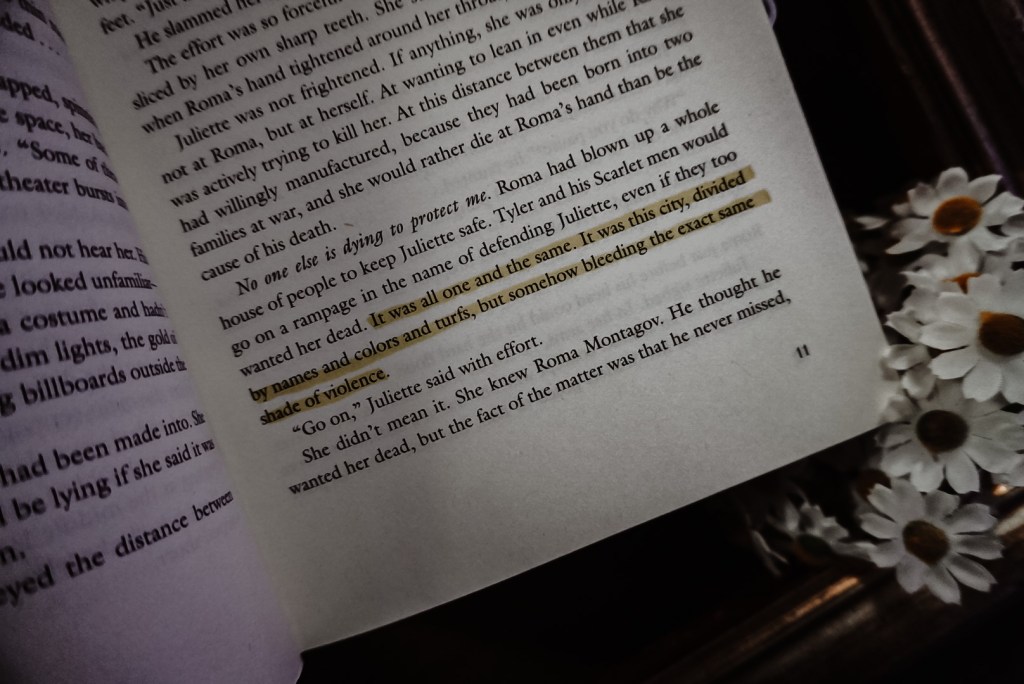
Roma and Juliette are physical embodiments of Shanghai. They are the city because the city shaped them into who they are. In choosing to throw the lighter, they choose the city over themselves in a physical sense, but it saves them in a spiritual one.
That’s because the spirit of their love lives on. The blood feud fizzles out as Lord Montagov goes into hiding and Lord Cai works under the Nationalists, but the city itself is not completely at peace — because the feud was just a byproduct of a city that was poisoned. However, the story of Roma and Juliette brings a sense of hope where there was only darkness.
“They speak of Roma Montagov and Juliette Cai as the ones who had dared to dream. And for that, in a city consumed by nightmares, they were cut down without mercy.” (490)
Seeing the response to their deaths, I have to wonder what would’ve happened if their love story came out sooner. What if Roma and Juliette, at 15 or at 19, stepped out as a united front with their dream of ending the feud? Would the city see that not even the heirs believed in the feud and it would die out? Or would the two heirs be executed or exiled for dreaming?
Is their message one that needed to be brought forth by something as final as death to show how committed they were?
(Also, shout out to Alisa for sending that forged marriage certificate out. She’s such a smart cookie, and I love her character.)
I’m a sucker for open-ended stories that keep me awake at night. Our Violent Delights positively ruined me with thoughts of whether or not Roma and Juliette were alive. The final chapter of this book is seriously top-tier storytelling on Gong’s part.
The detail of Roma and Juliette’s tombs having their birth names and not their chosen names was excellent in showing how the characters we met and learned to love aren’t the ones who died. Alisa not wanting to chase down the fishing boat because she couldn’t stand losing hope if it wasn’t them made me sob more. The thought that maybe, just maybe, Roma and Juliette escaped and are forging the life they always wanted but could never have, is the tissue I used to dab away my tears. Immaculate.
“But alongside everything there has to be love — eternal, undying, enduring.” (494)
*sobs*

I have to bring this up again
I love Gong’s writing. I’m obsessed with it. Positively and absolutely enamored by each and every word. The way she makes the city feel alive is just so fascinating to me. She mentions several times that the city itself was poisoned, and she really shows that and how it had seeped into the people.
Two quotes in particular stuck out to me. The first comes at the beginning of the book just before a monster strikes a White Flower cabaret:
“Everyone is here for the exact same reason. Some chance it with drunken stupor, pouring gasoline into their veins so that maybe, just maybe, something will ignite in an otherwise empty chest. …” (31)
This quote gives imagery to a group of people in such a grotesque, yet beautiful way. It makes them one with the city and how they’re a cog in the machine of the monster.
The second is when Benedikt runs into the blood feud fight despite Roma’s warnings, looking to avenge Marshall:
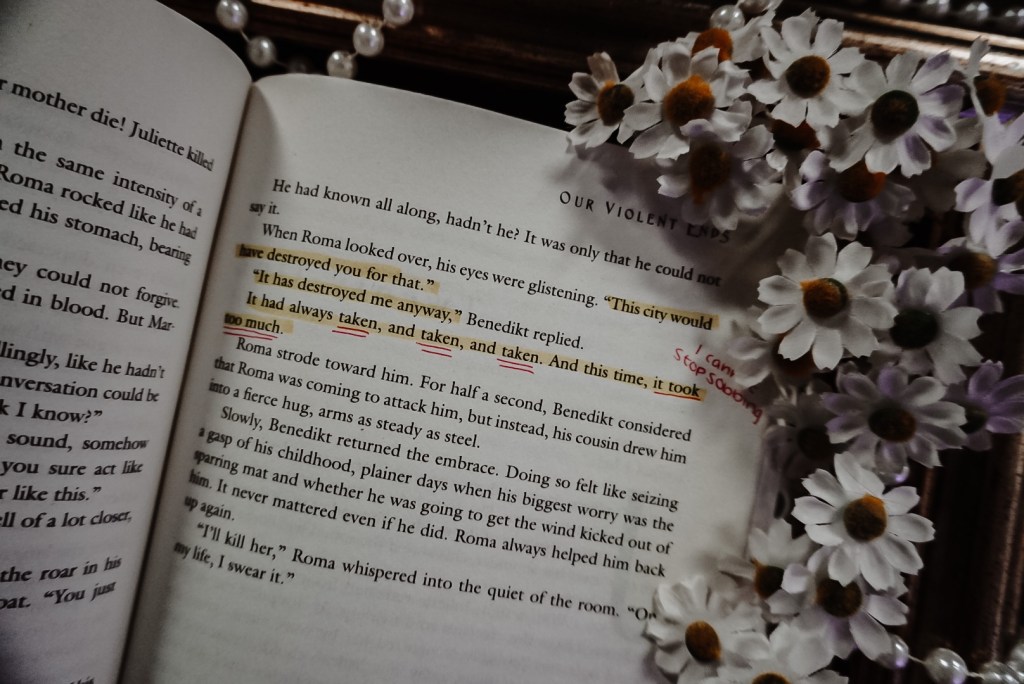
“It had always taken, and taken, and taken. And this time, it took too much.” (Benedikt, 197)
Much like the other quote, this internal thought from Benedikt shows perfectly how the city has broken the people as it was being fractured.
There’s also some neat scenes that I became absolutely obsessed with. The first is a form of parallel editing of sorts with Roma and Juliette.
After the attack at the White Flower cabaret, a letter arrives at both the White Flower and Scarlet Gang headquarters. Gong seamlessly goes back and forth between the views of both gangs, and it ends with Juliette finishing a sentence that Roma began in another part of the city.
“ Roma Montagove kicks a chair. ‘God—’
‘— dammnit,’ Juliette Cai finishes with a whisper, far across the city.” (33)
This happens again when the pair are staying at the whorehouse while investigating the monsters. Neither can sleep and, at one point, they each put their palm to the wall.
“Like twin statues reaching for each other, they both fell asleep at last.” (163)
I loved these scenes and how they showed both how Roma and Juliette were similar and how they had gotten physically and mentally closer as the story progressed.
Finally, there was a really interesting parallel I found toward the end of OVE. The scene where Juliette nearly uses the grenade to blow up her home while the Nationalists were downstairs having a party reminded me of the moment in These Violent Delights where Juliette saw the person dying of madness on the street while on her way to the masquerade ball.
It shows the disconnect between the gangs, the politicians and the people extremely well, and it showed a lot of character growth on Juliette’s part for seeing this and wanting to do something about it rather than ignore it to fulfill her duty as heir.
Brilliant.

Final Review
Our Violent Ends by Chloe Gong is a proper soul crusher.
It takes the age-old story of Romeo and Juliet and shatters it before piecing it back together in a totally unique way.
The relationship between Roma Montagov and Juliette Cai is an intoxicating rollercoaster of emotions, the greater plot is a commanding puzzle, the side characters are impactful and careful, the symbolism and themes made me feral, and the writing is simply exquisite.
OVE is a tragedy from start to end. As a reader, you can feel the tragedy bleeding through the pages. Yet, when the biggest tragedy strikes, you’re caught entirely off guard — not because you didn’t see it coming, but because you wanted to believe you didn’t.
It’s such a powerful story of loyalty and love, of power and fate, and of monsters and madness — both internal and external.
When I reviewed These Violent Delights, I said that it wasn’t a book that kept me up at night. Our Violent Ends will keep me up at night, thinking about a little fishing boat on a lake in a quiet, little town outside of Shanghai and the possibility of hope.
A perfect five-star read.




 Life of Bry
Leave a comment