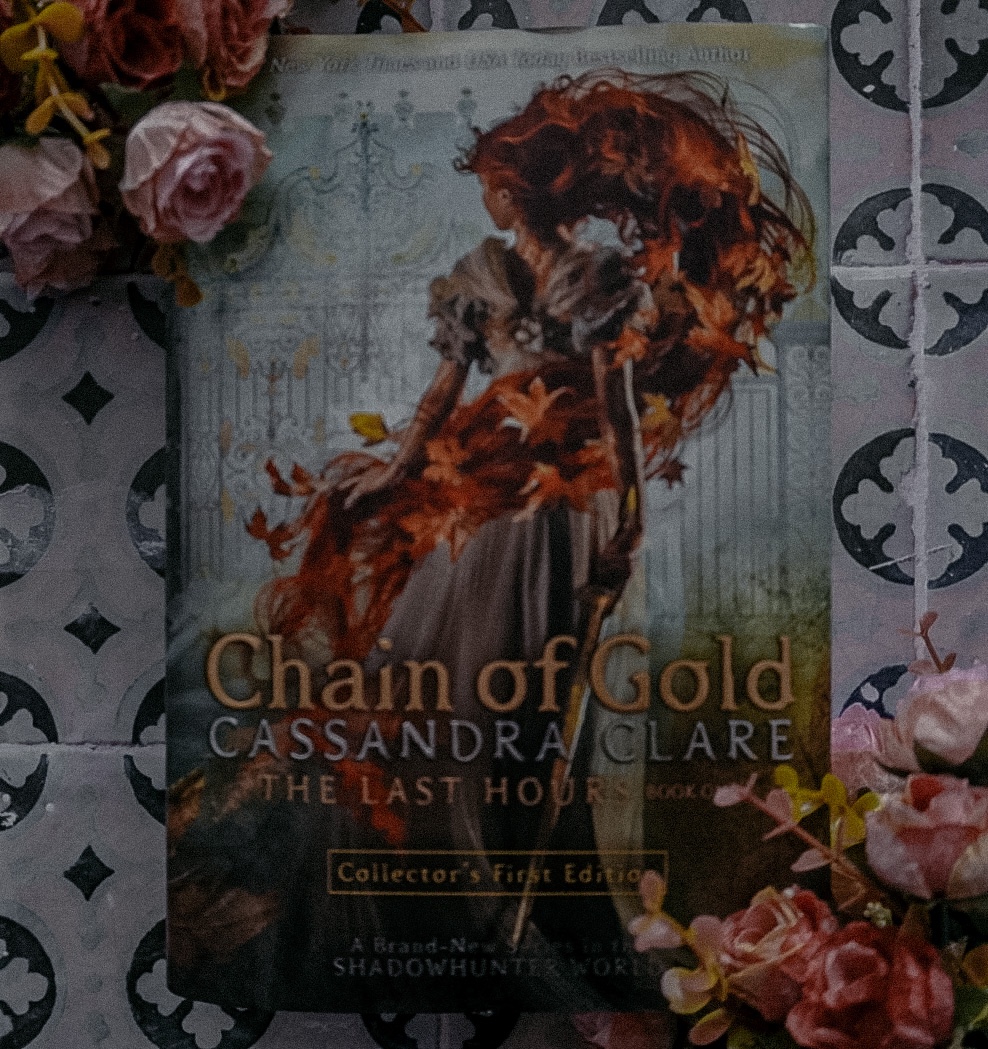
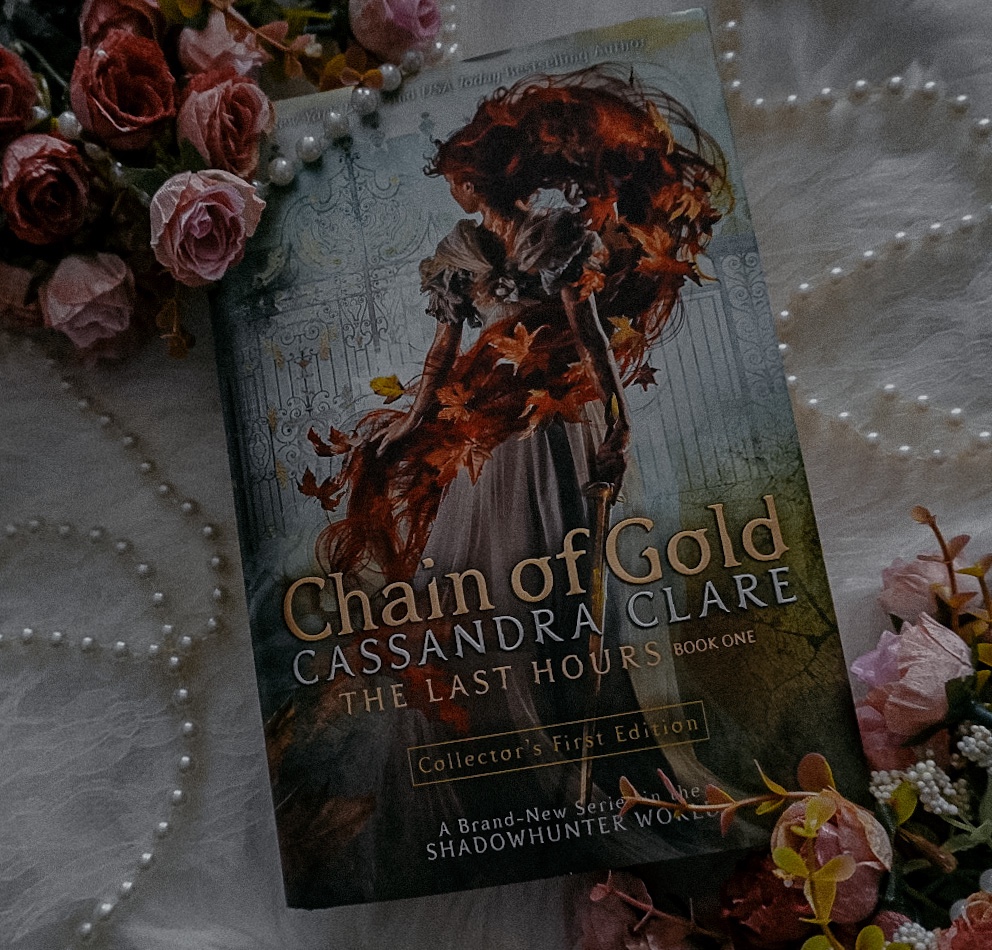
Analyzing book No. 1 in Cassandra Clare’s The Last Hours trilogy
“The broken heart. You think you will die, but you just keep living, day after day after terrible day.”
Great Expectations, Charles Dickens
OH MY GOD. OH MY GOD. OH MY GOD.
Chain of Gold by Cassandra Clare is what I like to call drama cocaine — addictive and deadly.
This first book of Clare’s The Last Hours trilogy follows a gang of teenaged Edwardian hooligans — the sons, daughters, and cousins of the characters readers fell in love with during The Infernal Devices — in a game of societal politics, secrecy and sinister magic. But these young Shadowhunters have been sheltered and left unprepared for the darkness that envelopes London in Chain of Gold.
The previous generation of Shadowhunters fought a war in the name of love. This generation is playing for power — whether they want to or not.
Here are all my thoughts on Chain of Gold. (Spoilers ahead!)
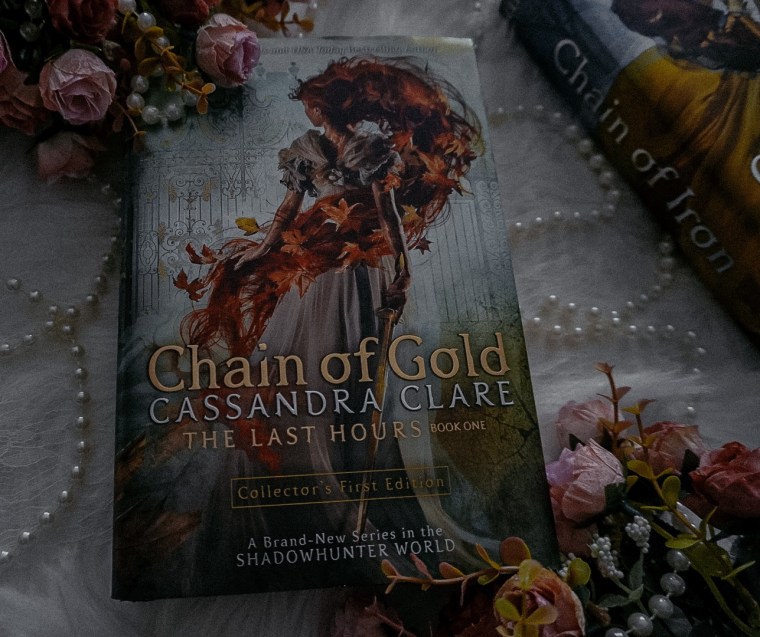
BOOK STUFF!
Let’s all take a moment to just applaud Cassandra Clare for growing as a writer.
When you read Chain of Gold compared to City of Bones or even Clockwork Angel, you can see a clear difference in the writing and construction of the novels. CoG is more put together, more polished, more precise and more concise. One would hope that an author’s 20th book is more well-written and developed than their first, but we’re here to give positive affirmations.
I truly believe Chain of Gold is a testament to Clare’s growth as an author.
The writing was just *chef’s kisses*.
A major issue I’ve had with Clare’s writing in the past is that it often felt inconsistent and awkward. The odd sentence structure would have me rereading a paragraph several times to understand the context. I didn’t do that a single time while reading Chain of Gold, which is even more impressive because I’m not a fan of historical fiction. Clare didn’t try to overcomplicate her writing to make this novel appear more sophisticated than it is. She kept it simple. This is still very much a story of a bunch of chaotic teenagers way in over their heads, using stubbornness and determination to save the day.
I also loved the way CoG was structured.
It swings between present day (London, 1903) to what Clare refers to as “Days Past”. These Days Past chapters give readers brief glimpses into moments that defined our characters growing up. It’s a great way to show readers rather than tell them about specific traits, feelings and instances that led to the current predicaments of both our protagonists and antagonists.
There’s the flashback of Cordelia Carstairs reading to James Herondale when he had scalding fever as a child, showing the foundation of their feelings for each other. Then, readers get a peak at how Alastair Carstairs changed upon arriving home after the Academy through the eyes of Cordelia, which shows that Alastair hadn’t always been cold and distant, he was forced to become that way to defeat his own bullies. There’s also the glimpse at Jesse Blackthorn’s death that gives context to how this young boy was desperate to become a true Shadowhunter and why Tatiana Blackthorn is more scorned toward the Nephilim since that unfortunate tragedy.
The Days Past chapters are brilliant in that they are always short so as to not take readers too far away from the current problems at hand. They aren’t even every other chapter. They’re thrown in when the situation calls for some context. It’s a wonderful addition to fill in details while still keeping the story flowing.
Finally, the plot of Chain of Gold exceeded my expectations the most.
I have said this in nearly every single one of my Shadowhunter analyses, and I’m going to say it again in this one. Clare gets away with subpar plots by creating incredibly fascinating characters that make you forget everything else that’s going on.
As much as The Infernal Devices tore me to pieces, it had the worst plot of any Shadowhunter series I’ve read. I’m not even sorry. It was trash. Now, The Dark Artifices had a great plot through two books that fizzled out toward the end of book No. 3 as the villains just disappeared, but Julian and Emma’s relationship saved the series.
The Last Hours has a lot of potential to be absolutely amazing with the plot Clare established in Chain of Gold. There’s a lot going on — so many characters all dealing with their own trauma, their own secrets, their own motivations and their own goals. However, there’s a good balance of these individual exploits and a common arc that they all travel along together.
Everything that’s happening is connected in some way, centered around our three big baddies: Tatiana, Grace and the Prince of Hell Belial. The strange demon attacks during daylight that leave Shadowhunters with a contagious disease, the shadow realm James finds himself in and the identity of his grandfather (the demoney one), the spite and bitterness of Tatiana toward Nephilim and how she roped her children into it, and the never-ending societal politics that turned this generation of Shadowhunters soft are all part of a larger plan.
I felt as if I was left GASPING at certain plot points, which is exactly what I want from a book. It was a great mix of intriguing mysteries and divulgent details.
One more thing!
I don’t think it’s super important, honestly, but The Last Hours is meant to be a very loose retelling of Great Expectations by Charles Dickens. I absolutely LOVE Great Expectations. It’s one of my favorite classic books (much better than A Tale of Two Cities, in my opinion), and my knowledge of it allows me to create theories on what’s going to happen moving forward.
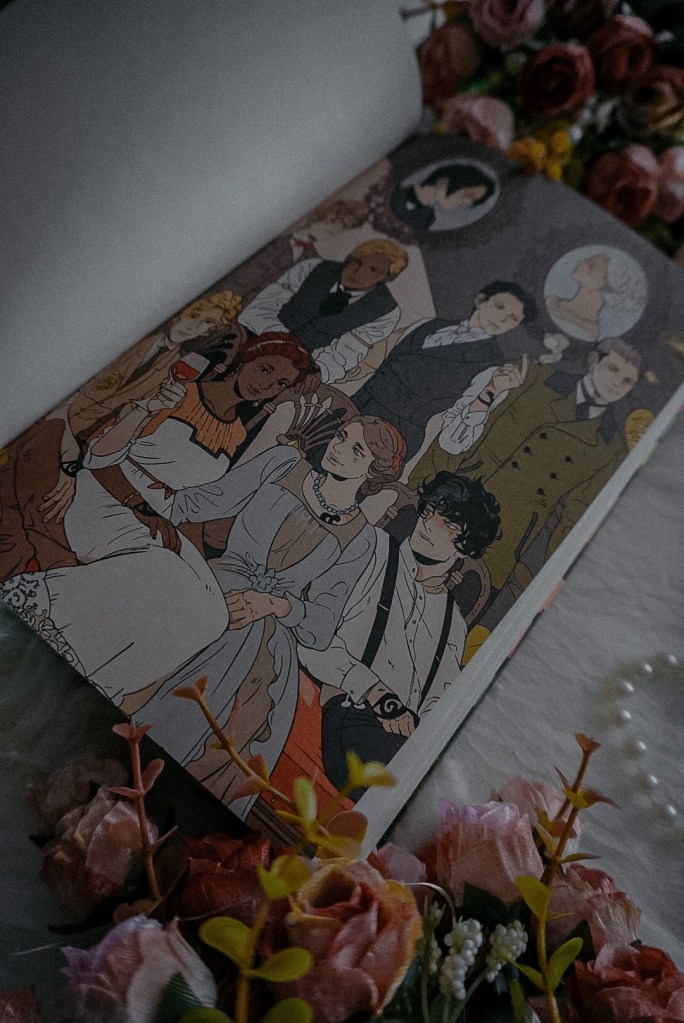
Clare has clearly set up James as the main character Pip, Grace is Estella and Cordelia is Biddy.
A QUICK RUNDOWN: In Great Expectations, Pip meets Estella, an orphan taken in by a wealthy family, when he is brought to their disastrous mansion by Estella’s adoptive mother with a clandestine agenda to have this girl break his heart (the mother was left at the altar or some shit on her wedding day and is salty). Estella is very cold but Pip is infatuated and spends his life trying to be the perfect gentleman for her.
After years of pining and being shot down, Pip decides he loves his childhood best friend, Biddy, and goes to propose to her. However, Biddy is already married … to Pip’s best friend/brother-in-law/father figure, Joe. Super awkward. They name a kid after Pip. It’s weird.
Now, there’s actually two different endings to Great Expectations, in the published editions, Pip finds Estella after the death of her abusive husband about a decade after the Biddy situation, and they essentially walk into the sunset holding hands. A major theme of the novel is Pip’s tendency to misjudge situations and it’s often disputed that the ending is merely Pip wishfully thinking he has a chance with Estella. But, it’s entirely up to the reader’s interpretation.
In Dickens’ original manuscript, Pip bumps into Estella in London. Her abusive husband did die, but she remarried. The hint toward a rekindling is completely extinguished and, instead, Pip finds solace in knowing Estella has become less cold and cruel despite her harsh upbringing.
With all this being said: If Clare continues to follow the course of Great Expectations, it looks like James is going to get cucked by his parabatai. Matthew Fairchild would be The Last Hours’ version of Joe. However, it seems too obvious for Clare to follow the outline exactly. It would take away the element of surprise, in my opinion. I do think that she’s going to use this parallel to give readers a genuine heart attack. She’s not above that. My biggest prediction for Chain of Iron is that Matthew will grow closer to Cordelia to tease the Biddy/Joe plotline of GE.
Clare always includes literary parallels (TID was A Tale of Two Cities, TMI was Paradise Lost and The Inferno, and TDA was Annabel Lee), but this is my favorite one yet. It was close enough to the original text that I could easily pick up on the similarities, while also having a fresh story. It also made me want to reread Great Expectations.
Here’s a few more quick correlations I made between the two texts:
- In CoG, Grace tells James: “My mother made me her blade, to cut every barrier raised against her.” In GE, Estella tells her mother: “I am what you designed me to be. I am your blade. You cannot now complain if you also feel the hurt.”
- Estella’s adoptive mother is Miss Havisham. When Pip arrives at their dilapidated mansion as a child, he notices that she wears a wedding dress everywhere because she was left at the altar and all the clocks in the house are stopped at the same time. In CoG, Lucie notices that all the clocks in Blackthorn Manor are stopped at 8:40 and Tatiana is often seen wearing the dress she wore the day her father and husband were killed.
- Much like how James is willing to do *nearly* anything for Grace, Pip devotes his life to becoming the perfect wealthy gentleman for Estella. He feels he has to change who he is to deserve her love — this reminds me a lot of how James turned into a Shadow to steal the bracelet for Grace despite not wanting to do it.
- Pip has a big heart, strong emotions and good intentions, which ends up making him an easy target for manipulation by Estella. Miss Havisham kind of uses Pip as a training for Estella. Sounds familiar.
People are dying, Charles!
“This is not an issue of love, but of ambition. … Love has no place in this plan.” (Matthew to James, 317)
A massive theme throughout Chain of Gold is power over love. This coincides with the plot device of emotions being used as a tool for manipulation.
Just as mundane society is evolving with the turn of the century, so are the Shadowhunters — not necessarily for the better. London has been unnaturally quiet as demon activity nearly comes to a standstill. This causes a few major cultural shifts in the Nephilim of the city — the first being that this generation of Shadowhunters is softer and less battle-hardened than the previous and the second being they now focus purely on finding power in politics rather than war glory.
A great example is how Charlotte Fairchild earned her position of Consul through her success and bravery in the Clockwork War, while Charles Fairchild believes he should be handed the position because he is her son.
The game of societal politics in CoG is honestly one of my favorite parts of the book. It seems frivolous for these Shadowhunters to be concerned with false marriages and personal propositions when they have a sacred duty to uphold. There’s a web of lies and secrets that make it feel as if they are all playing the same game of chess but on different boards. Simple communication could easily clear up a good portion of the protagonists’ problems in CoG, but what’s the fun in that?
It’s frustrating, but in a way you want a book to be frustrating.
Much like the mundanes around them, the Shadowhunters are building alliances among themselves through marriage.
Charles, AKA the biggest political slut in this book, is engaged to Ariadne Bridgestock, the daughter of the Inquisitor. The thing is, neither Charles nor Ariadne is straight. The marriage appears to be an understood political ruse between the two. While the whole situation feels slimy to begin with, it gets worse. While Ariadne is unconscious from demon poison, Charles calls off their engagement and commits himself to Grace Blackthorn.
“It was never a sign of your worth that Charles Fairchild wanted to marry you. It is a measure of his lack of worth that he chose to break it off in such a manner.” (Anna to Ariadne, 303)
Now … I was both pissed and confused by this situation. While the original engagement is sad and shady, it seemed like a mutual agreement that they could make their political advancements as a couple and have their affairs behind closed doors. It made strategic sense (don’t confuse me saying it makes sense with it being right. It’s not right.).
But why does Charles want to now align himself with Grace? James fell in love with Grace because she made him pity her and then trapped him with the bracelet. I don’t take Charles for a man that succumbs to emotional pleas, and Grace puts the bracelet back on James ruling out that magic.
What power does Grace give him in his bid for Consul? Is she blackmailing him? Did she use the bracelet on him, thinking her mother’s deal with Belial could be fulfilled with Charles instead of James? Of course Grace would go after the Consul’s son for the Clave’s protection against Tatiana. Once again, it makes strategic sense on her part. But what is Charles getting out of this besides a wife to cover up that he’s gay?
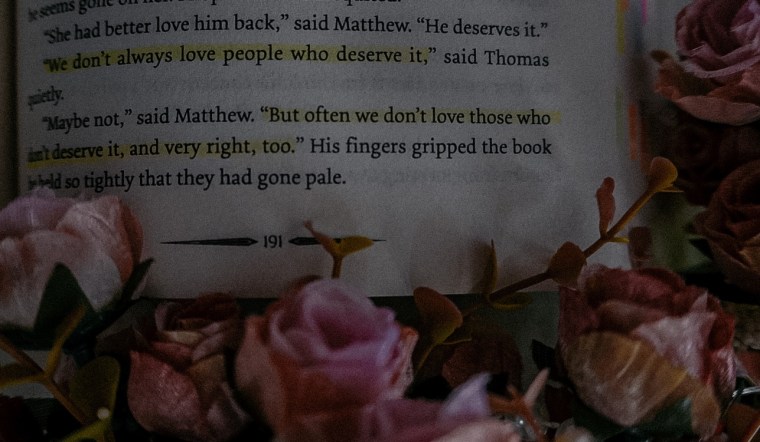
Charles was by far my least favorite character; HOWEVER, I think he did use his forced position of power to help in some ways. When Cordelia overhears Charles and her brother Alastair (they have a secret relationship), Alastair informs her that “everything Charles does is so he and I can be together”.
Much like Alec Lightwood’s goal in TMI/TDA, if Charles becomes Consul, he can change laws.
Perhaps Charles planned to make the changes necessary to ensure he and Alastair could live openly. The thing is, I think Charles is too much of a coward to do that. Charles is here to play the game by the rules already established; not bend, break and mold them to fight for what’s right like Alec did. I think Alastair saw that, as well, which is why he called things off at the end of Chain of Gold.
“I have realized that you will never care half as much for me — or for anyone — as for your career.” (Alastair to Charles, 560)
Side note! Why does Alastair have the most well-rounded character development so far? He starts off very detached and secretive in his pursuits, but then warms up and starts divulging all these things he kept hidden for so long, like Elias’ drinking problem and his sexuality. He tells off Charles, he’s happy that James stood up to marry Cordelia, he dyes his hair back to its original color because he’s no longer pretending to be someone he’s not, and he wants to make amends with the Merry Thieves. He’s the only character who actually communicates! It’s wonderful! But it’s also puzzling because he’s technically a side character. I’m not going to complain. I enjoy his character and want to see his growth continue (especially with Thomas).
Back to what Charles did right. When Alastair tells Cordelia that the charges were dropped against their father, he mentions that Sona’s pregnancy essentially gave them sympathy points. Nobody wants to tear apart a family. Since nobody outside the Carstairs’ home knew about the pregnancy, it’s safe to assume that Alastair told Charles, who relayed the message to Charlotte to help sway her decision.
Same goes for the leniency an otherwise cruel Clave showed Tatiana. If Grace had not been engaged to Charles, I don’t believe Tatiana would’ve been sent to the Adamant Citadel. She would’ve had her Marks stripped and been exiled. Or am I giving Charles too much credit and it’s Charlotte’s influence that deserves to be recognized for turning the tides of what is expected out of the Clave?
Charles does tell people Ariadne was the one who broke the engagement off to preserve her eligibility moving forward. That’s decent.
Good for Charles, I guess.
Charles is made out to be the “bad guy” for playing these political games, while the Merry Thieves and Co. are painted as purer, more honest people for leading with their hearts. However, James and Cordelia make their own marriage pact at the end of the book to save Cordelia from ruination.
What makes them any different than Charles and Ariadne or Grace?
We can argue that love is the difference. James proposes marriage because he genuinely cares about Cordelia. He doesn’t want her life destroyed because she saved him from the cruelty of the Law, much like how Cordelia is willing to ruin herself to protect James from punishment. They both act on their love for each other, rather than political advances, despite both benefiting from the arrangement.
James also wants Cordelia to be happy during their year of marriage and agrees to be faithful — two things I don’t believe Charles cares about in his pseudo-relationships.
I really enjoyed this parallel by Clare. It makes the reader question themselves and their prior opinions. I spent 500 pages calling Charles a political slut because of his fake marriage propositions, but then I immediately started to justify James and Cordelia’s arrangement the second that Herondale took a knee. It forces you to sit back and assess everything you’ve already read, and it softened me to Charles a bit. I could better see why he chose to make these proposals.
It’s clever writing, and an A-plus plot device to drive the story forward that also fits the theme of the book.
What’s in a name?
After reading The Eldest Curses, it was a little overwhelming to get so many POVs in The Last Hours. Much like TDA, there’s just SO MANY CHARACTERS. Per usual, though, Clare does a phenomenal job at crafting this fleet of characters so that they steal your heart and they all have distinct voices and insights.
James Herondale and Cordelia Carstairs are technically our two main characters, so I’ll focus primarily on their story arcs. HOWEVER, I have a great deal to say about Matthew Fairchild and how he stole my heart and made me weep for simply existing. We’ll get to that.
The Shadow World’s Sweetest Cinnamon Roll
James is the son of Will and Tessa Herondale (WHY AM I CRYING JUST TYPING THAT?). He’s a quiet leader, a book nerd like his parents and undoubtedly the sweetest cinnamon roll in the Shadow World. However, his upbringing of love and patience has left him naive and open for manipulation.
“He himself was like his father in that way: they both loved intensely, and could be intensely hurt.” (278)
It couldn’t have been a coincidence that Tatianna chose to ask James to cut the briars around Blackthorn Manor the same night his grandparents died. Tessa and Will were distracted and overcome with grief, leaving James feeling helpless and unsupervised. He was emotionally raw, which made him an easy target.
I’m going to discuss Grace as a villain later, so I’m not going to go into detail about her quite yet. Right now, I think it’s only important to showcase how both she and Tatiana used James’ deep emotions from the very beginning. It sets the tone of James’ character.
Like so many of these characters, James is a product of his home environment. I loved that he was equal parts Tessa with her stubborn bravery, Will with his noble need to leap into danger and Jem with his quiet confidence. It made my heart warm to know how much of an impact Jem had on Wessa’s children.
James’ parents and Uncle Jem taught him to see the best in people even when they don’t deserve it and to feel deeply and passionately. They did not prepare him for people who would use that against him — which is exactly what Magnus predicted in The Bane Chronicles.
“Tessa, Will, and Jem had raised James in love, and had surrounded him with love and the goodness it could produce. But they had given him no armor against the evil. They had wrapped his heart in silks and velvet, and then he had given it to Grace Blackthorn, and she had spun for it a cage of razor wire and broken glass, burned it to bits, and blown away the remains, another layer of ashes in this place of beautiful horrors.” (“The Midnight Heir”)
It was such a great (but sad) full-circle moment to realize that the reason James was so distraught in “The Midnight Heir” when Magnus found him was because Grace had called off their relationship briefly. It’s a subtle nod to those who read the novella collection and a way to show both the toxicity of their relationship and how James doesn’t really have a lot of control over his emotions.
This lack of control is a huge plot point in James’ character development, because he’s always been sort of fighting for control. Since discovering his unique powers at the Academy, James has been training with Jem to stop the sudden falls into the shadow realm. I think it was a disservice to James that they focused primarily on preventing the act rather than being able to wield that power to his advantage. To me, it felt as if this strategy only fed into James’ thoughts that this ability damned him despite his family telling him otherwise.
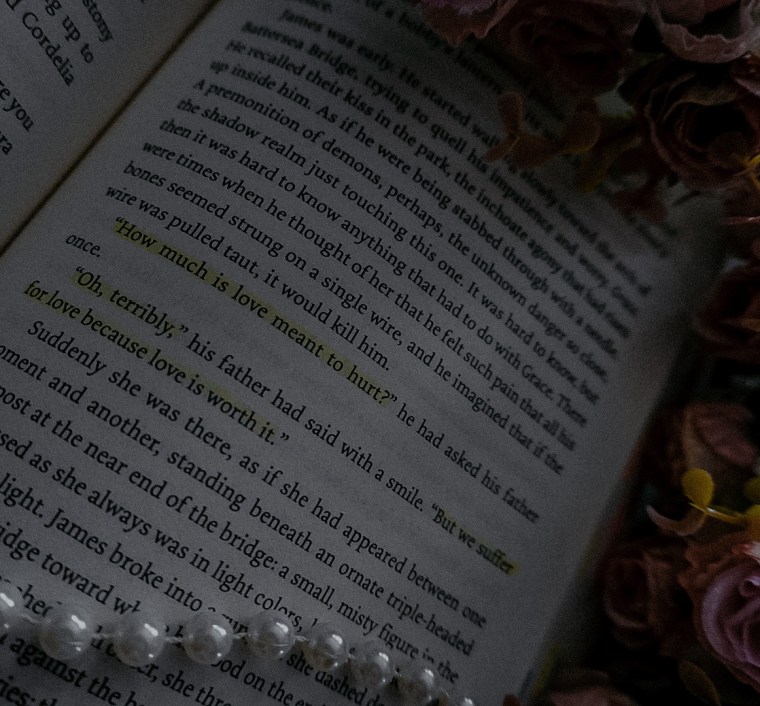
It also opened him up to even more manipulation by Grace. James turns into a shadow to retrieve Grace’s bracelet from Tatiana because this girl is the only one who shows him how his ability can be helpful instead of hurtful. This also shows how, even before the bracelet is put on his wrist, James struggled to control his deep emotions. (He’s a teenager! And a Herondale! Those feelings are all willie nillie!)
James is fighting for control between these two sides of him: the one who’s a devoted Shadowhunter from a noble family and the other that derives from Hell and reaps darkness. In general, I enjoy seeing these dueling personalities and how it adds to James’ development because, like Jem says in the quote below, nobody who genuinely knows James would look at him and see anything but goodness.
“You are the flame that cannot be put out. You are the star that cannot be lost. You are who you have always been, and that is enough and more than enough. Anyone who looks at you and sees darkness is blind.” (Jem to James, 280)
This doesn’t take away from the fact that James does have demon blood — powerful demon blood, as we find out in Chain of Gold. The demons that attack London recognize James, they tell him he’s one of them, and they even say he’s the cause of all the blood and death. They give James an ultimatum to succumb to the darkness inside him or allow more people to die.
We’ve seen this trope delivered in a variety of ways throughout The Shadowhunter Chronicles.
Jace believed Valentine injected him with demon blood in City of Glass and saw himself as a monster because of it (yuck, just thought about the “your my sister” quote from the Wayland Manor scene and threw up a little). Then, there’s Magnus, who also had to come to terms with his demon heritage and how it affected his humanity.
And, finally, my favorite TSC boy: Julian Blackthorn. While Jules never had a demon blood arc, he did have a dark side that he fought with throughout TDA. Unlike James, Julian fully gave into the darkness. He did whatever he had to do to protect his family. He lied, he manipulated and he killed because he had to.
James doesn’t give into that darkness inside him, and I think that’s because he’s put in a position of privilege to do so. This Herondale boy has a loving family and devoted friends to take care of him, to remind him of who he is and to pull him from the shadows. For so long, Julian didn’t have that. He was a teenager with the weight of a family on his shoulders, and, if he didn’t feed into that darkness, he would’ve watched his family be torn apart even more than they already were.
What does James lose for choosing not to side with Belial? Nothing.
(OK, he nearly lost his life, but Cordelia showed up just in time and Jesse was a real G — so he didn’t lose anything.)
The battle with Belial was a turning point for James as a character. He’s dying from demon poison and trapped in this shadow realm with a literal prince of Hell, but he uses the tools Jem taught him to channel his emotions and bend the realm to his will to defeat the Mandikhor.
Belial tells James: “Resist the devil, and he will flee from you.”
It’s part of the Bible verse James 4:7. “Submit yourselves therefore to God. Resist the devil, and he will flee from you.”
At base value, it appears as if Belial is simply relating this verse to James’ personal choice between his demon and angel heritages. However, with a little more context, it gives a deeper meaning to the story at large.
James 4:1-12 deals with the prophet James confronting the many problems believers have with the teachings of the church. He tells them that it isn’t the church that is problematic and causing them strife, it’s them. They are creating issues by falling victim to their own desires — lust, hatred, envy, selfishness, etc. (God isn’t answering your prayers because you’re praying for money and that’s totally not cool.)
The solution to all their woes is to give themselves fully over to God and to be an active resistor of evil — don’t forget the devil exists, but fight him relentlessly.
I’m geeking out over the symbolism of this single line.
As James rises to his feet against Belial with the sand swirling around him, it’s the boy embracing this dark side of himself and using it to actively deny the Prince of Hell standing before him. He’s no longer pretending this power doesn’t exist, he must stare it in the face and choose to use it for good, to accept that it’s a part of who he is and give himself over to his sacred duty as one of the Angel’s soldiers in the endless war against demons.
It’s a tipping point for James who has spent the last several years fearful of the shadows.
It’s also a nod to the overall plot of the book. The Shadowhunters are their own undoing. They have turned their backs on their divine duty to fiddle with politics and indulge in selfish endeavors, and they are now suffering because of it. The quietness of the last years have made these Nephilim forget that evil existed.
Man … I just loved the little details of this book.
I hope we see more of these glimpses of DARK! James. I think this is only a teaser of what he’s capable of. I never want to see him tip the scales like Julian in TDA (I don’t think that’s his personality), but I do want to see him really lean into what he can do and use it for good. I think it will make him a more interesting character overall.
After the fight with Belial, James was still dying but ghost Jesse Blackthorn (OMG I LOVE HIM) gave his last breath to revive a boy who should be his enemy. This is a reflection of a rebirth for James. He is brought back from the brink of death with new lessons on who he is and who he wants to be. He practically tells Cordelia he loves her when he remembers her favorite story and suggests they read it together. He feels more confident and sure of himself. Near-death situations do that to a man.
But then Grace puts the bracelet back on him, and he takes three steps backward into his old destructive ways.
Grace lured him back in once again with pity. She drops her knees in front of him and begs for his help because she knows he’s too noble to deny her. She has to play his emotions before she can slap that band on him to gain control. Then, he’s all too happy to run off to Idris to destroy an automaton that’s a clear setup so Tatiana can frame James.
However, I think the bracelet isn’t as strong as it once was because of the experiences James has had and his growing feelings for Cordelia.
Cordelia calls this state that James is in the Mask. She notices that sometimes the Mask falls, and he’s himself again. These slips of the Mask often come when the two of them share something special or emotional: when he saves her life in a burning Blackthorn Manor, when he tells Will and Tessa about their proposal and when they’re dancing at their engagement party.
These instances, along with seeing James able to fight back his emotions for Grace at the engagement party so he would not be even a tiny bit unfaithful to Cordelia, tells me that this bracelet might not be entirely effective anymore. I think we’re going to eventually see love conquer magic.
I’m interested in how Clare is going to direct James going forward. How will he react when he finds out about the bracelet’s powers? His feelings for the past four years have been manipulated. That has to give you a bit of an existential crisis. Also where do you take him past that discovery? Because, right now, I just don’t know what you can do with James.
As much as I love him for his innate goodness (much like how I felt about Jem), I just don’t get main character energy from him. He’s not flashy, boisterous and outwardly witty like Will or even Matthew. He’s quiet, caring, thoughtful and clever. He’s not your stereotypical leader (similar to Julian) or hero. Maybe that’s his appeal?
Unless this boy starts dabbling more with his shadow powers, I don’t think he’ll even crack my top 10 list of favorite Shadowhunter characters.
You got work to do, Cassandra Clare.
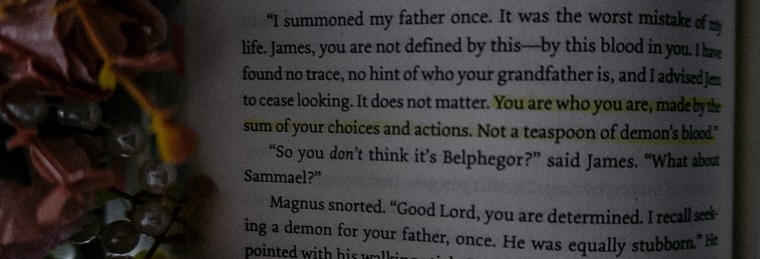
Cordelia is a QUEEN
This section took me the longest to write.
I sat sifting through my notes, paging through my book and staring at a blank Google Doc just trying to find the right words to describe what Cordelia Carstairs’ story meant to me. I wanted it to sound poetic, for my words to do such a pivotal character justice, to relay to you how Cordelia’s bravery and stubbornness and faith in love and justness made me emotional.
I just can’t do it. Instead, I’ll keep it simple with one sentence:
Cordelia is the heroine I wish I had when I was 16.
When I was in high school, it was the height of the YA literature renaissance. We’re talking The Hunger Games, Twilight, Divergent, The Maze Runner, etc. All these series were gaining traction, getting movie deals and changing the publishing industry. But, I remember reading these books and wishing more for the female protagonists — more substance, more emotion, more action and more deserving, equal love interest.
It felt as if young women had two options: you could either be defenseless, meek and bland like Bella Swan, waiting for a vampire to save you from your boring life, or you could be cold and callous like Katniss Everdeen, forced into love as you fought for your life. You couldn’t be strong and delicate. You couldn’t believe in love and be able to cut down your enemies.You couldn’t be an equal partner to the one you loved most.
Cordelia gave me what I wanted.
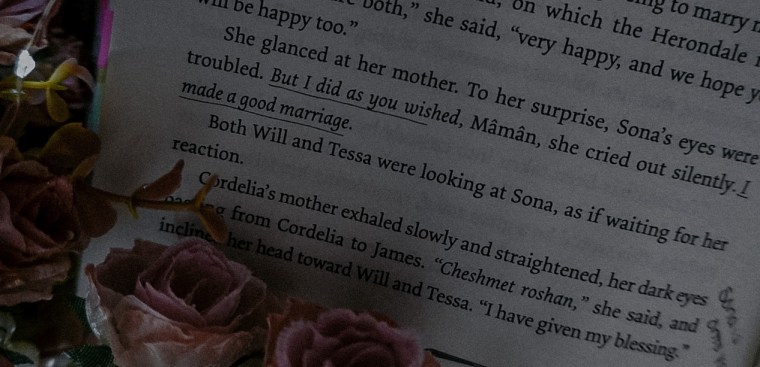
She’s strong, fierce and intelligent, but she’s also warm, kind and loving. She arrives in London with a mission to save her family name and free her father from what she believes is an unjust trial. While her mother hopes to marry her off to do this, Cordelia is set on using her wits to make powerful allies to aid her.
“She would solve this with cleverness and bravery — not with the sale of herself as a bride.” (34)
My favorite character trait of Cordelia’s was this intrinsic stubbornness she always held. She knows what is expected of her from her family and society as a woman, but she’s also not afraid to cast away those expectations to do what’s right.
We see this happen in a few ways: she’s the one who cuts Barbara’s corset open to allow the eldest Lightwood sister to breathe, she crawls into bed with a sick James when they were children to warm him up and pull him from the shadows, and she ruins herself in front of the Enclave to protect James from being punished.
Unlike James, Cordelia always felt to me to have an understanding of who she was and what she felt, but that her self-image and emotions were impeded upon by the standards and perception of women at the time.
In the Days Past chapter where Elias Carstairs chose which one of his children would inherit Cortana, Cordelia proclaims that she’s worthy of the sword because she wants to be a “merciful hero”. However, Elias still chose Alastair purely because of his argument that Cortana is a Carstairs family sword and Cordelia’s children will have a different last name due to her expectation to be married. Thankfully Cortana can choose its own bearer, and she loves strong women.
Cordelia’s perspective gives a different take on the Shadow World than the other young Nephilim she befriends.
As I mentioned earlier, there’s a privilege that our main group of protagonists share.
James and the rest of the Merry Thieves, along with Anna and Lucie, grew up in stable homes in London with wealthy families and their tight-knit group of friends. While they all battle their own personal strifes, they are, and have always been, surrounded by love, support and people who hold positions of power.
The Carstairs family was always on the move, never staying in one city for too long. Cordelia didn’t have many friends outside of the Herondales, Elias kept them from seeing their cousin Jem, and she often felt lonely and isolated. With Elias on trial, they are cutting corners to save money in case he is imprisoned or worse.
All these reasons are why Cordelia is so adamant to make alliances among the London Shadowhunters. She recognizes that her friendship with the Herondale children is an advantage, she asks Matthew to put a word in to his mother (the Consul) to use the Mortal Sword on her father, even Alastair convinces Sona that Anna is a powerful friend to make because of her popularity among the younger generation and who her parents are.
This is what separates Cordelia from Lucie and Anna, who never seemed concerned to marry for love or for politics. They don’t need to be concerned. They’ve been put in positions where their family status did not make it a focus like Lucie or it allowed for them to shun the idea entirely like Anna. It’s also a way to connect Cordelia and Grace, who grew up in an abusive home and sought marriage for protection.
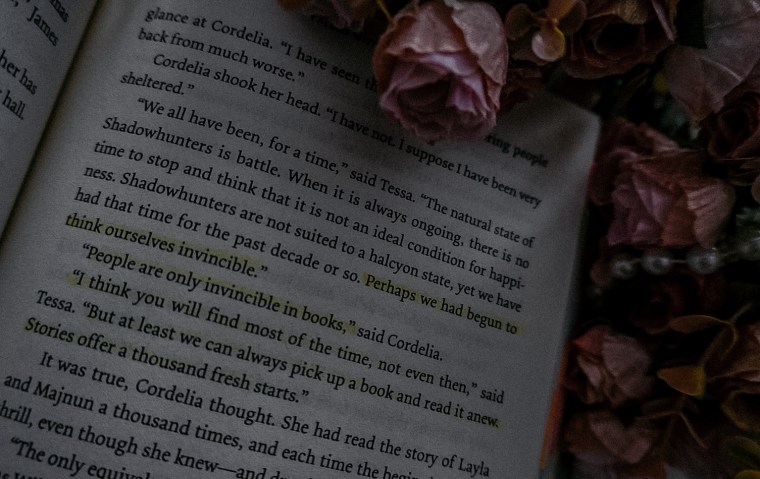
I never thought our group of friends flaunted their privilege.
Like most, I don’t believe they recognize it because it is the only life they’ve ever known. Plus, they often use it in meaningful ways (Matthew does send a letter to his mother on behalf of Cordelia, Anna makes important connections in the Down World, Christopher and Thomas use Henry Branwell’s lab to make the antidote). Privilege isn’t necessarily a bad thing and it doesn’t mean your life is perfect, but it is important to recognize it and understand how your life experiences differ from another simply for where, when, how and to whom you were born.
Side note! No one understands the divide more than Alastair, who has served as Cordelia’s protector his entire life. It’s easy to paint Alastair as a villain for all the pain he’s caused Matthew and James at the Academy, but I LOVED his character. I don’t blame him for being weary about Cordelia befriending the Merry Thieves. Their privilege gives them power to hurt her, and she’s naive to what people are capable of because he protected her from the harshest realities of their life.
Their sibling bond is honestly one of the best and most accurate that I’ve seen portrayed in a book. I love how Alastair would be pissed at her and then immediately huff and break out the “Layla” with the utmost concern and love. Accurate.
Everything comes crashing down on Cordelia when Alastair opens up about everything he and their mother hid from her about their father, creating a defining moment for our heroine.
Elias is an alcoholic, but Alastair went out of his way to hide it from his little sister so that she could have a childhood. Essentially, all of the work Cordelia has done in London was in vain because Elias is guilty — he was drunk and his incompetence allowed his fellow Shadowhunters to be hurt. Sona wanted to marry off Cordelia, not to save the family, but to make sure her husband’s mistakes didn’t affect the life of their daughter.
It’s how Cordelia reacts to this moment that defines her character.
She could easily be bitter and angry at her mother and brother for lying to her and allowing her to pursue this fake dream of saving Elias. I wouldn’t have blamed her for questioning who she was and who she wanted to be moving forward. But that’s not who Cordelia is.
While she does feel a little sad that her mother and brother held this secret and guilty that she didn’t pick up on the clues, her belief in herself and the ability to do what is right doesn’t wane. She has compassion toward her father who she now wants to get help, she cuts through the gateway and stabs Belial to save James, she pulls Matthew through the portal when they see Blackthorn Manor on fire, she stands up to give James an alibi when she realizes he won’t defend himself against Tatiana and Grace.
Cordelia simply has a new definition of what it means to be a hero.
“It was only in stories that heroes were rewarded; in real life, acts of heroism went unrewarded, or were punished, and the world turned on as it always had.” (544)
She knows how cruel the world can be, that heroics don’t mean the world stops to applaud your bravery. Sometimes you do the right thing, you get what you want and you save the day, but you still hurt.
The charges against Elias are dismissed, she’s proclaimed a hero in defeating the manticore demon, she has a group of loyal friends and she ends up engaged to the boys she’s loved all her life — but it all felt like a sham because of the secrets they shared.
“For a year, she would stand close to the fire and know what it was like to burn.” (578)
I loved that Clare chose to not have Cordelia entirely alter her personality with this life-changing information about her father. I feel like most YA heroines get trapped inside a box of not being in control of their emotions and being finicky with who they are (it’s a stereotype that girls can’t make up their mind *eyeroll and EW*). You do not have to change your identity when your perspective changes. You can adapt to the world while remaining true to yourself.
It was refreshing to see a female character take on new information and only become more sure of themselves, just like how it’s nice to see a very emotionally raw boy who struggles with his feelings. It reminds me a lot of Julian and Emma and how Clare swapped gender stereotypes by giving us a boy who was soft and domestic and a girl who was a bit aggressive and violent. *sighs* I miss them.
Another similarity I saw between James and Cordelia and Julian and Emma was the equality and respect they share. There’s a moment in Queen of Air and Darkness where Emma is in tears as she tells Julian how she loved him because he never second-guessed having a girl as a parabatai and that he never made her feel weaker to make himself feel stronger.
James and Cordelia never tell this to each other (which isn’t saying much because they don’t tell each other a lot of important things), but we see this same respect in their actions. While Grace always asks James to do things for her (get the bracelet, run away and marry her, destroy the automaton, etc), Cordelia stands up as an equal partner (she fights Belial and the demons on the bridge with him).
The best example is when James tells his parents and Sona about their engagement:
“‘Enough!’ James moved protectively in front of Cordelia, but Cordelia stepped forward to stand next to him. They should face trouble side by side. If their agreement meant nothing else, it should mean that.” (548)
Also, I enjoyed the repetitive detail of Cordelia pulling James from the darkness. When he’s in the shadows, he always sees Cordelia and Cortana gleaming gold in her hands and she brings him back to the mortal world — this comes to a head when Cordelia actually shows up in the shadow realm as James faces Belial. When Grace put the bracelet back on James, he sees Cordelia back away from him and cover her face with her hands, symbolizing how all these emotions he just began to understand are now out of his reach and Cordelia will now never see how he truly feels about her.
There was so much great symbolism in this book!
I’m not sure how I feel about James and Cordelia as a couple. On one hand, I think they’re perfect for each other. They’re both book nerds, both kind and good hearted, both stubborn and brave, both so intelligent yet so clueless. They’re childhood best friends! They’re a Herondale and a Carstairs!
Maybe that’s why I’m so on the fence about whether or not I want Jordelia to be endgame. It almost seems too good to be true. An evil part of me wants James to not get the girl just to mix things up. Sorry for even putting that out into the world. (But we know that Jace Herondale is a direct descendant of Will, so James has to eventually have a child with someone.)
However, I don’t think Clare will give me that. I do think that Cordelia will become closer to Matthew and accept that what she has with James will never be real, all while James slowly starts realizing that he actually does love Cordelia. Things are about to get messy. (Wait, didn’t we already get the whole “parabatai fall in love with the same girl” plot device? Ugh. Clare better find a way to mix this up or that’s super lazy writing on her part.)
To wrap up James and Cordelia’s arc, Clare does what she does best in making what looks like a happy ending feel like a tragedy:
“Love had found her years ago, and now, and every day since she had first seen James in London. You don’t love me, he’d said to her. He had no idea. He never would.” (547)
These two belong together, but not like this. It wasn’t supposed to happen like this.
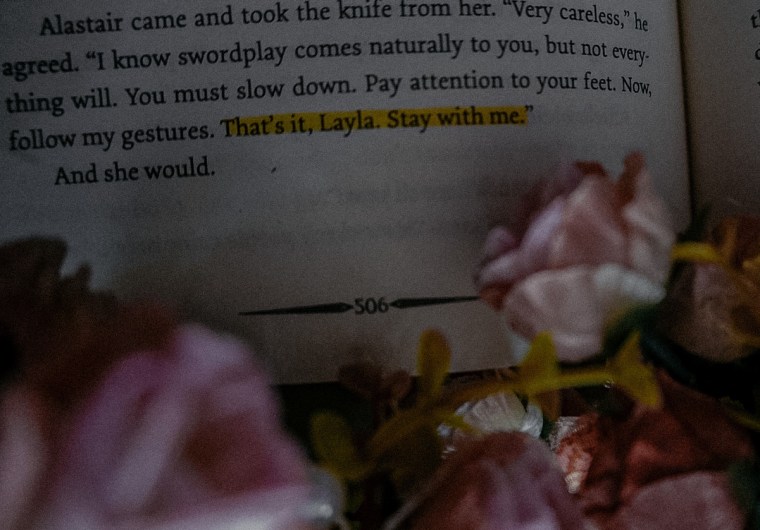
The world failed Matthew Fairchild, and I’m ready to throw down
I didn’t care much for Matthew Fairchild in Tales from the Shadowhunter Academy, but I warmed up to him in Ghosts of the Shadow Market. In Chain of Gold, I fell head over heels in love with him and have sworn my life to protect him at all costs.
To put it bluntly, Matthew is a functioning alcoholic.
We learned in GoTSM, that rumors spread by one Alastair Carstairs about Charlotte having an affair to conceive Matthew, led the young boy to buy a truth serum at the London Shadow Market. Only it was poison instead of truth serum, and it caused Charlotte to have a miscarriage and to nearly lose her own life, as well.
Matthew kept his involvement a secret, turning to the bottle to drown out the pain of believing he’s a murderer.
First off, if you didn’t read GoTSM, you don’t know what Matthew did to cause himself so much strife. I thought it was strange for Clare not to give new readers that knowledge, since novellas are meant to be additional texts and not essential to the overall story — but knowing why Matthew drinks his days away is ESSENTIAL CONTEXT.
Matthew reminded me so much of our favorite warlock, Magnus Bane. He hides his pain under elaborate waist coats, an easygoing and amusing personality and a good bit of alcohol. It hurts a little more to see Matthew be so self destructive. He’s not immortal. He doesn’t have hundreds of years to figure out that his life is not defined by a mistake he made at 15 and that he does not have to bear the weight of his sins alone.
My favorite description of Matthew came from Hypatia Vex.
“You are a child — a silly and beautiful child, who touches the fire because it is lovely, and forgets that it will burn him.” (225)
Matthew drinks and lives a libertine lifestyle because he thinks the glitz and glamour of parties and exploits will soothe the suffering of his soul. But he doesn’t recognize how this life will one day catch up to him … it will hurt him even more.
The entirety of Chain of Gold, I just wanted to cup Matthew’s face in my hands and whisper to him that he was worthy of life, of love, of happiness.
It was equally frustrating and heartbreaking to see Matthew spiral, but I also could understand why he felt the way he did. Everyone around him repeatedly failed him — his parents, his brother, his parabatai, his friends, and even Jem. All these people failed to protect Matthew who never failed to protect them.
I don’t have much of an opinion on Charlotte, to be honest.
However, I think she hasn’t exactly been there for her children because of her position as Consul. Nope, we’re not mom-shaming her. You can excel in a career and be an amazing mother. It’s just an observation of how Clare has written her in The Last Hours thus far. She was so devoted to Will, Jem and Jessamine in TID. She never gave up on Will despite his cruelty, she loved Jem fiercely despite knowing she didn’t have long with him, and she never pushed Jessamine too hard to be a Shadowhunter despite the Clave breathing down her neck to do so.
Yet, she seems absent from Charles and Matthew’s lives. She doesn’t even show up in CoG until the second-to-last chapter. Though, Matthew does write to her about Elias and she does respond, so there’s still that open line of communication.
She’s the first female Consul, so I’m sure she experiences a lot of criticism for how she splits her time between being a politician and a mother (things never change *sigh*). Perhaps like so many of our other characters, she has set her children aside since they are older and no longer in need of direct care in order to more fully devote herself to her position. Politics over love. Or maybe Matthew is an expert actor and they truly don’t see what is happening with their son.
No matter what the reason is, Charlotte and Henry have failed to notice the change in their son and his self-destructive behaviors — or, worse, they’ve noticed and chosen to ignore it. They don’t wish to see their son struggle, so they act as if he is OK.
They failed him, and I’m so mad at them.
Like I said, it’s not just Henry and Charlotte who fail Matthew, it’s everybody. It seems that all of them notice Matthew is not well, but refuse to acknowledge it and, when they do, it’s much too harsh.
This is how Lucie addresses Matthew:
“Others, like my brother and my parents, do not see what they do not want to see. But I see, and I am worried.”
“Worried about me? I’m flattered.”
“I am worried that you will get my brother killed.” (305)
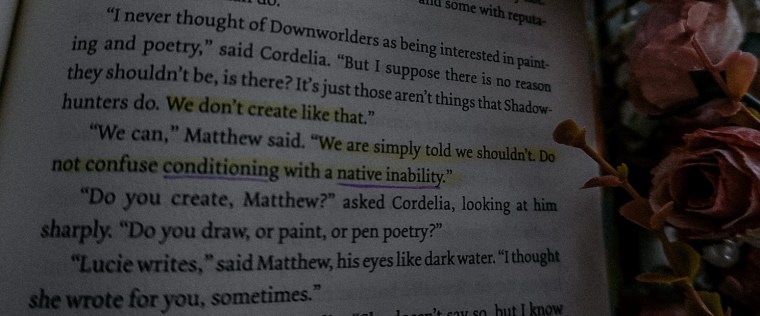
I don’t really like Lucie as a character. I enjoy her feral Herondale energy, but she seems very entitled to me. She bosses around Jesse with her powers, she makes fun of the whole Benedict Lightwood situation TO JESSE (whose life was damned before it even began by that day), and she talks to Matthew like this. There’s tough love, which Matthew may need, but this felt cruel. She says it herself, she is not calling him out to help him; she’s doing it to protect her brother.
Matthew already feels inadequate in so many ways. This statement only adds to his list of reasons to hate himself as he begins to feel as if he doesn’t deserve James as parabatai. Meanwhile this is what James thinks of his parabatai when he comes to comfort him after Grace breaks his heart:
“People were wont to dismiss Matthew — because of his clothes, because of his jokes, because of the way he took nothing seriously. They assume he was liable to break, to give way when things became difficult. But he wasn’t. He was holding James up now, as he always had — and making it look easy, as he always had.” (315)
James always sees the best in Matthew when Matthew can’t help but see the worst. They remind me of Jem and Will. Jem never questioned why Will was so outwardly cruel because he knew that his parabatai had a good heart and he would love him no matter what he’d done to weigh down his conscience so heavily. I think James feels the same way about Matthew. He knows in his heart that Matthew is a good person, so he doesn’t pry for answers. Instead, James gives Matthew his trust and love.
But is it enough? Does Matthew need to be told and not shown to be reminded of his worth?
Finally, Jem is the one who has failed Matthew the most because he is the one person who knows what happened that fateful night. Jem was there when Matthew purchased the potion and he was there when Charlotte miscarried. He was the one who urged the boy to confess and that he would be shown love and understanding. In GoTSM, Jem said that he would keep Matthew’s secret because it was his to share, but when do you toss that noble bullshit aside to save an actual child?
The more I learn about Jem, the less I like him. I adored him in The Infernal Devices, but Clare has slowly destroyed his character for me. Every single series Clare dotes Jem around as this wise, righteous soul who saves lives and is this holy embodiment of goodness, but it seems to me that his protection only extends to those with the last name Herondale. Even in TDA, Jem tells Emma that he wants to be an Uncle to her and then vanishes to find the Lost Herondale and then disappears with the Lost Herondale. He did protect her and the Blackthorn children during the Dark War in City of Heavenly Fire, I’ll give him that one. But, generally, he just kind of shows up with some poetic bullshit advice and slips away.
Clare loves to tell us about how great Jem is without showing us how great Jem is and it’s INFURIATING.
Jem seems to be a very present figure in James and Lucie’s lives (he’s around enough to train James), which means he has to have interacted with Matthew since that night. They’re parabatai! I’m so incredibly pissed at Jem. There’s nothing but Matthew’s own intrusive thoughts that indicate that his family and friends wouldn’t be understanding. There’s nothing holding Jem back from telling Charlotte or Will or even James about the burden Matthew carries. Matthew may be angry with Jem at first, but it would be better for the boy mentally and physically to share the weight. It’s worth it to break someone’s trust to save a life — or, as we’ve seen with Elias, several lives.
It’s a Celine Montclair situation all over again. Matthew’s life means less to Jem because his last name isn’t Herondale.
I’M PISSED. I love Jem so much, and I don’t know why Clare would do this to his character.
The people who don’t fail Matthew? Cordelia and Magnus Bane.
I’m going to give an honorary mention to Grace. Matthew has rightfully never liked Grace, but she delivers this single line to him that I really respected.
“You have no idea what terrible people are like.” (312)
I know that she says it in a menacing way, but it’s interesting that even Grace can tell he’s not the type of person he pretends to be. Plus, she tells him! That’s more than any of his friends do.

By the end of the book, we learn that Matthew has a crush on Cordelia, which was hinted at throughout CoG. It’s easy to fall in love with Cordelia, but I think Matthew is drawn to her because of how she doesn’t treat him like a liability. Cordelia reassures Matthew that no matter how he feels, he has the ability to choose who he is in the world.
“Matthew, you may speak however badly of yourself as you like, but it does not make it true. You decide the truth about yourself. No one else. And the choice about what kind of person you will be is yours alone.” (525)
Matthew is used to being a sidekick to James and sort of picking up the pieces of his parabatai’s cluelessness. When James leaves Cordelia on the dance floor, Matthew swoops in to make sure Cordelia isn’t embarrassed in front of the Enclave. He warns Cordelia that James can hurt her (why are we villainizing James?) because he is so unsure of his own emotions. And, when Matthew and Cordelia see that James has set Blackthorn Manor on fire, Cordelia drags him through the portal because they don’t have to listen to everything James tells them.
I really, really enjoy the friendship they share. I adore that Matthew makes her laugh and she makes him care. However, I’m not sure if they would be romantically compatible. They seem like twin flames to me — two intensely hurt people just doing what they can to survive. I’m sure Clare is going to toy with my emotions in book No. 2, so we’ll see if my opinion changes after Chain of Iron.
And finally, we have Magnus Bane. I was surprised to get a Magnus POV, but I was obsessed. It made sense for Magnus to be the one to notice the agony Matthew was hiding, since they are so similar and the warlock has a reputation for finding Shadowhutners in need of help.
“In Magnus’s life there had been a hundred Mathew Fairchilds: young men and women as self-destructive as they were beautiful, who despite all the gifts that had been given to them, seemed to wish for no more than to burn down their own lives.” (574)
The whole interaction between Magnus and Matthew tore me up. It both hurt and felt like a relief to have Magnus notice all the little details about Matthew’s drinking problem: “a man who brought his own drink to a party where drinks were provided was indeed in a sorry state”, “no one else seemed to notice that Matthew was only standing up because the wall was holding him”, and “it wasn’t the drinking, so much as the fact that Matthew was clearly practiced at pretending he had not been drinking.”
FINALLY. FINALLY SOMEBODY NOTICES! And it’s somebody who will fucking do something! YES!
I am so damn excited to see more Magnus and Matthew interaction in Chain of Iron. Please, Magnus, please help my boy. He needs your magic touch. Please.
OK let me collect myself.
…
To wrap things up, we get this boiling point for Matthew right before his encounter with Magnus. Alastair attempts to be friendly with the Thieves at the engagement party, which a violently drunk Matthew wants no part of. Thomas, being the sweet angel baby that he is, wants to let bygones be bygones, but Matthew won’t allow it because he knows the truth.
“Thomas, you are kind. Too kind, and you wish to forget. But I am not kind, and I cannot help but remember.” (570)
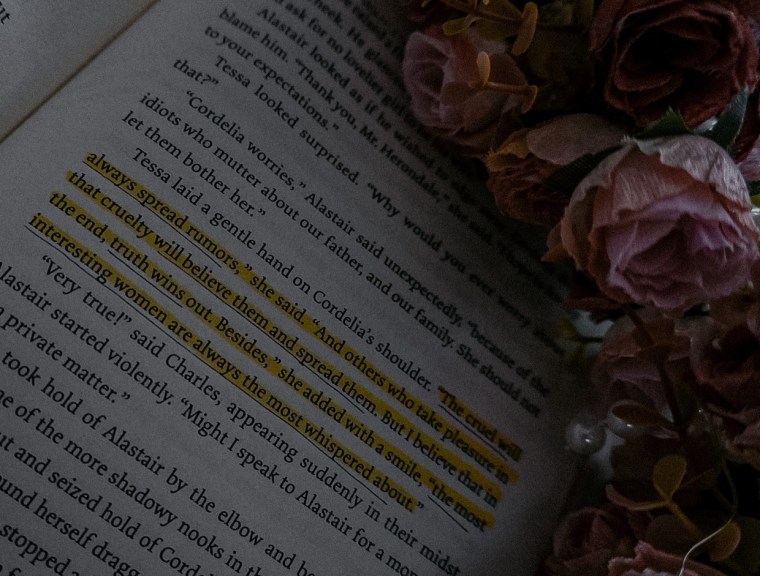
Matthew proceeds to tell Thomas how Alastair was the one who spread rumors about Charlotte and Gideon and Sophie, about all of them. Just as the fire was burning down to embers, Matthew tossed gasoline on it.
This reminded me of what Dru said in QoAaD:
“When you’re hurting, it’s sometimes hard to see how other people might be hurting differently or worse.”
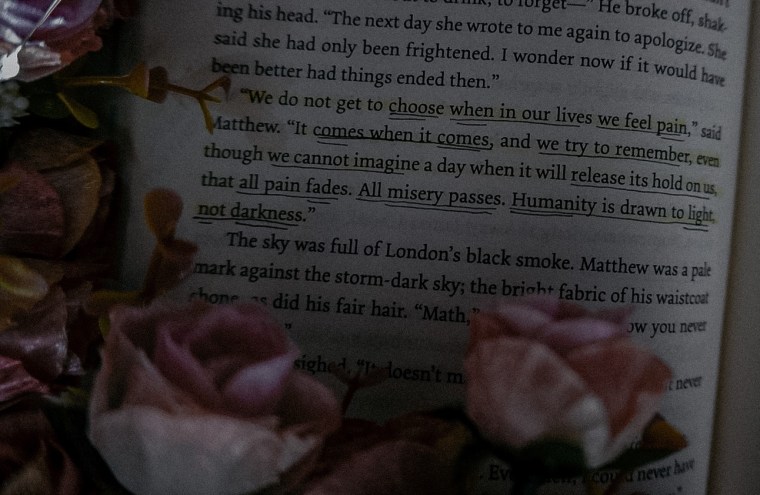
I think it’s also easy to hurt other people when you’re hurting as deeply as Matthew is during that moment. He can’t share why he hurts, so he hurts others so that they all hurt together. He believes the others are not suffering or hurt, and he cannot bear for them to be happy while he is miserable. So he reignites the flame.
Matthew is such a relatable and raw character. He’s extremely different from any Shadowhunter we’ve met before. He doesn’t seem concerned with his sacred duty as a child of the angel, and he never exudes the same righteousness as we’ve seen from the Nephilim in the past.
I love Matthew Fairchild, and all I want is for this boy to forgive himself and allow himself to love and be loved. I demand it.
Oh, and Matthew has a golden retriever named Oscar Wilde. My huskos and I are big fans of Oscar. As a dog person, this makes me love Matthew more.
Please don’t ruin these villains, Cassie
Chain of Gold presents readers with three main villains: Tatiana and Grace Blackthorn and the Prince of Hell Belial. I hold villains in very high regards, and these three were a triangle of damn-near perfection, which makes me extremely worried that Clare is going to mess them up in Chain of Iron. It’s kind of what she does. (If you’re wondering, I’m still not over how Clare threw away Annabel Blackthorn too soon. It’s a tragedy.)
I’m going to get Belial out of the way first, because I liked him the least. I don’t think he’s a bad villain, he just doesn’t measure up to Tatiana and Grace.
James was trying to figure out who his demon grandfather was throughout the book, despite Jem and Magnus telling him it didn’t matter. But it did matter, because Belial is his grandfather, the cause of all the demon attacks in London and he wants James specifically.
I liked the way Belial seemed to be playing 3-D chess with James. He’s smart, he’s willing to play the long game and he seemed to be a couple moves ahead of our Shadowhunters. Belial actually kept demons out of London to soften the Shadowhunters for his attacks. He’s the one who kept showing James glimpses of the shadow realm he occupied. He’s the one who tricked James into going to the Silent City and then he possessed the patients to lure him to the gateway by pressing on his conscience.
And when James enters the realm and meets his grandfather face to face, Belial riles him up to show him what he’s capable of and what truly lingers in his blood.
“We could share your body, James. My presence would cure the Mandikhor venom in your veins. You would live, and the power you would have would be immense. For are you not my heir, my own flesh and blood?” (470)
“When I order it to cease attacking Nephilim, the attacks will stop. The deaths will stop. But if you refuse me, they will continue. And you, my boy, will die.” (471)
Just as so many others have, Belial attempts to use James’ emotions to make him a willing participant in possession. But James is no longer under the bracelet’s spell, making him stronger and more in control. He refuses Belial despite the Prince of Hell’s threats.
I enjoyed Belial for the same reason I did Sammael in The Lost Book of the White. There’s something about the relaxed, informalities of the Princes of Hell that really make them terrifying. They aren’t worried about flexing their strength, so you have to outwit them rather than outpower. It adds a layer of complexity to the story as the characters struggle to find a way to take down an antagonist whose motivation is unclear.
We know Belial wants to walk in the mortal world again, but why? What does he have planned once he finds a willing host?
I think Belial provides a good balance of curiosity and understanding. Unlike Axel Mortmain in TID, readers aren’t left in an awkward suspense for three books as the characters dance around his identity. We are presented with a mystery, we are given clues throughout the text and then he is unveiled along with his ties to both our protagonists and antagonists.
There’s also already a base level of interest established because he is the father of Tessa and the grandfather of her children. He’s a vital piece of the puzzle in figuring out what Tessa, Lucie and James’ powers mean for them.
The most intriguing part of Belial is his alliance with Tatiana.
If you read The Infernal Devices, you already knew who Tatiana was going into Chain of Gold. When Benedict Lightwood reached the final stage of demon pox in Clockwork Princess, he turned into a big ole demon worm that Jem, Will, Cecily and the Lightwood brothers were forced to kill him. Not before he ate his son-in-law, while a pregnant Tatiana watched.
Watching her husband and father of her unborn child being eaten by her father who turned into a demon, didn’t do a lot of good for Tatiana’s mental health. This girl is understandably emotionally scarred. All of this and the addition of Jesse’s early death is enough to make anybody crack.
Tatiana is cruel. She’s bitter. She’s a bit ruthless.
But I can’t hate her.
I feel for her. She’s obviously hurt, and, in that state of hurting, she has allowed herself to simmer in loneliness and resentment. Yes, the Herondales, Jem, and her brothers have reached out and tried to make amends, but can you blame her for resisting when they all make a mockery of the day that destroyed the life she wished for herself?
I sure don’t.
Upon the death of her son, Tatiana fully snaps. She believes the Shadowhunters have stolen yet another life from her, and she can no longer take it. She aligns herself with Belial on a trade off — she prepares James for Belial to possess so that she can raise Jesse from the dead fully. He kills Barbara as a gift to her.
Honestly, I didn’t care about Barabara … We didn’t know much about her. Her death meant very little to me except for the sympathy I extended to her family. However, knowing that Tatiana is the cause for the loss of her brother’s oldest child really hit me. That’s so unbelievably awful. She knows what it’s like to lose a child, so why would she inflict that on Gideon?
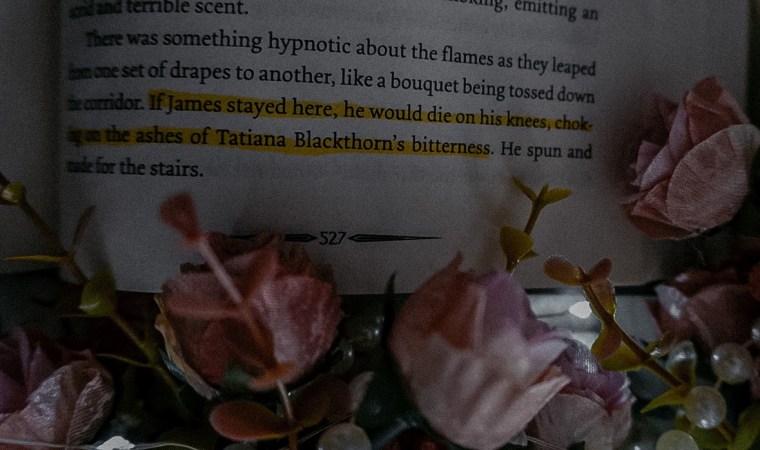
It did add to the depth of Tatiana’s cruelty, which made her an even more intriguing antagonist. She’s desperate and she has the motives of a broken heart. That’s a dangerous combination.
The saddest part of Tatiana is how she’s using her adopted daughter to carry out her plans.
Before anything else, I need to ask the question: why would the Clave allow for Tatiana to take in Grace in the first place? She was clearly not mentally well, she wasn’t trained to be a Shadowhunter and she refused to allow Jesse to be runed. It simply doesn’t add up.
Just like Tatiana, I can’t hate Grace. I actually adore her. I think she’s smarter and less helpless than she lets on, but I also think she has that dark edge from her upbringing. I also can’t figure her out or read her, which is equally frustrating and fascinating. I can gauge Tatiana by her desperation and eccentricity, but Grace has a bit more depth to her.
It’s easy to paint Grace as the ultimate baddie in this story. She’s the one who puts the bracelet on James, she’s the one emotionally manipulating him and she’s the one repeatedly breaking his heart.
Grace is very much a product of her home environment. While James and Co. were swaddled in love and support, Grace was wrapped in thorns and abused mentally and physically. Jesse was all she had in that ghastly home, and he died in her arms and made their mother even more detached and deranged.
Tatiana raised Grace to be a weapon, and it is now all the girl knows.
I couldn’t figure out if Grace was genuinely afraid of Tatiana or if her fear was a part of the ruse to lure James further into their trap.
On one hand, I definitely think Grace asking James to run away with her was just a test to see if the bracelet’s magic was intact. However, Grace is crying when Tatiana shows up to whisk her away. Is she upset that she’s failing her mother and the consequences that will bring, or is she still playing a part of damsel in distress to toy with James?
This moment also points toward how heartless Tatiana can be and how she treats Grace. When James threatens the woman to tell the Clave about her demons, she claims she will tell them that Grace is the one dabbling in black magic. She is willing to throw Grace at the mercy of the Clave.
“You care, Herondale. That is your weakness.” (Tatiana to James, 254)
Then, when Tatiana is poisoned, Grace immediately attaches herself to Charles as a way of protection and takes the bracelet off of James. It makes me wonder if this test and Tatiana’s poisoning is the turning point for Grace. My gut feeling is that Grace actually cares about James as a friend. He’s shown her nothing but kindness even before the bracelet. With the spell wearing off, she doesn’t know what Tatiana will do to prepare him for Belial. With the threat from the demon, Namtar, and her mother being cured, she has no choice but to put the bracelet back on James. She even apologizes before she does it.
This adds to my sympathizing of Grace. She doesn’t seem to be an equal participant in her mother’s actions. She calls herself her mother’s blade … not an accomplice, not a partner, not even a devoted daughter. She is a blade to be wielded, and, when her mother swings, she is who feels the blow.
Yet, she still tells James the story of the automaton that’s clearly a setup, meaning she’s willing to frame James and allow him to be thrown to the Clave for punishment. But she also doesn’t argue with Cordelia’s proclamation of being compromised by James as his alibi in the burning of Blackthorn Manor. Then, she disappears when James doesn’t respond to her proposal of getting back together after his year of marriage.
So, I’m not sure where Grace stands, which is keeping me curious and invested. I am beyond excited to see what she and Lucie get into while trying to bring back James.
Plus, there’s that whole thing with Tatiana being sent to the Iron Sisters in the Adamant Citadel. I’m all for the Clave showing people mercy, but who thought Tatiana, who has consistently conspired against Shadowhunters, should be allowed near adamas? Are we going to get corrupt seraph blades? That would be pretty cool.
If Clare kills off Tatiana or Grace and ushers in a new round of baddies instead of developing these amazing villains, I’m going to make like Alec Lightwood and jump out of a window.
Quickies
Here are a few quick thoughts that I don’t want to go too far into but felt were interesting:
- Cordelia and Grace are obviously each other’s foils, but my favorite touch to show the difference between the two is how James describes Grace as cold but Cordelia is always warm.
“He was struck as always by her beauty. It was cold and perfect.” (110)
“He was under mountains of blankets and she was atop them, of course. But her presence began to force back the cold. Instead of feeling the agony of being whipped raw by ice, his awareness turned to the length of her body, warm and solid, all along his own.” (92) and, “When he thought of marriage to her, he imagined a warm room, a fire in the grate, a chessboard or a pack of cards laid out …”
- Anna Lightwood is a bad bitch. I loved the confidence and strength she exuded and how she constantly felt like the only one of our protagonists who used her head. Anna’s book of “conquests” genuinely made me laugh so hard, and I appreciated that nobody ever judged her by these sexual exploits. In fact, it comes in handy when they need to distract Hypatia Vex at the Hell Ruelle to get the pyxis. All the guys are just like: “Go get ‘em, Anna”. Respect. Also, I’m so invested in her and Ariadne! “I think that romantic love is the cause of all the pain and suffering in this world.” “I will change your mind. I will win you back.” YES! We love strong-willed women!
- Speaking of strong-willed women, I was obsessed with how Clare flipped the script on how YA literature typically presents relationships among women. There never appeared to be any animosity between our gang of female protagonists. There was always a level of respect. Never once did these ladies speak ill of another.
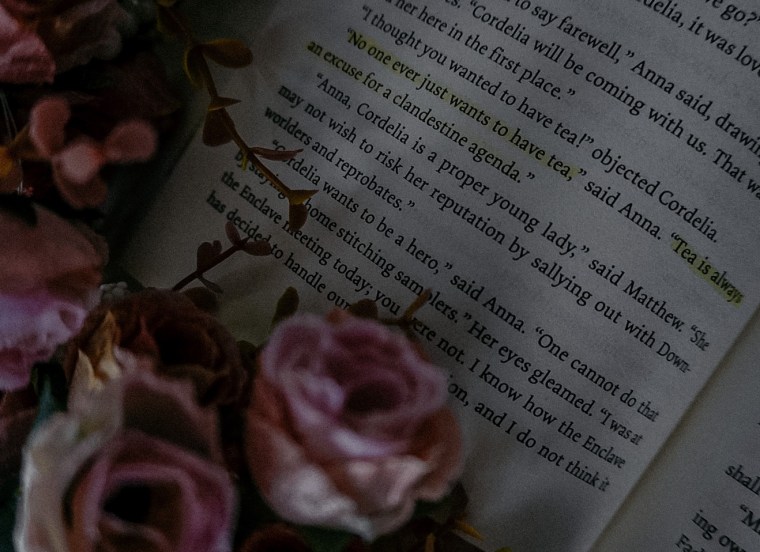
Cordelia agrees to not turn in Tatiana until after Charles announces his engagement to Grace in order to protect the girl. Grace even tells James that he is lucky to have Cordelia and that she was surprised at how the other girl was so swift and smart to protect him. By the end of CoG, Lucie and Grace are teaming up to bring Jesse back from the dead. (Hot girls do necromancy.)
It’s such a different vibe than what readers are usually fed, and it made me feel all warm and cozy. Clare fell into the same trap in TMI with the rivalry/jealousy between Clary and Izzy, and it took away from the story. There’s not really a point in adding unnecessary drama between women simply because they’re women, and we’re spoon fed the stereotype that women can’t get along. Screw that. Give me women supporting other women.
- This is more of an observation: After Grace removes the bracelet from James, he runs out of the Institute under the archway that says “we are dust and shadows” on his way to Blackfriars Bridge to wallow away in heartbreak. He watches the boats on the Thames and thinks: “They could leave no real mark on the river, as their troubles left no real mark on time.” I thought this was a really cool hint toward his father’s own philosophy on life as an angsty teen. Will clung to the Nephilim’s motto as a way of saying he felt as if his life meant nothing in the grand scheme of the world around him. This is James believing a very similar theory. He is just another boy with another broken heart. The pain he felt does not change the way the world continues to spin.
- Finally, I AM A SUCKER FOR BLACKTHORN BOYS. I have no reason to love Jesse Blackthorn as much as I do. We know so little about him besides his tragic death, yet he has such a strong hold on my heart. I think I love him. Actually, I know I love him.
First of all, his personality is just so calm and casual, but still a bit goofy. (His humor reminds me a lot of Julian …) Like when he mouths Lulu? to Lucie when Will checks on her in her bedroom and the way he looks so unconcerned when Lucie tells him that Will would’ve tore him “limb from limb, even if he couldn’t see him.” There’s also my favorite: “I am a ghost. What is it exactly you imagine I might do?”
Secondly, I enjoyed seeing him rile up Lucie. I talked a little about how I didn’t care for Lucie in Part 1, because she felt entitled to me. I think Jesse is the only one not to pander to her and gets angry at her immaturity and ignorance. He critiques her writing (pro tip, Lucie: you don’t become a better writer by surrounding yourself with yes men) and he’s absolutely pissed when Lucie commands him to travel via ghost to Highgate Cemetery. The “God damn you, Lucie Herondale,” was everything. I think Blackthorn boys love feisty, strong and stubborn women. Oh, and Herondales. It’s their type.
Mostly, I love how adorably kind and noble he is despite being raised by Tatiana. He has every right to be scornful toward the Herondales because of his mother and to hate Shadowhunters for his unfortunate death. Yet, he gives up his last breath — the thing that holds him to the world of the living and the key to bringing fully back to life — to save James.
“This is his life. Not a shadow of a life. Not years of waiting in the dark.” (495)
Jesse died because he wanted to be a Shadowhunter, and he forced Tatiana to let him be runed. It was nobody’s fault that the Mark killed him. In giving James his last breath, he finally gets to play a part in this world he so desperately wanted to be a part of — a world he died trying to make a difference in.
I also think he thought of Grace in that moment and how he died in her arms — another little sister holding her older brother as he struggled to take his last breath. He couldn’t stand by and allow Lucie to experience that same crushing loss.
I love him and I’m currently gathering the ingredients myself to bring him back. Also, Will is definitely going to beat his ass when he learns that his daughter is having an affair with a ghost boy. But this chaos is exactly what Will deserves for his years of tormenting Charlotte with his antics. You reap what you sow, Will.
Final thoughts
Chain of Gold was exhilarating, fun and frustrating.
Cassandra Clare outdid herself with a series opener that is fabulously paced with a brilliant plot that perfectly balances mystery and candor, along with a fleet of bewitching characters readers can love, hate and want to smack upside the head all at the same time.
These Edwardian Shadowhunters are a second-generation found family, overcoming their sheltered upbringings and societal pressure to defeat the darkness that has shadowed their city. It’s a story packed with secrets and personal strife as emotions get tangled and shoved aside in the name of political and societal gains.
It’s a clever retelling of Great Expectations that expertly weaves hints of Pip’s tale into James Herondale’s own trials and tribulations as a boy with a big heart that makes him naive enough to fall into emotional manipulation, while also being a fresh story with depth and layers outside of Charles Dickens’ original.
The pages of Chain of Gold drip suspense and drama, engaging readers through a winding road of love, friendship and power that left me gasping and clutching my imaginary pearls.
From Matthew Fairchild’s destructive mission to burn his life to the ground, to Anna Lightwood’s long list of love conquests, to Cordelia Carstairs’ noble pursuit of being a merciful hero, to Jesse Blackthorn’s sweet soul despite a cruel life and even crueler death, and to every side plot in between, Clare created a masterful opener that made me angry it had to end.
Chain of Gold is my first read of 2022, and I think I have to give it a perfect 5 illegally acquired magician books out of 5.
(Please don’t break my heart, Chain of Iron, I’m not ready for that.)

 Life of Bry
Leave a comment