Analyzing book No. 2 in The Eldest Curses trilogy
“Life is tremendously dangerous whether you have magic or not. … I know of no safe worlds. You have to be strong to survive in all of them.”
Ragnor Fell, 193
Our band of protagonists from Cassandra Clare’s The Mortal Instruments are all grown up, but that doesn’t mean they’re done saving the world — or out of snark and chaotic energy.
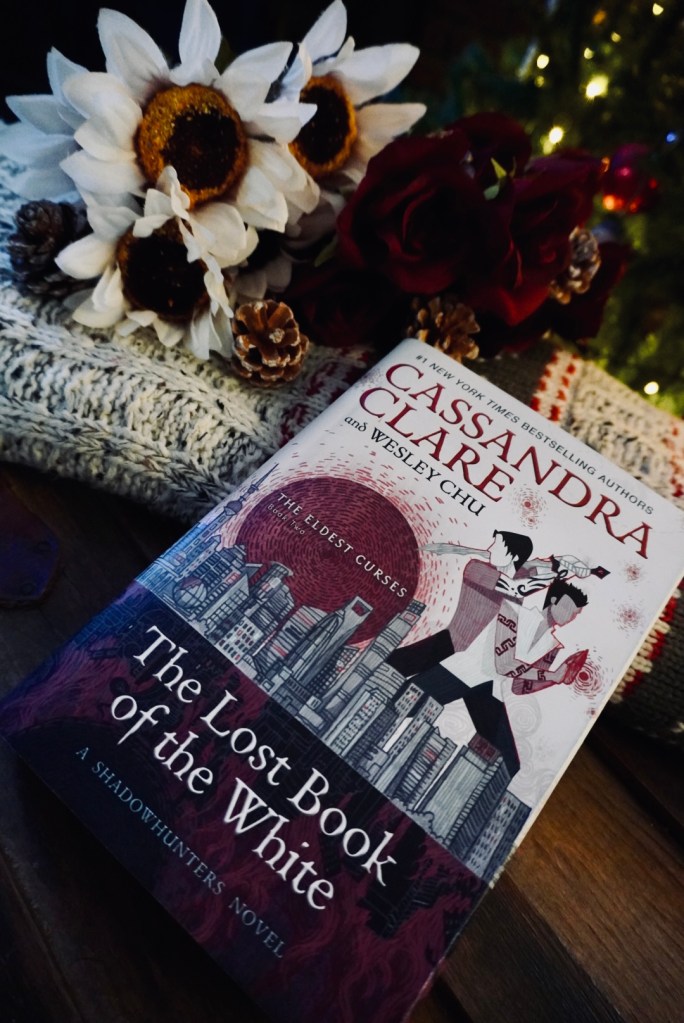
The Lost Book of the White, the second installment of Clare and Wesley Chu’s The Eldest Curses trilogy, tackles what it means to be a hero when you’re no longer 16 and free of responsibilities — or in Magnus’ case, immortal and more concerned with the drink in your hand than settling down.
Magnus Bane and Alec Lightwood’s relationship is no longer fresh and awkward as they fumble through getting to know each other like in The Red Scrolls of Magic, it’s strong and true and tried. They know who they are alone and who they are together, but they’re also trying to figure out how to balance being parents to their toddler son and jobs that involve world-ending danger.
When Shinyun Jung reappears in Magnus and Alec’s loft three years after the Shadowhunter had set her free out of an act of kindness and mercy, she brings a surprising ally to help steal the Book of the White.
Magnus and Alec have no choice but to find the warlock, recover the Book of White and put a stop to whatever evildoings these two have in store. Plus, Magnus has a magic hole in his heart from being stabbed with a mythical thorn. They’ll have to figure that one out, too. And save Magnus’ oldest friend from whatever hold Shinyun has on him. That’s important.
It’s a long list for two people to tackle alone (no matter what Magnus says otherwise), so the Avengers of the Shadow World are assembled: Jace Herondale, Clary Fairchild, Isabelle Lightwood and the newly-ascended Simon Lovelace.
What’s one more hell dimension anyway?
Here are all my thoughts on The Lost Book of the White:
Where are we? When are we? How are we?
I was very apprehensive before opening TLBoTW. Long time jumps between books in a trilogy can often feel like a bump in the tracks that the story travels on. I hate it.
TLBoTW falls between Tales from the Shadowhunter Academy and Lady Midnight, covering a time period in the Shadowhunters Chronicles that fans know little about. We got basic details on the TMI gang’s lives during this time in The Dark Artifices, but nothing of real substance.
There’s also three other books that bridge the gap between TRSoM and TLBoTW. So, if you followed TSC, you didn’t miss a beat.
I actually like this timeframe better than that of TRSoM because there’s not any preconceived expectations. In the first book of The Eldest Curses, readers knew Alec and Magnus would break up shortly after the events of that story. Personally, I read The Red Scrolls of Magic looking for clues on what exactly led to the tragic events at the end of City of Lost Souls. I felt none of that anxiety while reading The Lost Book of the White. *Relief*
Instead, it felt like a fresher plot more unique to the other Shadowhunter books, rather than a prequel for disaster.
Yes, it’s still a fill-in-the-blanks type story to preface The Dark Artifices, but Chu and Clare made it feel more like catching up with old friends. Readers get to see how Jace and Clary made the decision to run the N.Y. Institute, how Simon adjusted to his new life as a Shadowhunter and the grief from losing George, and what Ragnor was up to all those years after he “died” in City of Glass. Most importantly, readers get a look at the domestic life Magnus and Alec had settled into.
I’m honestly not sure how I lived without all these details.
Also, Shanghai was a very cool city to place this story in. I’m a sucker for world-wide adventures, and the Shadow World just keeps expanding.
It’s more than just the physical place, it’s about how the culture influences this fantasy. Chu does a wonderful job at weaving Asian mythology and culture into Clare’s world — Black and White Impermanence, Hu Shen the tiger, Diyu, etc. It really hit home how much depth there is to the Shadow World. The Shadowhunters all share one sacred duty, but they carry it out differently based on their geographical location.
Shanghai is a city with a rich and unique history. It makes perfect sense to have that flow into Clare’s low fantasy world.
The Downworlders Concession, a safe neighborhood for the city’s Downworlders, was a fascinating inclusion that fit right into Shanghai’s history, and I liked how its existence forced our protagonists to question why it couldn’t exist anywhere else. The Shadowhunters in Shanghai are willing to give the city’s Downworlders more freedom and less policing, allowing trust to form between the two factions.
I wonder if Jace and Clary will try to establish something similar in New York later on?
Shanghai as a setting also allowed for the reintroduction of our favorite former Silent Brother, Jem Carstairs. It genuinely weirded me out when one of the TMI gang would call him Brother Zachariah, even though it made sense that they’d have trouble knowing him as anything else. It just felt good to see Jem find his way back to his family home and be welcomed so heartedly. We wish only the best for daddy Jem. (I didn’t know Tessa Gray was the daughter of a Prince of Hell. Is this mentioned in any of the previous books? Is this knowledge we learn in The Last Hours? I haven’t gotten there yet, damn it!)
And, finally, Diyu.
Clare always does a fantastic job at creating alternate dimensions — Edom was a terrifying wasteland and Thule was a downright horrific view into what could’ve been. If I had to rank these dimensions, I would say that Diyu would sit firmly between these two worlds, above Edom and below Thule.
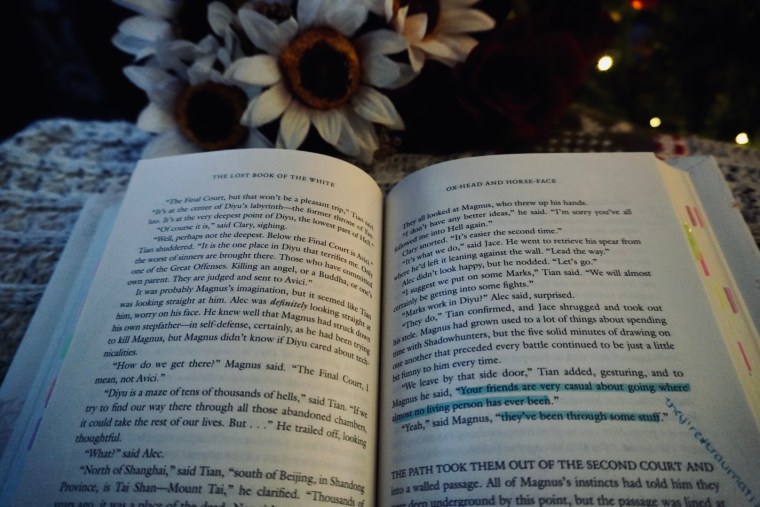
Diyu was a desolate land of vast nothingness. It had no true rhyme or reason. While parts closely resembled the mortal world, it was mostly a maze of horrors and unpredictability. Team Good was often forced to wait for the villains to come to them rather than seek them out to act on the element of surprise.
Nothing felt familiar. Even the church our gang finds refuge in is slightly off. It created a sense of uneasiness as a reader. It set me on edge and laid a blanket of suspense over our characters, which made the story that much more enjoyable to read.
There were so many layers to Diyu, as every soul that crossed through was sentenced to a different land of hell, and I feel like Clare and Chu could have done so much more with it moving forward. Unfortunately, Diyu seems to be lost forever, so that’s wasted potential.
For example, there was that alleyway on the way to the Downworlders Concession that entranced Magnus and had the rest of our gang anxious for an attack. My theory is that it was either the location of the portal into Diyu or that Sammael, Shinyun and Ragnor messing with portals had leaked part of Diyu into the mortal world, creating a sort of glitch in reality. The latter is obviously the cooler option. What if those spots started popping up across Shanghai? That would be nifty.
Setting: A-
BADDIES & BESTIES
The Lost Book of the White definitely falls into a hole that most middle books find themselves in as a catalyst for some grand event in book No. 3, rather than a whole plot of its own. While TRSoM was more of a complete story that wrapped up neatly, TLBoTW is unfathomably more open ended — to the point that the only thing our heroes can truly celebrate a victory for by the final page is being alive. This is mostly due to a new antagonist being introduced that our protagonists simply can’t defeat at the moment.
As with most of Clare’s work, TLBoTW is primarily character driven rather than plot centered. In particular, three antagonists push the story forward (and back) in this addition. Let’s take a look at each and what they brought to the pages:
RAGNOR LIVES: Ragnor Fell appearing in Magnus’s loft holding Max and the Book of the White was a twist I absolutely never saw coming — and it happened in the very first chapter.
It raised my interest level by about a billion percent and immediately had me invested in whatever plan Shinyun had up her sleeve. Ragnor is an expert in dimensional magic and Magnus’s oldest friend. His addition essentially helped drag Magnus into the story since Sammael admitted he didn’t plan to pull the High Warlock of Brooklyn to the Dark Side. The idea had been Shinyun’s, and she used Ragnor as emotional bait.
It adds a second layer to the plot. Yes, the gang must get the Book of the White back to prevent Sammael from entering their realm, but Magnus has a personal mission to save Ragnor’s life. It gives an emotional pull to the story. Our group of heroes know more than anybody how risking it all to save your friends is a no brainer. Ragnor means a lot to Magnus, making it their priority to save him, as well.
There’s an interesting parallel between Ragnor and Jace also. When the rest of the gang starts to question whether it’s worth it to prioritize saving Ragnor’s life, it’s Jace who nods in agreement with Magnus. He was once in Ragnor’s shoes, left helpless as someone else took away his freewill. He was saved, and now they were going to save Ragnor. Beautiful parallel, increased the sentimentality. Loved it.
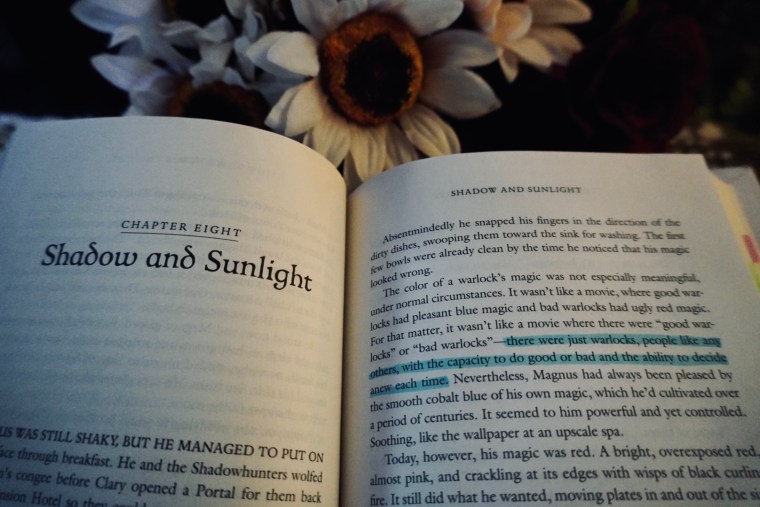
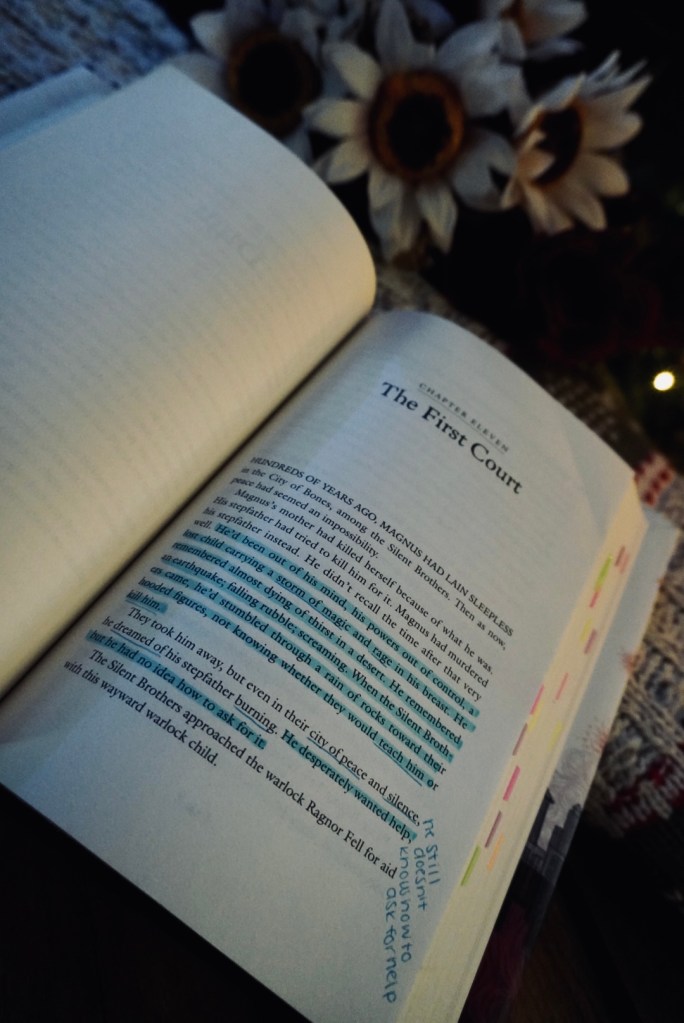
Finally, Ragnor allowed Clare and Chu to develop Magnus’s character even further by laying the foundation of the High Warlock of Brooklyn’s personality and ideology before he met one Alexander Lightwood. It was Ragnor who took in a lanky preteen Magnus after the Silent Brothers had found him in the desert and taught him what it meant to be immortal.
“I know you weren’t one of the lucky ones. But we are warlocks. We live forever, and that means sooner or later, we are alone. When others call us the spawn of demons, try to use our power for their own ends, envy us, fear us, or simply die and leave us, we must decide ourselves what we shall be. Warlocks name ourselves, before someone else can name us.” (194)
Also, Ragnor insisting on Magnus telling him how he and Alec came to adopt Max was so adorable. Oh no … I just thought about how Magnus will have a similar conversation with Max about what it means to be a warlock … Good thing Max is one of the lucky ones <3.
Wasted Potential: Yikes. I’m very disappointed in how Shinyun’s character is playing out. I was so excited to see more of her and dig deeper into her backstory, but that just never happened. Instead, Shinyun becomes a power hungry monster that is neither relatable nor sympathetic.
I found myself disinterested in her as a villain. She was more annoying than fearsome. She was Sammael’s right-hand woman, but somehow didn’t seem very threatening — even when she was poking
Magnus with the Svefnthorn .
“Power is all anybody can ever want. Power is the ability to choose what happens, to will something and have it come to pass. Ideals humans talk about — having freedom, meting out justice—these are all just power by other names.” (91)
Shinyun’s value to the story was purely to be Magnus’ dark mirror as their beliefs collided, which is a damn shame. She had so much POTENTIAL to be a great character on her own accord. I know The Eldest Curses focuses on Alec and Magnus, but COME ON! Magnus has been featured in 16 books prior to TLBoTW, and Clare and Chu are making Shinyun a prominent figure in this trilogy without putting in the effort to give readers more knowledge on what else happened throughout her immortal life to make her feel so jaded.
“You know that time is a cruel joke, that it takes everything from us eventually. Time is a machine for turning love into pain.” (254)
Readers know how Magnus has loved and lost throughout his long life, but we only know about Shinyun’s first. What happened between the Crimson Hand saving her life and the events of TRSoM? The ball is on the tee and they’re refusing to swing the bat. It’s so frustrating.
I’m even conflicted about the role Shinyun currently plays as a dark mirror. In one way, it’s extremely enjoyable to read Shinyun constantly questioning Magnus’ philosophies on life and seeing him defend them and his newfound family fiercely. In another, it feels extremely redundant to hash out Magnus’ philosophies when I read 16 other books that told me how he arrived at those conclusions.
“Living forever isn’t a power when your life is a tragedy.”
“Every warlock’s life starts as a tragedy. There are no love stories in any warlock’s origins. But you get to choose. You choose what kind of world you live in.” (92)
This quote is the perfect example. Magnus’ response to Shinyun’s statement is a beautiful reflection of how Ragnor showing Magnus friendship had taught him to choose a happier life for himself, yet it’s a lesson readers learned way back in The Bane Chronicles from “What really happened in Peru?”.
If TEC was a reader’s first dip into The Shadowhunter Chronicles, maybe all of these passes at immortal philosophy would hit a little harder. But, to me, they felt like a reiteration of what I already know.
Before anybody calls me out … I picked up that Magnus was trying to be there for Shinyun as Ragnor was for him. It’s just not being executed very well. It feels stale. Don’t come for me.
Fingers crossed that when The Black Volume of the Dead comes out, Clare and Chu will have done justice to Shinyun as a villain. (Don’t even give her some redemption, just make her have more reasons to be evil. Tell me why she is the way she is!)
The Nephilim’s other dad: Sammael, THE father of demons, is an amazing addition to TEC. I’m obsessed. I’m more obsessed with the general concept of the Princes of Hell and their Eldest Curses, but Sammael is our first major introduction into this plotline and a damn good one.
The lore is that Sammael is the one who opened the mortal world to demons, forcing the Angel Raziel to create the Nephilim. This establishes the connection between Sammy and all Shadowhunters. Also, Sammael and Lilith are said to be lovers. If you read City of Fallen Angels, you know how Lilith’s return to the mortal realm panned out. Not great for her. This creates a string tying Sammael to our specific group of protagonists — Simon killed Lilith with the Mark of Cain as a Daylighter.
Sammael makes a good introductory villain because of his very nature. He’s the second-oldest Prince of Hell, he has a personal connection to our protagonists and he’s casually terrifying.
That last point is my favorite.
Shinyun’s hunger for power is boring and overplayed. I’m not scared of her or what she has planned moving forward. I’m annoyed by her existence. But my boy Sammy? He has no desire to flaunt his power with grand gestures. Instead he imposes fear with indifference.
“It occurred to Alec that most of the powerful people he’d fought were at pains to demonstrate that power. Valentine, Sebastian, Shinyun herself, Lilith … They wanted respect. They wanted fear. Sammael didn’t seem to care about any of that. As if his power was so great that he didn’t care if it was disrespected.” (326)
I love this comparison and how it sets Sammael apart from other antagonists we’ve met. Our gang kind of knows how to handle power hungry baddies — they usually have a personal insecurity you can manipulate to defeat them. However, how do you take down a villain with no real drive?
“Magnus had begun to wonder if Sammael was so removed from being a person that he was more like Raziel — a force of will beyond understanding, incapable of human emotions like pettiness or spite. He thought that maybe Sammael was less like a demon and more like a weather pattern, or a god, too monumental and too unearthly to be comprehended.” (259)
Magnus does notice Sammael has a real hatred for Simon, so there’s a touch of humanity in him. I feel like this is foreshadowing. If Sammael has the capacity for hate, he probably has the capacity to love and be empathetic. Maybe Sammy just needs a nice little hug like Sebastian? Clary, grab the sword.
TLBoTW ends with Sammael calling a meeting with all of the Princes of Hell to discuss the possibility of raising the biggest baddie of them all — Lucifer.
I seriously can’t wait for The Black Volume of the Dead solely for that plot line. LUCIFER? THE Lucifer? I can’t wait to see TMI gang’s reaction to having to face down the devil himself. I want a collective groan of, COME ON!
Villains/Plot: C+
Ask me if I’m OK. Spoiler alert: I’m not.
Guys … I missed the TMI gang so much. However, I was really worried that adding the rest of the characters from The Mortal Instruments would take away from Magnus and Alec’s storyline. Luckily, there was no need to worry. These characters added their usual witty banter and sassy attitudes, along with a healthy dose of self reflection, while staying a safe distance in the shadows to allow Malec to keep the spotlight.
I would describe this group as a cross between the Avengers and the Scooby Doo Mystery Gang. They’re heroes and have a lot of expectations on their shoulders; however, they’re also silly and fun — especially now that they’re all grown up.
There’s way less angst and drama circling our band of friends. Izzy and Simon, Jace and Clary and Magnus and Alec are all settled into their relationships, meaning we get to see them flourish rather than struggle to bloom. Their personalities get to shine without being weighed down by teenage angst.
I loved seeing how much all six of them have grown while staying true to themselves.
My absolute favorite subplot was Jace still trying to figure out who he is after winning two wars.
Jace is faced with the decision on whether or not he will accept Maryse’s offer to take over the New York Institute. Throughout the novel, readers can see him subtly weighing his options and whether or not he’d be a proper leader. He sees the near-harmonious balance between the Shadowhunters and Downworlders in Shanghai, the tension the Cold Peace has brought to the Shadow World, and the dangers looming from the rise of the Cohort.
I think he accepts the position with Clary because he sees that running the New York Institute places him in a position of power to help people. If Jace turns down the offer, there’s a possibility that Idris sends a Cohort sympathizer to run the Institute, putting Magnus and Alec in harm’s way, along with other Downworlders. He can’t let that happen.
To go along with this decision, there’s a lot of minute character development coming from Jace. He learns his value is far greater than what he can do with a sword … or morning star (definitely a flail).
Three conversations stick out to me most for Jace’s self reflection:
First, readers get a tender moment between Jace and Alec when both parabatai can’t sleep. The pair discuss the decision to run the Institute and Alec’s worries about Magnus. (Clare really does a much better job at developing the bond between Jace and Alec in this book, and I’m very thankful.)
“It’s going to be fine. We’re going to save the day again. It’s what we do.” (Jace, 132)
As a reader, I took this line as a sort of acceptance on Jace’s part of his role in the Shadow World. Because of his lineage and his life experience, he will always be looked to when the world needs saving. He has power in this world no matter his position in it. It helps that he doesn’t have to do it alone. He has a family who is just as chaotic and righteous as he is.
Secondly, Jace hits us with this super deep line that made me cry a little for absolutely no reason.
“The war between angels and demons. In which we are soldiers.” (214)
Jace was born and bred to be a warrior, even more so than the typical Shadowhunter. He was raised to be a weapon against the Clave. It kind of broke me to read that line. He recognizes that he and his friends are pawns in a game in which they don’t know the rules. If you don’t know how to play, how do you win? When does the game end? Does it ever end?
(Oooooh this actually points to the conversation between Clary and Emma in Lord of Shadows when Clary says she thought the war was over, but it will never be over.)
And finally, this conversation between Alec and Jace that probably left the rest of the gang internally screaming, DIDN’T WE FIGURE THIS OUT LIKE THREE YEARS AGO?
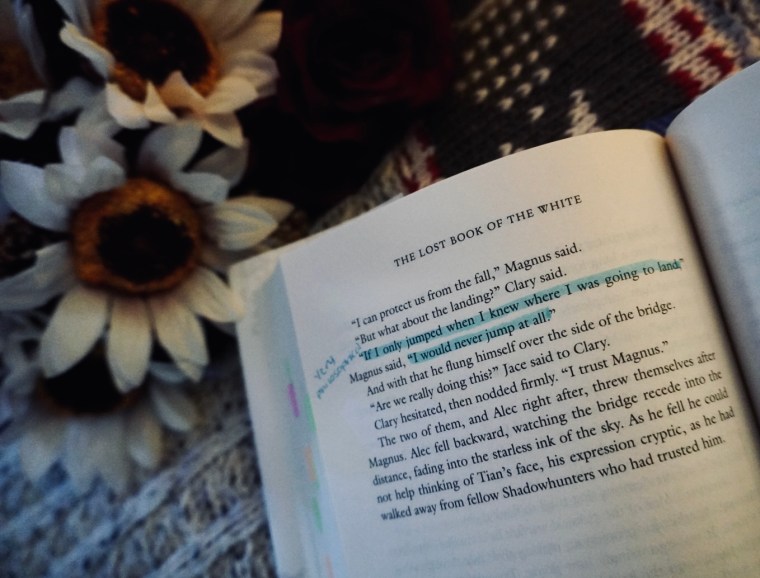
“Sometimes you just go. You know that.”
“But that can get people hurt.”
“You do crazy, rash things all the time!”
“Yeah, but that’s just risking me. I can risk my safety. It’s different to risk other people.” (244)
I LOVED this. Jace is finally, finally, realizing that his actions have consequences that affect not only just him. And he comes to this conclusion because he’s facing down the decision of taking over the Institute, where every single choice he makes will affect a large number of people. It took him a few years, but he got it.
I also liked the symbolism of jumping off the bridge to arrive at this moment. It represents how you often have to make difficult decisions without knowing the outcome and having to trust your gut instincts, and it showed the level of trust Team Good has in Jace’s plans. He’s a natural leader.
Bonus quote: “You are, actually, good at plans. It’s just usually you’re yelling them behind you as you sprint toward danger.” (Magnus to Jace, 343)
My second favorite subplot is Simon’s existential crisis.
From the very beginning of the novel, Magnus notices that Simon hasn’t exactly been himself recently. I adore that Clare and Chu had Magnus notice this first. The warlock has become protective of Simon, because he’s the one who convinced him to reenter the Shadow World. That didn’t stop after he ascended.
Simon is one of my favorite underrated characters, and he’s been through it. After watching his best friend from the Academy die at the mercy of the Mortal Cup, I didn’t expect him to just march into life as a Shadowhunter unphased. That’s not who he is as a character.
In TLBoTW, Simon becomes overwhelmed with what it means to be a Shadowhunter. He’s kidnapped by Sammael immediately upon entering Diyu and is tortured by the Prince of Hell. After being rescued, he thinks it’s time to cut their losses, count their blessings and beat feet out of Diyu. But the other Shadowhunters and Magnus are dedicated to their mission.
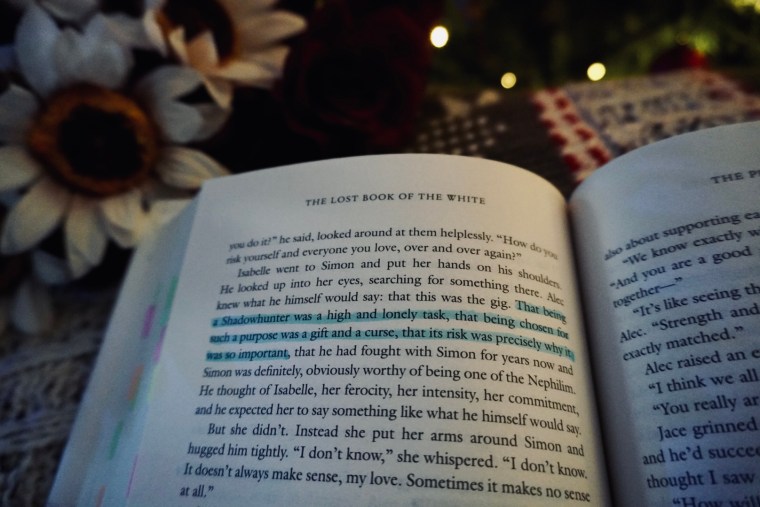
“It’s too much gambling. You can’t win every time. Eventually you lose.” (283)
“This time it worked out. What about next time? And by the way, next time is tomorrow. How do you do it? How do you risk yourself and everyone you love, over and over again?” (284)
This is seriously such a powerful breakdown by Simon, because, unlike the others who were born into this world of magic and danger, he chose this life. He will always have that lingering question about whether or not he made the right decision. The others don’t really question what it means to risk your life in the name of protecting the world from demons because it’s what they are born to do, but Simon has an outsider’s perspective on how fucked up it is.
It’s overwhelming to have to risk yourself and everybody you care about day-in and day-out. It’s very realistic, and I appreciate Clare and Chu including this perspective.
Another quick hit about the inclusion of the TMI gang is how soft Izzy is with Simon. She knows he doesn’t respond well to preaching, so when he has this breakdown, she soothes him. She tells him she doesn’t have an answer to why they risk themselves, she holds him, she whispers comforting sentiments.
Even Alec is surprised to see his sister so soft, but it’s a testament to her growth. She is not as guarded or defensive as she was in TMI. She seems more at peace, which is beautiful.
TMI gang A+++++
We tried to prevent the Cold Peace
The Lost Book of the White isn’t all about revisiting old friends, it’s also about meeting new faces. Well, one new face in particular — Ke Yi Tian. If that name sounds vaguely familiar, it’s because Tian is a member of the Ke family. Who else is a member of the Ke family? Jem Carstairs — Ke Jian Ming.
I liked how Clare and Chu immediately established this connection, as it almost gives readers the nod to trust this new character. Tian is a distant relative of daddy Jem, A.K.A. the purest soul to ever roam the earth, there’s no way he’ll betray you.
Wrong. Kind of.
I thought Tian was a fascinating addition for a couple reasons:
First, he ends up being a sort of tour guide (in more ways than one) for our group as they adventure through Shanghai. He knows the lore, the culture and the traditions of his home city; so our protagonists can lean on him for accurate information rather than leaving room to misconstrue details they read in books.
This is smart writing on Clare and Chu’s part, as well. Without Tian, this story could very easily fall into a pit making it look like a bunch of white kids — well, young adults — and Magnus were butchering the rich and vibrant culture of Shanghai.
Instead, readers get to learn about the Shadow World’s history in Shanghai through Tian and the stories passed down through generations — from the war with Baigujing and Yanluo, the search for the portal to Diyu, the lore behind Black and White Impermanence and the giant tiger Hu Shen.
It’s much more impactful to the novel as it makes Tian more reliable and involved. It makes you trust him more.
And second, I really, really enjoyed how Tian’s relationship with the faerie Jinfeng gets to highlight how the Cold Peace is affecting the Shadow World. It allows for some social commentary on the politics readers see boil over in The Dark Artifices trilogy and for our heroes to reflect on how little impact they had in the reparations for the wars they won.
“The Law is hard. It’s too hard. It’s become so hard and brittle that it has begun to break. … We are a house divided. A house broken into pieces.” (Tian, 236)
We are about two years away from the battle with the Cohort and tension is already beginning to rise. Our TMI gang aren’t supporters of the Cold Peace, they argued against it, yet they have to uphold it. They won the war to protect Shadowhunters and Downworlders alike, but they are still the judge, jury and executioner in the eyes of the Downworld.
Tian and Jinfeng’s relationship is technically illegal due to the Cold Peace. It leads Tian to do some … eh … questionable things in the name of love. Tian delivers a double betrayal.
I saw the first coming a mile away.
It was obvious that Tian was up to something sketchy. The biggest hints were him being missing during the deliverance of Dark and White Impermanence before the portal to Diyu opened in the Sunlit Market and the fact he led the gang through Diyu and straight to Sammael. As the kids say, he was super sus.
Tian’s reasoning for aligning himself with Sammael was both heart-wrenching and selfish. A war is coming, the Shadowhunters are divided and Tian is doing what he has to in order to protect himself and his girlfriend.
“It’s noble to sacrifice for love, isn’t it? I’ve been taught my whole life that that is noble. To sacrifice everything. That is what I have done. Sacrificed everything for love.” (238)
And this leads to the most surprising part of TLBoTW — Magnus defending the Nephilim’s sacred duty.

“All love is important. Your love is important. And for some people, their love can be the single most important thing, more important than even the whole world. But not for Shadowhunters. Because keeping the whole world safe is not everyone’s reason for being, but it absolutely is yours.” (239)
I squealed while reading this. It’s a throwback to City of Heavenly Fire, when Magnus insisted he wanted somebody who would choose him over the world and then Alec said he didn’t want the world, he wanted Magnus.
This is a fresh take from Magnus and shows signs of growth and maturity. I think being adopted by this group of chaotic yet loyal Shadowhunters has made the warlock softer toward Nephilim and more understanding of their job as protectors of the world. The world is now home to their son, and it needs to be safe. I think if given the choice of saving the world or saving Magnus, Alec would be expected to save the world. For Max.
Back to Tian. He’s not really working for Sammael. He was cornered into a partnership by Ragnor and Shinyun, who threatened to feed information to the Cohort about his relationship with Jinfeng if he didn’t cooperate. Tian made the most out of his servitude to Sammael by learning the layout of Diyu, which helped him find Izzy and rescue Simon.
So, he’s a good guy after all, that I didn’t see coming. I appreciated Clare and Chu turning Tian into a protagonist after all, because it helps our original gang learn to trust those outside their circle. Not everyone is going to betray you, but everyone is dealing with their own hardships and they have to make hard decisions because of them.
“It’s getting worse among Shadowhunters. Less and less trust. More and more secrets. I don’t know how far the system can bend, before it breaks.” (Alec, 280)
Yes. This one single quote encapsulates the entirety of The Shadowhunter Chronicles, honestly. All Shadowhunters are constantly keeping secrets from each other because they fear the Clave. The Clave cares more about upholding the Law than it does about the wellbeing of its people, and they are weaker because of it.
This perfectly sets up TDA and the collapse of the Clave as we know it. Tian also builds another bridge for Alec becoming Consul by urging him to be loud in the face of the rising Cohort. Little does Tian know that Alec’s voice will become the loudest. We love some good foreshadowing.
New guy gets an A.
SO DOMESTIC IT HURTS
Now it’s time for the main course: Magnus and Alec.
I adore Malec with my entire heart and soul. I love them individually. I love them as a couple. I love them as parents. I love everything about them. They’re some of my favorite characters to ever exist.
OK, now that that’s out of the way, I have a gripe.
I had trouble getting through The Lost Book of the White and even more trouble writing this analysis. It felt slow, inconsequential and at points boring. Even as the plot plowed its way through actual hell, I found myself yawning. The pacing of this book was incredibly painful compared to other Cassandra Clare works.
After scouring through my notes, I think it might be intentional due to the domestication of our heroes. Alec and Magnus have, for lack of a better term, settled down as Max’s parents. This is amplified by Magnus’ carefree personality that allows him to brush off danger and the scary indifference and lack of urgency by Sammael. Collectively, this all led to an unevenly paced novel.
Not that I didn’t enjoy the majority of this book. In fact, I adored all the fluff. It was just hard to immerse myself as completely in the story as I have in Clare’s other works.
TLBoTW is wonderful, especially in what it delivers in terms of Alec and Magnus’ progression through life. It dives into how this pair is adjusting to their new domestic lifestyle — trying to find time to be intimate with a baby with a sixth sense, reading troubling bedtime stories over and over again, realizing that the world is so much more precious now that it’s where your child calls home and rediscovering who you are as a couple once you become a parent.
“They loved Max, they loved him more than life itself, but it was also true: they were still them.” (86)
What hit me the absolute hardest was seeing the fear Magnus and Alec experienced upon realizing their lives were inherently dangerous. It’s Alec who comforts Magnus when the warlock expresses his concerns for their baby who will grow up experiencing prejudice and danger simply for being born and then for being raised by a Shadowhunter and an Eldest Curse.
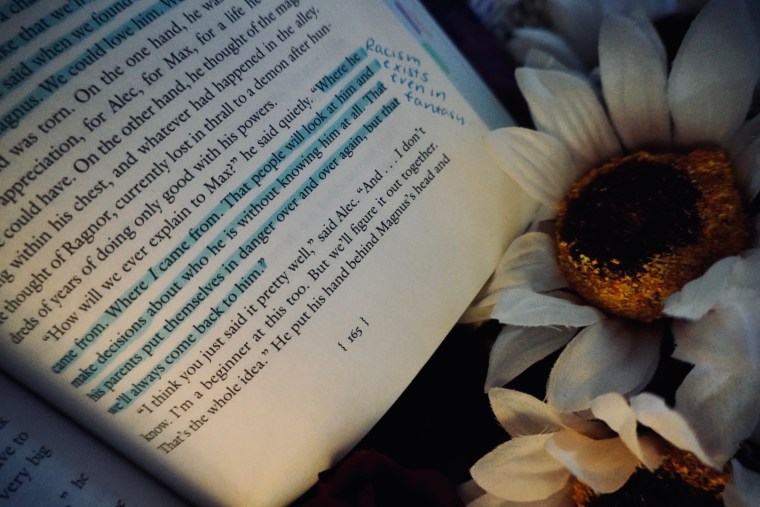
“I like our life. I like that I don’t know what will happen next. I like that we get a chance to give Max the kind of life that warlocks rarely get. I like that we’ll be doing it together. You remember what the note said when we found Max? ‘Who could ever love it?’ We could, Magnus. We could love him. We do love him.” (165)
This little glimpse shows how far Alec and Magnus have come as a couple. They’re not afraid to share their fears and concerns with each other, instead they communicate, they reassure the other, they create a support system within themselves. Readers actually see Alec call Magnus out quite a few times in TLBoTW for concealing his true feelings for the situation at hand, and then Magnus will break down his walls to open up. Growth.
Both Alec and Magnus have a moment in this book where they think of how there’s a very real chance that there could be a time when neither of them would survive to return home to their son — and, if faced with the choice, one parent was parent than none.
“A conversation with Max, a horrible conversation, about how Magnus wasn’t going to be back, how it was just the two of them now.” (Alec, 276)
“But the choice between him and Alec both definitely dying, and only of them dying, was no choice at all. Max was waiting at home. Better one parent than no parent. The calculus of it was self-evident, the conclusion inevitable.” (Magnus, 330)
This is very similar to the lesson Jace learns about how his reckless actions affect more than just him. Alec and Magnus learn they can’t put protecting each other over making sure Max doesn’t end up an orphan. Though Alec still stabs himself with the thorn not knowing if the Alliance rune would keep him from dying, so I’m not sure if the lesson was learned fully. *sigh*
While I’m talking about Max and the idea of family, let me just scream into the void about how much I love the way Magnus has acclimated into the TMI family. Throughout TLBoTW, Magnus’ inner-monologue is full of little quips from the warlock about his newfound family. He shows concern for Simon and notices he’s not his usual self, he thinks about getting Izzy a chain whip as a gift, he compliments Jace on his strategies, and he always has a soft spot for Clary (his little warrior woman).
Magnus, who was taught that being a warlock was a lonely life, has found friends that have made him family — family who will walk into hell and face down a Greater Demon to save his life. Clare and Chu did an awesome job with the subtlety of showing Magnus’ attachment to this group of Nephilim, and it made my heart happy.
“Those so-called sentimental attachments — they are where strength comes from. Where real power comes from.” (253)
Magnus has once again learned the power of friendship, and he’s wielding it.
Finally, the scene that absolutely broke me in unimaginable ways was at the end when Clare and Chu give readers a flashback to Magnus comforting Catarina Loss after the Herondale boy she saved dies of old age. Magnus seems to be the go-to guy to meet up with after a hard loss, and I think it’s because he’s held onto the idea of love and humanity despite his immortality.
“Life seems to me to be a matter of choosing love, over and over, even knowing that it makes you vulnerable, that it might hurt you later. Or even sooner. You just have no choice. You choose to love or you choose to live in an empty world with no one there but you. And that seems like a truly terrible way to spend eternity.” (348)
I love Magnus Bane, and I’m weeping. This quote is gorgeous — absolutely gorgeous.
It felt like the perfect way to wrap a very loose bow on this story as a reflection of how Magnus has always fought for love and he now gets experience all it has to offer.
Magnus and Alec? S-tier.
Final thoughts
I called The Red Scrolls of Magic a casual read in my review. Despite the description feeling innately wrong. I stand by it. It’s a really great casual read. However, The Lost Book of the White definitely feels more than casual.
It’s a fun read, a thoughtful read and an essential read if you’re a Shadowhunters fan.
Magnus and Alec are now confident and fully committed in their relationship, settling into a domestic life with their toddler son. Only their lives are still dangerous and they must balance what it means to be both a hero and a parent.
Maturity takes a front row seat in this novel as familiar faces from The Mortal Instruments return as full blown adults rather than angsty teens. The gang’s all grown up and it’s up to them to decide how they move forward in the Shadow World.
It’s an entertaining plot full of silly snark, hard choices and bittersweet backstory. The pacing is uneven and the villains disappointingly subpar, but Clare and Chu still found a way to weave an incredibly new, fascinating and suspenseful adventure that feels like catching up with old friends.
Plus, they leave readers with a cliffhanger for the ages. Lucifer?
4 hell dimensions out of 5.


 Life of Bry
Leave a comment