What to Read Wednesday No. 1
There’s something about being told I have to read a book that immediately makes me want to hate it.
I’m not talking about friends and fellow book lovers enthusiastically insisting for me to read the latest book that touched their soul. That’s something I absolutely adore, because I feel like they’re sharing a personal piece of themselves with me. Keep doing that, please.
What I’m talking about are the books forced upon oneself by the education system, whether it’s a worn copy of a beloved classic handed out by a high school English teacher or an obscure work of fiction that’s essential for a Gen Ed college course that you can’t find a free PDF of online.
Those are some of the worst books I’ve read in my entire life. I’m looking at you, Frankenstein! In fact, my AP English class senior year of high school hated Frankenstein so much that we didn’t even finish it. Our teacher took our relentless snark and complaints to heart, and we Shmooped to the end of the book.
I still hold it as my least favorite book of all time, purely because of the amount of hatred we built up for it in AP English nearly eight years ago. In reality, it’s probably not that bad, but I’m definitely never going to reread it. Sorry, Mary Shelley.
However, sometimes educators get it right.
My AP English teacher also handed me To Kill a Mockingbird by Harper Lee and that stands as my all-time favorite book. Plus, my college professors were pretty great at choosing some interesting and unique works for my literature and writing courses. You get the good and the bad, I guess.
Here’s three books I read in college that I didn’t hate.
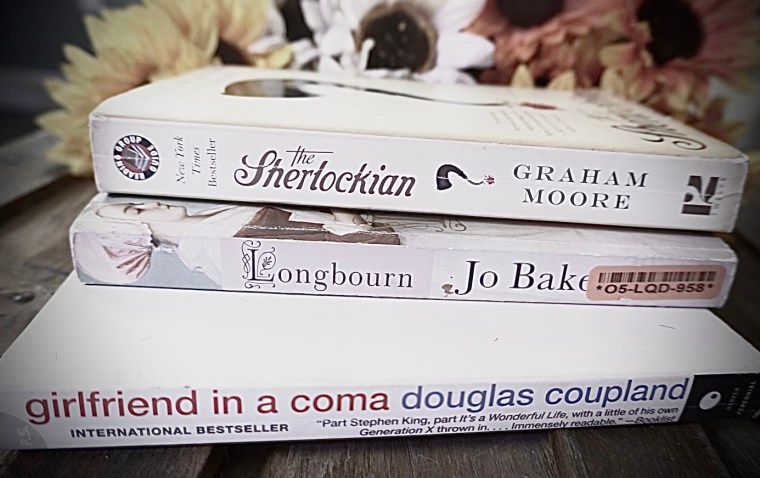
Girlfriend in a Coma by Douglas Coupland
This was required reading for my second-semester freshman writing course, and I remember being shocked about the difference between the books handed to me in high school and those I was forced to buy in college. (Can you tell I hated buying required books?)
My professor for this course was pretty eccentric. He once told us about the time he was sitting in a coffee shop and somebody fell from the roof onto the sidewalk in front of the shop’s window. Nobody looked up from their coffee. I still wonder if that story is true or if he made it up as a way of symbolizing the way the world will always keep spinning even if your own world collapses. You could die and most wouldn’t look up from their coffee. The world is brutal.
Also, the thing I remember most about this course was that it was a small group of about a dozen liberal arts students, and we figured out that the majority of us were left handed (like 8 out of 12). Perhaps that proves the theory that lefties are mostly creatives.
Anyway, Girlfriend in a Coma, written by Douglas Coupland and published by HarperCollins in 1998, follows a group of friends growing up in Vancouver in the late 1970s. The novel is split into three parts.
In part one, 17-year-old Karen Ann McNeil falls into a coma after washing down some valium with alcohol. There’s a couple twists. First, she seemed to have been expecting for something drastic to happen, leaving a letter for her boyfriend Richard that detailed dreams that left her wanting to sleep for a thousand years to escape the dystopia she saw. Second, she was unknowingly pregnant.
The remainder of part one follows the 17 years after Karen’s tragic accident. Her group of friends move through life without her. Richard struggles with the loss of Karen and the gaining of a daughter, along with the responsibilities of fatherhood. The others balance the typical conflicts of growing up. They get lost in work, in chasing dreams or the emptiness of not having any, in drugs and alcohol, and in making money to afford more drugs and alcohol. Somehow, despite drifting apart in life, they all come back together, unable to fully escape the draw of the North Vancouver suburb they all called home … and the fact they all get hired for a supernatural television series.
Then, Karen wakes up, nearly two decades after falling into her coma.
Part two follows Karen’s reentrance to life and a world that is now foreign. She still feels mentally 17, but yet she’s in her 30s and has a 17-year-old daughter. The world moved around her, while she slept. Then, the vivid and terrible dream she had 17 years ago becomes a reality, and Karen is awake to see the rest of the world fall asleep.
I don’t want to spoil anything, so I’ll just say that part three deals with the aftermath of part two. That’s it.
Why you should read it. It’s thought-provoking. Girlfriend challenges readers by having the characters challenge themselves with life’s most mysterious questions. Through cynical comedy, Coupland presents questions on one’s purpose in life, where one stands on values and morality and why, the interpretation of youth and what it means for it to be gone, and so much more.
It’s the perfect novel for a 20-something-year-old (or 30-something) to read and reflect on. Though, beware, it’s quite capable of giving one a quarter-life crisis. I think that’s why this professor had us read it freshman year of college. It’s an eye-opener.
It’s also a wild ride, full of twists and turns. It’s fun and funny despite being devastating and disturbing. It’s one of those books you simply can’t put down once you’ve started it.
Warnings: It can be confusing. The narrator changes along with the POV. In fact, the first chapter is narrated by Jared, a friend of the group who tragically passed away from leukemia, then it flops to be narrated in the first-person by Richard for the remainder of part one. Part two doesn’t have a narrator at all, while part three swings back to Jared.
If you’re looking for a casual, easy book to simply pass time, this probably isn’t for you. Girlfriend requires thought and poses questions that demand answers.
Favorite quote: “There are things we cry for in life — things that are lost, things that are found, and things that are magnificent.”
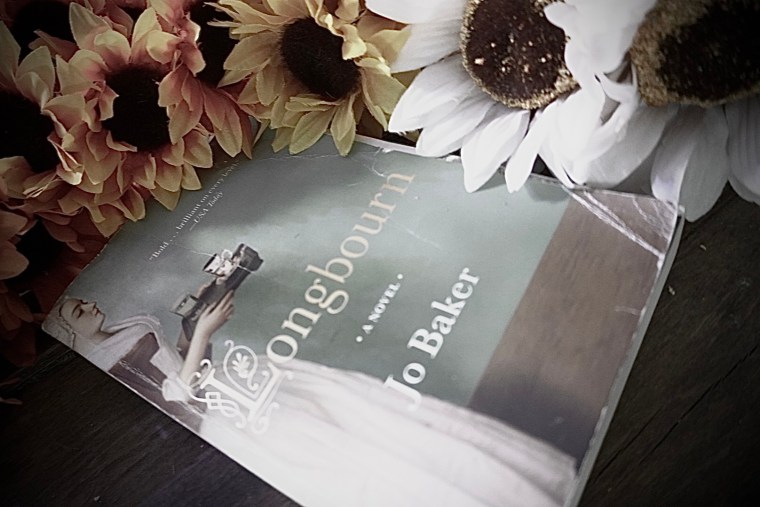
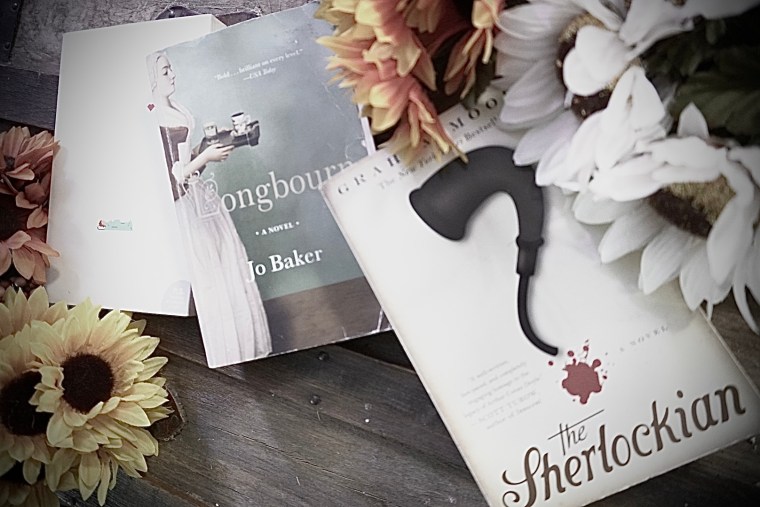
Longbourn by Jo Baker
My final semester of college, I took Fiction 101 to fulfill a literature credit I needed to graduate. The class consisted of me and about 20 awkward freshmen that refused to answer questions or participate in any type of discussion whatsoever. I ended up filling the silences, because the professor was sweet, passionate and clearly trying her best.
The course had us read a classic book first, in this case Pride and Prejudice by Jane Austen, and then a more modern novel based on the original. It was a really fun and cool concept for a class, and I loved comparing classics to contemporary works and seeing the influence of literature.
Longbourn, written by Jo Baker and published in 2013, tells the story of the servants who lived in the Bennet family home during the events of Pride and Prejudice. The Bennet family takes a backseat in this tale, making Longbourn feel less like a retelling and more like a fresh perspective on one of history’s best love stories. (I despise Mr. Darcy and P&P, by the way.)
Instead, this novel tosses aside the Bennet family to make way for the, in my opinion, more interesting Sarah, Polly, James, and Mr. and Mrs. Hill as they struggle to manage the large household with so few hands. Longbourn is in part a love story, but a much more powerful one than the frivolous affairs of Pride and Prejudice. This is not a bunch of privileged girls desperate to find the affection of a man to ensure their family’s money will not be handed to a cousin, instead it’s the impactful story of people whose lives and choices on love aren’t entirely their own nor are they what matter most.
Sarah falls both for Ptolemy, the Bingley family’s footman, and James, the mysterious new footman for the Bennet’s. However, the love triangle between servants is just the tip of the iceberg of what was happening underneath the frilliness of P&P. The servants have secrets, secrets that mingle with the families that employ them, and Longbourn hangs them out to dry like laundry on a clothesline. True identities are revealed, affairs unearthed, proposals rejected, and love both denounced and found.
I can’t even give more details, because I don’t want to spoil anything.
Why you should read it: Personally, I think that Longbourn is better than Pride and Prejudice. I know, that’s a spicy take. If you enjoyed the original, you’ll absolutely adore Baker’s take on the happenings behind the scenes of the events of P&P. Even if you didn’t like Austen’s classic novel like myself, I believe you’ll find something to enjoy in Longbourn. It’s a realistic love story with complex characters who form a family amongst themselves as people with little to no power over how their lives play out.
Warnings: If you’re looking for a fun, light-hearted rendition of this classic, like Pride and Prejudice and Zombies, this isn’t it. Longbourn isn’t an easy read. It faces the harsh realities of the Bennet’s servants. While the Bennet sisters are obsessing over their woes about the need to marry to keep the house and family wealth, the servants live on penniless, fatherless, and without a home to call their own. The Bennet sisters have control over their futures, even if they don’t see it that way. The servants in Longbourn don’t have that luxury.
Readers must prepare their hearts and souls for the cruelty of the characters’ lives. It’s raw, real and a blow to the heart and soul.
Favorite Quote: “Life was, Mrs. Hill had come to understand, a trial by endurance, which everybody, eventually, failed.”
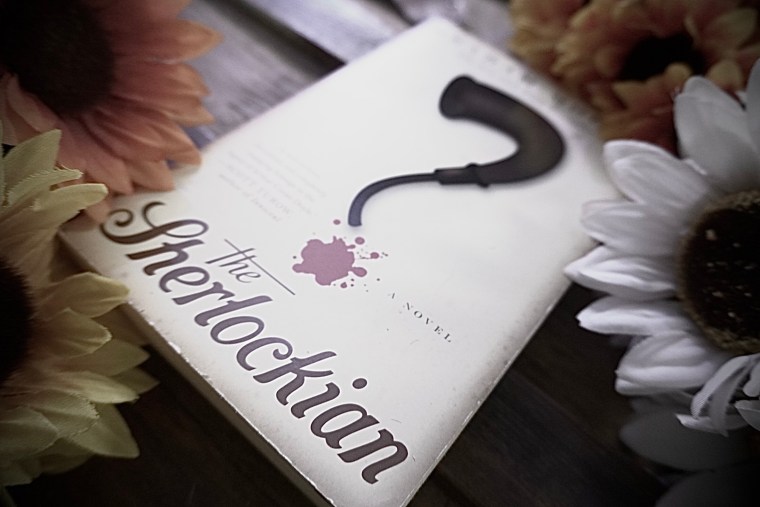
The Sherlockian by Graham Moore
This novel was also required reading for the same course as Longbourn. My professor truly killed it by finding interesting current books that linked back to classics and revolving her class around comparing them.
Prior to reading this 2010 historical mystery novel by Graham Moore, this professor had us read both Dracula and a variety of Sherlock Holmes stories to prepare us for the epic journey of The Sherlockian. I wrote my final paper on this novel, which filled up two whole blue books and gave me carpal tunnel. My professor actually gave me a hand-written note and a copy of The No. 1 Ladies’ Detective Agency by Alexander McCall Smith after our final exam as a thank you for participating in class. I cried after.
The Sherlockian goes back and forth between two storylines set in entirely different centuries. In the 1890s, Sir Arthur Conan Doyle killed off his iconic character Sherlock Holmes and London is in mourning. Conan Doyle receives a letter bomb, and, due to the police’s incompetence and refusal to help catch the criminal, decides to solve this mystery on his own. Well, not completely on his own. He reaches out to friend and fellow author, Bram Stoker, for help. Stoker becomes the Dr. Watson to his Holmes, with Conan Doyle keeping all records and findings in a diary that later goes missing.
That brings us back to present day, where 29-year-old Sherlockian Harold White realizes his dream by becoming an official member of the very elite Holmes society called the Baker Street Irregulars. However, a renowned Sherlock scholar, Alex Cale, who claimed to have discovered the infamous missing diary, is found murdered in his hotel room, and White becomes the No. 1 suspect for killing Cale to steal the diary. In an effort to clear his name, he sets out to solve the mystery of Cale’s murder and find the missing diary, with reporter Sarah Lindsay as his Watson.
Both mystery-solving duos find themselves in more danger than expected and discover that some mysteries are best left unsolved and there’s not always a satisfactory ending to an investigation.
Why you should read it: The Sherlockian is so incredibly fun to read. It’s relatively short and absolutely thrilling, meaning it’s quite possible to finish it in one sitting. You’ll fall in love with the friendship between Doyle and Stoker, who were friends in real life, and you’ll be rooting for White to prove his worth in the elite Holmes society. Most importantly, you’ll find yourself wondering what all of London was wondering in the 1890s, why did Doyle kill off his great detective just to bring him back years later?
It’s also based on some truth. There is a missing Doyle diary from the time period between when the author killed off his beloved character and when he revived the legendary Sherlock Holmes. In 2004, Holmes scholar Richard Lancelyn Green did claim to have found the diary but that Doyle’s heirs stole it from him. He was later murdered and the diary still remains missing.
Warnings: You’ll love it too much and simply won’t be able to put it down as the mysteries unfold. It’s a good book, trust me. Read it.
Favorite quote: “Why, of course, if the reader were smart enough, he could figure the whole thing through after just the first few pages! But in his heart Arthur knew that his readers didn’t really want to win. They wanted to test their wits against the author at full pitch, and they wanted to lose. To be dazzled.”
Honorable Mentions
Life of Pi by Yann Martel … This book’s ending kept me up at night. Also, my blog’s name is a pun of this title. It’s way better than the movie, but when isn’t the book better?
Dracula by Bram Stoker … One of my favorite classic books. I’ll definitely be talking about this book more in a future post.
Winesburg, Ohio: A Group of Tales of Ohio Small-Town Life by Sherwood Anderson … Another very eccentric book that has unconventional storytelling and a deep psychological element revolving around small-town life in the early 1900s.
A Series of Unfortunate Events by Lemony Snicket (AKA Daniel Handler) … My third grade teacher read A Bad Beginning to the class, and it became the first and longest book series I have ever finished.
Question(s) of the week!
What books have you read as part of a class that didn’t suck?
What’s a book you despise with a passion out of spite?

 Life of Bry
Leave a comment