Magnus Bane is an extremely glamorous and very powerful warlock with a storied past. Until now, Magnus has kept the tales of his life a mystery, only divulging minor details to those he trusts most when he appears throughout Cassandra Clare’s The Shadowhunter Chronicles.
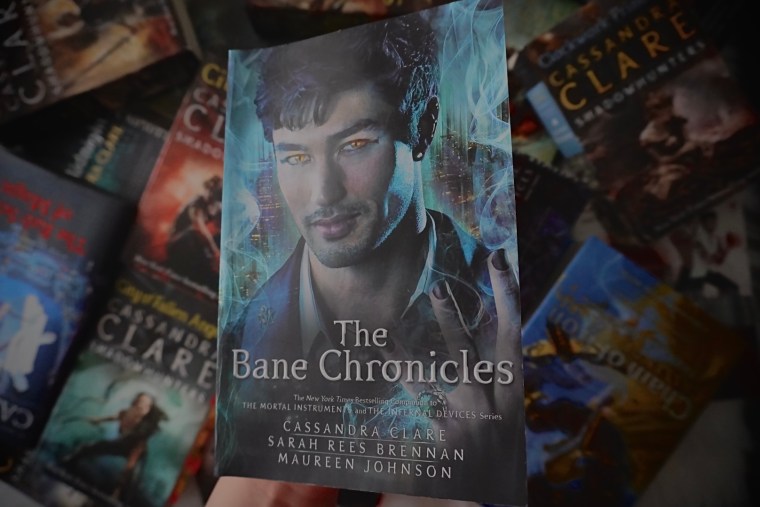
The Bane Chronicles, co-written by Clare, Sarah Rees Brennan and Maureen Johnson, showcases 11 short stories of Magnus’s long, illustrious life and some lessons he’s learned along the way. Readers get an inside look at the challenges Magnus faces as a Downworlder, person of color and member of the LGBTQ+ community throughout history; the warlock’s passion for fashion and party mentality; his many encounters with angsty Herondale boys; Bane’s warm heart and solid gut feeling; and his quest to keep his humanity and continuously find love.
Magnus is one of my favorite characters from Clare’s books. I love that he’s timeless and helps tie all her stories together. He’s always a voice of reason among otherwise headstrong and irrational teenage Shadowhunters (and an ignorant Nephilim governing body).
Magnus feels like a character you can never know enough about, which makes The Bane Chronicles such a fabulous read for those who already fell in love with him during The Mortal Instruments and The Infernal Devices. I didn’t expect much from this book because of the format. Novella collections tend to be more light-hearted and fun without adding too much depth to an overall story. This is often because you don’t want to have these short stories be necessary to read to enjoy the full series.
The opposite could be said for TBC. It provides wonderfully fun stories of Magnus’s adventures through time, while also giving real heartfelt insight on how he became the warlock we know today. Because of these 11 stories, I feel like I can better understand Magnus and the choices he made during TSC’s series. Meanwhile these stories aren’t vital to enjoying and understanding the rest of Clare’s works.
Side note! Cassandra Clare confirmed multiple times that TBC is essentially the notebook Magnus gave Alec at the end of City of Heavenly Fire with the stories of his life he wrote in the weeks following their breakup.
Here are all my thoughts on The Bane Chronicles.
A Herondale Problem
Magnus Bane simply cannot avoid the Herondales.
While we already know about his time with Will in The Infernal Devices and his hand in Jace’s path of discovery in The Mortal Instruments, Magnus has a much stronger connection with the Herondale bloodline than previously thought. In The Bane Chronicles, we learn about three additional Herondale boys that walked into and out of Magnus’s life, leaving both lasting and devastating impressions.
Edmund, James and Stephen Herondale are each unique in their own way and they cross the warlock’s path under varying circumstances, but they all have one thing in common — Magnus wants to help them.
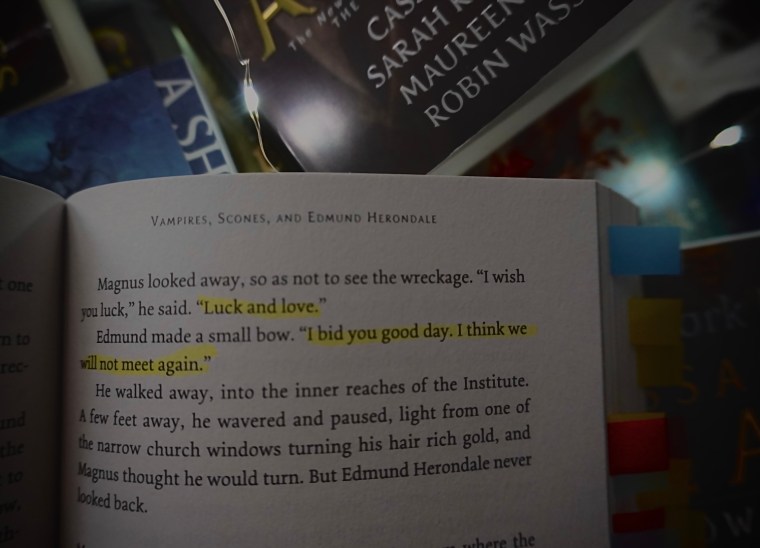
In “Vampires, Scones, and Edmund Herondale”, Edmund follows Magnus out of the London Institute after being told to stay away from him while listening in to the preliminary meeting for the Accords.
“No fewer than four of my esteemed elders told me I was on no account to ever converse with you, so I vowed that I would know you. My name is Edmund Herondale. May I ask your name? They referred to you only as ‘that disgraceful one-warlock show.’”
(Edmund to Magnus, Page 115)
They shared a night of drunken debauchery and spoke of love and life.
“I am not perfectly certain I believe in marriage. Why have just one bonbon when you can have the box?”
(Edmund, Page 117)
Magnus then watched as the fair-haired boy, who didn’t quite believe in love or marriage, fell head over heels for a girl that very same night.
The issue? The girl was mundane and didn’t wish to attempt Ascension to become a Shadowhunter, nor did Edmund want to take the risk of having the girl he loves die at the hand of the Mortal Cup. He tells Magnus that while he spent his life devoting himself to the Angel, he cannot give up love.
“I cannot believe the unfairness of it, that I have found the one woman in all the world whom I could love, and what does the Law say this feeling that I know is sacred? In order to be with her, either I am meant to ask my dearest love to risk her life, a life that is worth more to me than my own. Or I am meant to cut away the other part of my soul — burn away my life’s purpose and all the gifts the Angel gave me.”
(Edmund, Page 135)
Magnus had to stand by and listen to Edmund’s screams of anguish as his Marks were stripped for choosing love over his call to Glory. Magnus wanted to go to the boy, protect him from the Nephilim and save him from the pain, but the Shadowhunters of the London Institute wouldn’t allow it.
“This was the price Shadowhunters set on love … The long lonely cry of a suffering boy he could not help chilled Magnus through to the bone, like cold water seeping through to find a grave. Sometimes he thought they were all forsaken, every soul on this earth. Even the Nephilim.”
(Magnus, Page 143)
The story of Edmund is painful and stands as a cruel reminder of how harsh the Shadowhunters can be even to one of their own. The fact that Magnus so badly wished he could help Edmund but knew that the boy had already made up his mind and couldn’t do anything about it, left the warlock so distraught that he left London all together.
Side note! Perhaps Magnus saw a bit of himself in Edmund who knew the cost of love and still chose it despite the tragedy that would follow. Magnus knows that his immortality means that falling for a mortal ends in pain, but he’s willing to continuously love and be loved.
Edmund may be the first Herondale boy to cross Magnus’s path, but he would not be the last.
“Years later another desperate Herondale boy with blue, blue eyes would come to his door, shaking with the cold of the rain and his own wretchedness, and this one Magnus would be able to help.”
(Magnus, Page 147)
But Will would not be the last Herondale either. In “Midnight Heir”, Magnus stumbles upon a boy with disheveled black hair, golden eyes and an all-around beauty that “made Magnus think of cities burning.”
Of course, he’s the son of Tessa and James, and they showed him nothing but love and patience. However, he is still an angsty Herondale.
“My father was cursed. Whereas I? I’m damned.”
(James to Magnus, Page 164)
I loved how James was such a wild card. He gets drunk, takes on a bunch of bets and starts shooting things. I also adore how Magnus saw this broken Herondale boy and simply followed him around, determined to get him home safe. He pulled James from the river to stop him from drowning, scooped the half-conscious boy up in his arms and carried him to the Institute and into the loving embrace of his parents.
Magnus sees the despair and hurt that James is holding onto and pleads with the boy to let him in on the secrets of his woes and to allow the warlock to help him, just as he did for Will.
“Do not mistake my despair for nobility in disguise, for it is not that. I suffer for myself, not for anyone else … I gave my word I would never tell. And there is not a living soul on this earth who can help me.”
(James to Magnus, Page 176)
While Magnus leaves the Institute without James confessing his reasons for being so distraught, the warlock discovers it all on his own. Tatiana Blackthorn tries to hire Magnus to kill five Shadowhunters for her, and he obviously refuses. On his way out of Blackthorn Manor, he asks Tatiana’s ward Grace if she needs help to escape the grasp of the mentally-unwell Mrs. Blackthorn. However, Grace is just as ruthless as her adoptive mother, and it all clicks for Magnus. James muttered the word “Grace” after being dragged from the river. He fell in love with a girl who was equally cruel as she was beautiful.
“Tessa, Will, and Jem had raised James in love, and had surrounded him with love and the goodness it could produce. But they had given him no armor against the evil. They had wrapped his heart in silks and velvet, and then he had given it to Grace Blackthorn, and she had spun for it a cage of razor wire and broken glass, burned it to bits, and blown away the remains, another layer of ashes in this place of beautiful horrors.”
(Magnus, Page 195)
There was nothing Magnus could do for James once he knew the truth. The boy fell in love with a girl who would take advantage of his kind heart. If Magnus strode back to the London Institute and told Will and Tessa the reason behind their son’s recent shift in behavior, it would only cause drama between the Nephilim. It would not help James, and I don’t blame Magnus for not wanting to insert himself into the lives of Shadowhunters, especially those who were planning on murdering their own kind. James would have to help himself.
“He had offered help to three Shadowhunters this night. One of them had replied that he was beyond help, one had asked him to commit murder, and one had pointed a blade at him.”
(Magnus, Page 198)
Several decades later, Magnus would meet another Herondale that he would not be able to help.
In “The Last Stand of the New York Institute ”, Magnus comes face to face with Stephen Herondale, seemingly the last of Will and Tessa’s line, when Valentine Morgenstern’s Circle arrives in New York with the intent to kill an innocent werewolf family. The fair-haired boy with deep blue eyes, “so reminiscent of faces Magnus had loved” was not like the other Herondales he had met in the past. This Herondale had hate coursing through his veins.
Even as Stephen repeatedly proves that he’s fully devoted to Valentine and his stance on destroying Downworlders, Magnus tries to think of a way to help the boy just as he did for so many of his ancestors.
“Magnus looked at Stephen, at his beautiful face and his weak mouth. Magnus had a sudden impulse to tell the Shadowhunter that Magnus knew and loved his ancestor, that Tessa would be so disappointed in him … Magnus said nothing. Stephen Herondale had chosen his side, and Magnus had chosen his.”
Magnus, Page 427
Stephen was too far gone for Magnus to even attempt to extend a helping hand. This Herondale has been led astray, poisoned by an evil man with a promise for power and an idea that the world needed to be cleansed with the blood of those deemed unworthy.
“Stephen Herondale would have killed me if he’d ever met me … [He] died with hate in his heart and the blood of my people on his hands. I can imagine no more horrible way for mine and Will’s line to end.”
(Tessa to Jocelyn Morgenstern, Page 436)
Sometimes, there’s nothing you can do, and, in this case, there’s nothing you should do.
Clare, Brennan and Johnson did a wonderful job at telling the stories of Magnus repeatedly colliding with the Herondale family, using the tales as a way to show the warlock’s feelings toward Nephilim and how he made his judgement calls on when he could help and when he had to walk away.
Throughout everything, Magnus alway thought it was the right thing to aid the Herondale boys. His first thought was to help or reason, then the second was whether or not he could do either of those things. Magnus has every right to despise the Shadowhunters, to scoff in their faces when they ask for his assistance or to turn a blind eye when they struggle. They tossed slurs at him, consistently acted as if his life was not worth the same as theirs, and even threw away the plates that he and the other Downworlders ate from.
But Magnus has a heart of pure gold. He tries to remember the goodness that he was shown by select Nephilim, how they can be so helpless despite their superiority complex, and that the youth is bound by a merciless governing body and a divine call to protect humanity.
These three stories of three Herondales also show readers why Magnus would be so weary to assist the gang in City of Bones. He’s seen the best of the Nephilim, but he’s also seen the absolute worst. They could’ve been like William Herondale or they could’ve all been like Stephen. It was a gamble.
The Shadowhunters owe so much to Magnus, but he owes them nothing.
Side note! I need Magnus’s reaction to when he first sees Jace. Did he immediately suspect that the boy with golden eyes and hair was not a Wayland or a Morgenstern at all? When Jace’s Herondale lineage was discovered, did he mumble to himself, “here we go again,” but was also determined that this one he could help? These are the things that keep me up at night.
The Circle is Messed Up, My Dudes (and little Clary is cute)
While we’re on the topic of Stephen Herondale and the Circle, I want to point out that I did not fully grasp how messed up it truly was. In my head, the Uprising at the signing of the Accords was a singular event they planned. They didn’t actually do anything prior. That was not the case. The Circle terrorized the Downworlder across the globe before the Uprising. They killed senselessly and indifferently.
Being able to see the violence up close in “The Last Stand of the New York Institute” was eye opening to not only the brutality of the Circle but its lasting effects.
I also appreciated how Clare, Brennan and Johnson seamlessly compared the ignorance of the Circle toward Downworlders to the way people showed disgust toward patients during the AIDS epidemic.
“Every age thought they were so enlightened, and every age was stumbling around in much the same darkness of ignorance and fear.”
(Magnus, Page 396)
This quote … It says so much. It’s a fabulous social commentary on history. Every generation believes that they are superior to the last, however, so often they are corrupted by their own fears that lead to bloodshed and misery.
Side note! Catarina Loss being a nurse and using her magic to help the sick is truly amazing. She has centuries of experience and can make a difference not just in the Shadow World but for humanity as a whole. She has seen so much death and despair throughout history, but she still carries on as a medical professional. I agree with Magnus that Catarina is more of a hero than any Shadowhunter. “The Shadowhunters had been chosen by an Angel. Catarina herself had chosen to fight.” (Page 404)
It’s important to note two things: the Circle members were still very young and they genuinely believed they were doing what was best for the world. It doesn’t make it right. It doesn’t atone for their sins, but it gives reason to their actions.
“Many of them were heartbreakingly young, a brand-new generation of Shadowhunters, shining new warriors who had just reached adulthood. Magnus was not surprised, but he found it sad and infuriating, that they should throw the bright beginnings of their lives away on this senseless hate.”
(Magnus, Page 410)
These Circle members were just exiting the Academy, getting married, and having children. Valentine gathered the best that his generation had to offer and corrupted them by exacerbating the fears that all young people have when entering adulthood. Becoming an adult can be pretty terrifying, because you’re on your own for the first time and have to face the world as your own decision maker. This is only exemplified by the Shadowhunters’ divine call to protect humanity from evil. Valentine used these innate fears to convince his peers that what they were doing was morally right, which we see when Magnus and Maryse Lightwood exchange words.
“Through the ages your mandate has been to protect mankind, to fight against evil forces until they are finally vanquished and the world can live in peace. You don’t seem terribly interested in peace or protecting anybody. What is it that you’re fighting for, exactly?”
“I am fighting for a better world for myself and my son.”
“I have no interest in the world you want. Or in your doubtless repellent brat.”
(Magnus & Maryse Lightwood, Page 415)
Oh, Magnus … In about 18 years, you’re going to be pretty interested in Maryse’s “repellent brat”.
It’s ironic that Maryse claimed to be fighting for a better world for her son, but she ends up harvesting a home environment that makes Alec afraid to be open about his sexuality. Talk about a hypocrite.
I also found it interesting that Magnus cared so much that these young Shadowhunters were essentially throwing away their bright futures on spreading hate. Of course he cared because they were killing Downworlders, but I think it was more than that. No matter what the Nephilim had done, Magnus always hoped for the best out of them.
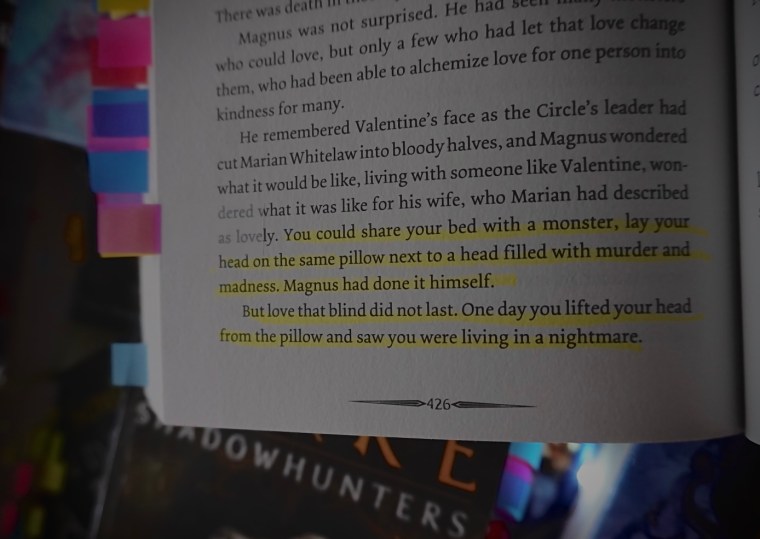
That is why he sent the fire message to the Whitelaw family of the New York Institute before running off to face down the Circle. He didn’t expect that they would come to his aid, but he hoped they had enough respect to trust his word. The Whitelaws did show up to help Magnus, and they paid for it with their lives. The Circle slaughtered the Whitelaws and covered up their deaths. Both sets of Nephilim surprised Magnus that night — one side for answering his call for help and the other for their unmasked cruelty and hatred.
Even after those horrors, Magnus still kept his hope for the Nephilim, even though it had a bitter taste.
When Valentine’s former wife arrived on the warlock’s doorstep with a baby in her arms, Magnus and Tessa Gray could have turned their backs on Jocelyn Fairchild’s desperation. Magnus sure wanted to. Instead, Tessa used it as a moment to show Jocelyn that Shadowhunters and Downworlders are not so different after all, and she is willing to help the woman despite what the Circle had personally cost her.
“I am the wife and mother of warriors who fought and died and never dishonored themselves as you have. I have worn gear, wielded blades, and slain demons, and all I wished was to overcome evil so that I could live and be happy with those I loved. I’d hoped I had made this a better, safer world for my children. Because of Valentine’s Circle, the Herondale line, the line that was my son’s children’s children, is finished … I will have to carry for the rest of my life the wound of what Valentine’s Circle has done to me, and I will live forever.”
(Tessa Gray to Jocelyn Fairchild, Page 436)
I really, really loved this interaction between Jocelyn and Tessa. These are two fierce women who have fought and continue to fight for those they love. Tessa sees Jocelyn’s desperation and devotion to her daughter’s safety and that this former-Shadowhunter also lives with what she has done in the past. This short story gave me a new-found appreciation for Jocelyn, a character who I disliked while reading TMI. She recognizes she’s done wrong, knows she doesn’t deserve help, and is actively trying to change.
“I want nothing more to do with the Shadowhunters. I want to be someone else. I want to raise my daughter to be someone else, not bound to the Clave or led astray by anybody. I want her to be braver than I was, stronger than I was, and to let nobody decide her fate but herself.”
(Jocelyn, Page 436)
That is something Magnus agrees with. He has seen first hand what the Clave is capable of. One can only imagine what the Clave would do to Clary if Jocleyn was found to be alive.
“He kept his eyes on the little girl, and thought of the young werewolf girl Valentine had blinded, of Edmund Herondale stripped of his Marks centuries ago, and of Tessa’s Jamie and Lucie and all they had borne. He would not give up a child to the Shadowhunters, for whom the Law came before mercy.”(Magnus, Page 439)
In the end, by helping Jocelyn and Clary, Magnus was able to influence the next generation of Shadowhunters.
“Valentine had wanted to crush the world as Magnus knew it. But this woman had helped crush him instead, and now she was looking at her daughter as if she would make another world, shining and brand new, just for Clary, so Clary would never be touched by any of the darkness of the past … Perhaps none of the children of the new generation — not this small stubborn redheaded scrap, or half-faerie Helen and Mark Blackthorn at the Los Angeles Institute, or even Maryse Lightwood’s children growing up in New York far from the Glass City — would ever have to learn the full truth about the ugliness of the past.”
(Magnus, Page 442)
While this generation of Shadowhunters does grow up to be burdened with a whole new brand of ugliness stemming from the past, these Nephilim will be fighting alongside Downworlders and not against them. They will be the Shadowhunters that Magnus always wanted to believe in.
“The Last Stand of the New York Institute” was my favorite story from The Bane Chronicles because of how well it framed together everything we learned about Magnus, his thoughts and feelings on Shadowhunters, and the relations between the Nephilim and Downworlders. It also gives readers some valuable background for characters they already met in TMI — for example, why Maryse and Robert Lightwood were so weary of Jace when they found out he was Valentine’s son, how Lucian Graymark and Jocelyn were able to work together to warn the Downworlders about the Uprising and redeem themselves, why Jocelyn fought so long and hard to protect Clary from the Shadow World, and a glimpse of Jace’s biological father whom we’ve only met prior through letters.
Honestly, this short story would’ve made a fantastic prologue for City of Bones. It gives readers more of a sense of what Valentine and his Circle were capable of and adds dimension to his character as a villain and those he surrounded himself with.
Phenomenal.
Love, Lust, or Just a Cold Dead Heart
Every time Camille Belcourt shows up in a Cassandra Clare book I gag a little. I can’t help it. The Infernal Devices gave readers the bitter breakup between Magnus and Camille, and The Bane Chronicles gives us the beginning of their relationship and the aftermath of its demise.
While I believe that Camille is sleazy, I now understand why Magnus fell for her. Of course she’s beautiful, but it’s more than that. She’s similar to Magnus in that she’s devoted to fashion and not afraid to be herself. In “Vampires, Scones, and Edmund Herondale”, all Camille does is smile and laugh at Magnus’s jokes, and he’s a puddle.
“Magnus had been alive hundreds of years himself, and yet the simplest things could turn a day into a jewel, and a succession of days into a glittering chain that went on and on. Here was the simplest thing: a pretty girl liked him, and the day shone.”
(Magnus, Page 129)
However, after seeing Edmund’s dreams crushed by love and werewolf Ralph Scott’s hopes for change diminished by the Shadowhunters, Magnus steps aside for the werewolf to live his mortal life alongside Camille.
“Love the boy. Give him his happiness. And when I return, I shall devote an age to admiring you.”
(Magnus to Camille, Page 144)
If you read TID, you know that the love between Magnus and Camille is fairly short lived for a pair of immortals. Magnus gave his loyalty, along with his heart and soul, to the vampire, and, in return, she tossed it aside for frivolous affairs with mundanes she’d later turn into a meal.
The difference between Magnus and Camille is the warlock has a heart. Camille is selfish and self-preservational. She made a toy out of Magnus’s devotion, seeing that he would remain faithful while she rendezvoused around the globe. She cares only for herself, while Magnus has always looked out for others.
It’s Magnus’s warm heart that makes him so devastated by seeing Camille fall into addiction in “The Fall of the Hotel Dumort”.
“When you lost someone to addiction — and he had lost many — you lost something very precious. You watched them fall. You waited for them to hit the bottom. It was a terrible wait.”
(Magnus, Page 327)
Side note! The concept of vampires becoming addicted to the blood of drug-addicted mundanes was so fascinating. It’s a fantastic way of showing how mundane culture influenced and affected the Downworld. The vampires felt they were invincible, but they could fall into vice just as mundanes.
Camille’s vulnerable state hit Magnus hard. She was not the cold, careless vampire he once knew. She was weak, which made the warlock weak with grief.
“She was crying. Camille did not cry. Even under these circumstances, Magnus was moved. He still wanted to console her, wanted to take the time to tell her everything would be all right.”
(Magnus, Page 335)
No matter what Camille had done in the past, Magnus could not allow for her and the other vampires to be burned without being given a chance. He summons the vamps with grave dirt, locks them inside the Dumort and forces them to dry out.
“There’s never been another like you.”
“Thank you for lying to me. You have always been kind. I never have been. That was why we couldn’t be, wasn’t it?”
(Magnus and Camille, Page 340-41)
That’s exactly why, Camille. Seeing Camille so defenseless, so unlike herself, shook Magnus to his core. It affected him so much that he convinced Catarina to erase his memories of Camille for the entire twentieth century.
“You know, there’s a reason we can remember.”
“That’s much easier when your life has an expiration date … I loved her. I can’t take what I saw.”
(Catarina & Magnus, Page 343
The fact that Magnus was hurt so deeply that he simply couldn’t stand to live with the memories was crushing to me. I think it was more than him not wanting to remember Camille in that state. He didn’t want to be tempted to fall back in love with her. Camille showed a softer, weaker side of herself to Magnus, and it would be easy for him to decide that he could unlock that to become a more permanent part of her personality. Magnus already knows that’s simply not possible, and he can’t bear to live with that for the rest of eternity.
TBC made me appreciate so many characters from TMI that I previously didn’t care for, but that cannot be said about Camille. I still can stand her.
Our Boy Raphael
Massive TMI spoiler ahead!
In my final review of TMI I said that Raphael Santiago’s death wasn’t impactful because I didn’t get the full sense of his relationship to Magnus. It felt cheap to add a backstory between these characters moments before killing one off.
I’m not going to retract that statement. It felt cheap at that moment.
*Cue up the “you’re entitled to your wrong opinion” meme*
However, I caught a bit of the feels reading “Saving Raphael Santiago”. I better understand why Raphael couldn’t kill the warlock who saved his life and how much that meant to Magnus.
Raphael’s mother arrived at Magnus’s apartment desperate to save her son who had gone after a vampire that was murdering children in their neighborhood. As we all know, Magnus is too noble to deny the request to save a child, plus somebody needs to put an end to the deviant vampire preying on children before the Shadowhunters find out.
Unfortunately, Magnus finds Raphael already turned and wishing for eternal death. The boy tries to throw himself into the sunlight, but Magnus stops him.
“You can’t save me. Nobody can do that.
“Magnus could taste his despair as if it were blood. Magnus believed him. He held on to the boy, newborn in grave dirt and blood, and he wished he had found him dead.”
(Raphael & Magnus, Page 268)
Magnus knows what it’s like to feel like a monster, to believe that what you are means that you do not have a soul and you do not deserve to walk the earth among mankind. Magnus knew that he could not take Raphael back to his religious mother in the boy’s current state and expect her to welcome him into loving arms. Guadalupe Santiago would believe her son to be a soulless monster.
“Love did not overcome everything. Love did not always endure. All you had taken away, love could be the last thing you had, and then love could be taken too … love could be a last hope and a star to steer by. Light that went out had still shone once.”
(Magnus, Page 270)
What Magnus could and did do for Raphael was allow him the space, time and support to train himself to do the things that would convince his family that he was still a living boy. Magnus gave Raphael another shot at life.
The interactions between these two are hilarious and sweet. Raphael’s ‘too cool’ attitude killed me. “Saving Raphael Santiago” gave Raphael what the entirety of TMI did not — a personality. Raphael is just 15, but he’s confident and has the gusto of a natural-born leader. He speaks and people are just compelled to listen. He also has an amazing sense of humor. He never lets up on poor Magnus, who simply can’t escape snarky teens. These two poke fun at each other, while holding a mutual respect. Not that either would admit it to the other.
When Magnus delivers Raphael back to his mother, convincing her that he had turned her son into an immortal sorcerer in order to save his life, I teared up a little. Magnus essentially raised this boy after his rebirth as a vampire. He helped give Raphael understand that he is still worth something in this world, especially to his family. He gave the boy hope and a chance at whatever happiness is possible for the Night Children. In the end though, Raphael’s own strength allows himself to be more than dust in the sunlight.
“If I gave you anything, give me your faith now. Teach one thing to all your children. I have never told you anything more true than this. Believe this, if you believe nothing else. Raphael saved himself.”
(Magnus to Guadalupe Santiago, Page 296)

Two disasters fall in love
I had nearly forgotten how much I adore Alexander Gideon Lightwood.
Alec is such an awkward cinnamon roll, and I love him with my whole heart. So does Magnus.
The Bane Chronicles includes three short stories revolving around Alec and Magnus’s relationship, and each one is somehow just as adorable and heart warming as the last.
Love is something that Magnus knows pretty well. He has seen love in many different forms, knows what it means to love and be loved in return, and has had love held and ripped away from him. However, after centuries of love and loss, Magnus didn’t think he’d ever experience the genuine love he had seen around him.
“How they had loved each another, these three, how they had suffered for each another, and yet how much joy they clearly took from simply being in the same room. Magnus had loved before, many times, but he did not ever recall feeling the peace that radiated out from these three only from being in the others’ presence. He had craved peace sometimes, like a man wandering for centuries in the desert never seeing water and having to live with the want of it.”
(Magnus, Page 175)
I love the above quote from “Midnight Heir” as Magnus observed Will, Tessa and Brother Zachariah together, especially since in “What to Buy the Shadowhunter Who Has Everything” he thinks, “Alec was a warrior who brought Magnus peace.”
There were so many little clues throughout both “WTBTSWHE” (that’s a long acronym …) and “The Course of True Love (and First Dates)” that proved that Alec was exactly what Magnus had been looking for all this time.
Throughout The Bane Chronicles, Magnus constantly notes the passing of time according to him as an immortal and in relation to those bound by mortality.
In “What Really Happened in Peru”, it’s mentioned:
“To them, as to Magnus, time was like rain, glittering as it fell, changing the world, but something that could also be taken for granted. Until you loved a mortal. Then time became gold in a miser’s hands, every bright year counted out carefully, infinitely precious, and each one slipped through your fingers.”
(Magnus, Page 29)
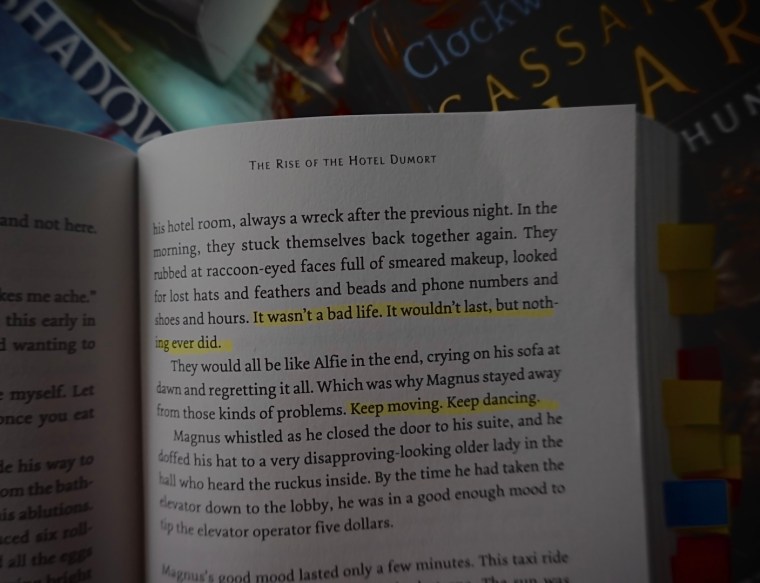
Then, in “The Rise of the Dumort”, Magnus gives his tactic of “Keep moving. Keep Dancing,” to avoid his problems and how time always seemed to change pace.
“Time was like water, sometimes glacial and slow, sometimes a still pond, sometimes a gentle brook, and then a rushing river. And sometimes time was like vapor, vanishing even as you passed through it, draping everything in mist, refracting the light.”
(Magnus, Page 223)
What Magnus is looking for is someone to set his soul at ease and calm the fitful waves of the sea of life, and he has found that in Alec.
“Time was something that moved in fits and starts for Magnus, dissipating like mist or dragging like chains, but when Alec was here, Magnus’s time seemed to fall into an easy rhythm with Alec’s, like two heartbeats falling into sync. He felt anchored by Alec, and his whole self felt restless and mutinous when Alec was not there, because he knew how different it would be when Alec was there, how the tumultuous world would quiet at the sound of Alec’s voice.”
(Magnus, Page 383)
Clare, Brennan and Johnson did a fabulous job at tying together all the worries and fears that Magnus had about love throughout his life, applying them to his relationship with Alec, and then proving why this Shadowhunter was different from the other loves that walked into and out of the warlock’s heart.
I also enjoyed seeing how Magnus was already so tuned to Alec’s personality and insecurities after knowing each other for such a short time. He bought Alec a coffee machine, because he knew that the Shadowhunter was uncomfortable about magically stealing from the local cafe. He leaves the door unlocked, because he knows Alec slips by early in the morning. He knows that the perfect birthday gift for Alec is enchanting Isabelle’s whip for extra protection, because he values his little sister’s safety over his own life.
Magnus also recognizes that Alec doesn’t see his own self worth, that he feels unimportant and overshadowed next to even his own siblings, and that he believes that “he would not be anyone’s top priority.”
“He was conscientious, the kind of person who believed that the others around him were so much more important than he was, who already believed that he was letting everybody down. And he was honest, the kind of person who was naturally open about all he felt and all he wanted. Alec’s virtues had made a trap for him: these two good qualities had collided painfully. He felt he could not be honest without disappointing everybody he loved. It was a hideous conundrum for him. It was as if the world had been designed to make him unhappy.”
(Magnus on Alec, Page 372)
The warlock sees all of these things and is determined to show Alec Lightwood how valuable he is to the world.
“If Jace was gold, catching the light and the attention, Alec was silver: so used to everyone else looking at Jace that that was where he looked too, so used to living in Jace’s shadow that he didn’t expect to be seen. Maybe it was enough to be the first person to tell Alec that he was worth being seen ahead of anyone in a room, and of being looked at longest. And silver, though few people knew it, was a rarer metal than gold.”
(Magnus, Page 455)
I also want to mention my appreciation for Clare, Brennan and Johnson including Magnus’s own insecurities — yes, even after hundreds of years of life, one can be insecure. He’s thought that Alec stood him up for their first date, he fears that Alec is only interested in him because he was the first man to show him attention, and he worries that this Shadowhunter will turn out to be like all the other Nephilim he’s met prior.
Sidenote! Magnus’s inner monologue of nervousness was a mirror to the awkwardness that Alec exhibited on the outside. That awkwardness was so funny though, and I feel bad for laughing so much at Alec’s pain. From Alec flipping the pickpocketer in the Subway to him falling down the stairs after the date was over, I was literally in tears from laughter. It was so adorably sweet.
As always, Alec proves Magnus wrong when a rogue werewolf interrupts their disastrous first date. Magnus is terrified that Alec’s natural Shadowhunter instinct would be to kill the werewolf girl. Instead, Alec works together with Magnus to contain the werewolf back to her human form and offer words of encouragement to soothe her guilt. The moment turns the date around as the tension eases around the pair, and they can laugh about the woes of the evening.
In the end, Alec gives Magnus a renewed sense of hope for finding love.
“He had been taught so many times that hope was foolish, but he could not help it, as heedless as a child straying close to the fire and stubbornly refusing to learn from experience. Maybe this time was different — maybe this love was different. It felt so different; surely that had to mean something … Maybe this time things would work out the way Magnus wanted them to. Maybe Alexander Lightwood would not break his heart.”
(Magnus, Page 488)
Excuse me while I pass out from how frickin cute they are.
Sidenotes! I love, love, love that we have the full story of the demon ruby pendant that Izzy now wears and that Magnus likes that she wears it because, “It charmed him, made him feel as if he had mattered in that space of time, to those people.” That pendant saved Simon’s life in City of Heavenly Fire and Izzy’s life probably several times before and after … It’s sweet that this Lightwood family heirloom has a treasured backstory that started with Magnus Bane.
Also, “The Voicemail of Magnus Bane” was such a hilarious addition to this novella. It shows how good of a sister Izzy is to Alec. She’s ready to break doors and bones for the sake of her brother’s heart. It gave so much personality to these characters and was a very good reminder that these are teenagers doing weird teenager things like calling their brother’s/friend’s ex-boyfriend to beg for them to get back together. It was beautiful.
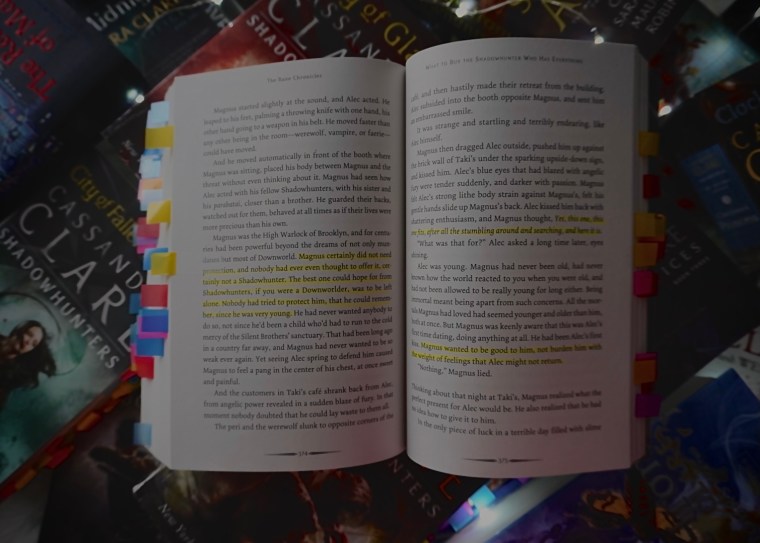
Conclusion
Magnus Bane is complicated, messy and mysterious. Throughout his 400-plus years of life, he has worn a mask to hide his inner pain. While the warlock may be the life of the party, he’s wallowing in the words of doubt passed down from his birth mother and step-father claiming he is a soulless monster. He drinks the days away, building up his carefree persona, as he desperately holds onto his humanity.
Clare, Brennan and Johnson captured the essence of Magnus perfectly throughout the 11 short stories of the warlock’s life. While TBC did not make me intensely sob like Clockwork Princess, I did find myself tearing up on occasion. They’re powerful stories that have strong messages of love, mortality, humanity and loss, without being overwhelming.
I also enjoyed how these three authors seamlessly blended Magnus into mundane history, like the French Revolution and Prohibition. It added to the warlock’s lore and made his immortality feel more realistic.
With all that said, I enjoyed this book for what it is — a companion novella. It gave me additional details to a character and story that I already knew. I probably won’t feel compelled to give a reread.
If I were to change anything to make TBC better, I would’ve added an overarching storyline to make everything flow smoother. At points it felt choppy because of time jumps, like when we went from “What to Get the Shadowhunter …” in 2008 to “The Last Stand of the New York Institute” in 1989 and then back to 2008 for “The Course of True Love …”.
Overall, it was a fun read and was super helpful to better understand Magnus’s character and his struggles and triumphs throughout his immortal life. If you’re reading The Shadowhunter Chronicles, I would say that The Bane Chronicles is a must-read addition to the long list of Cassandra Clare books.
TBC gets a solid 4 out of 5 stars.


 Life of Bry
Leave a comment