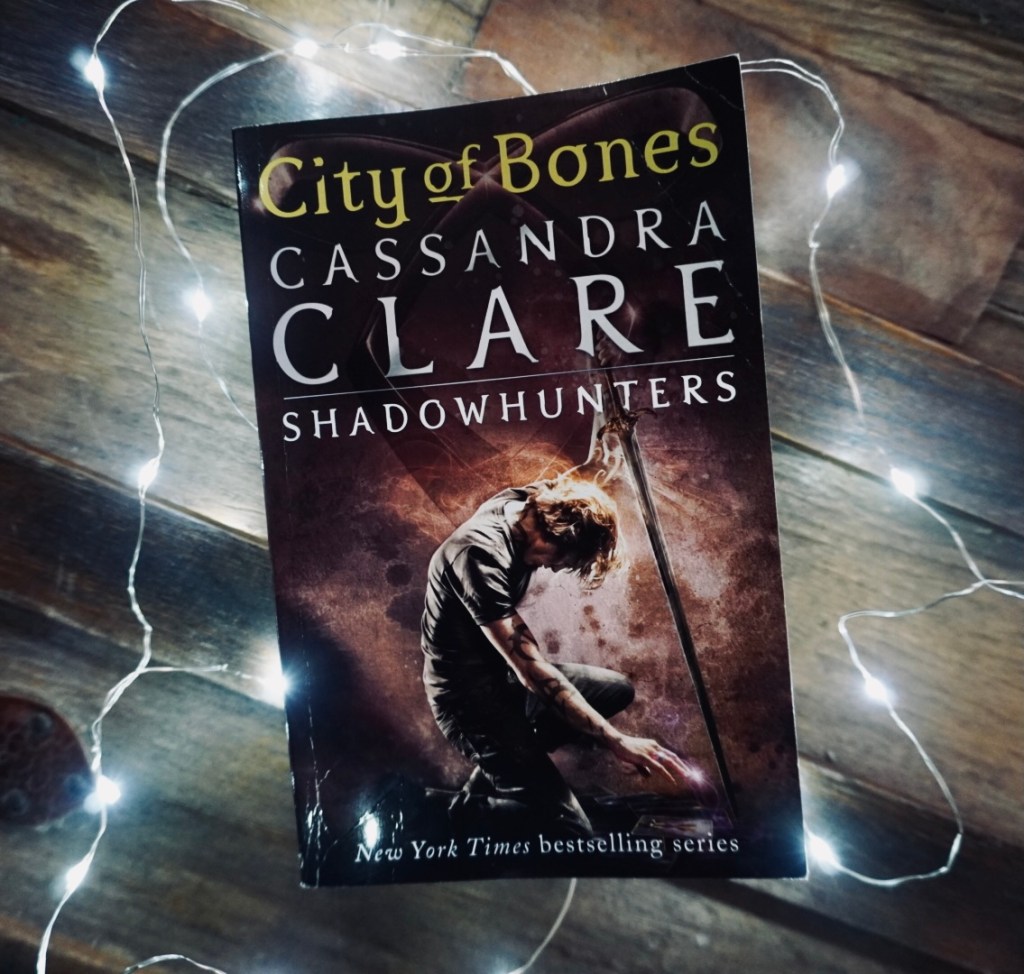
City of Bones by Cassandra Clare
I’m going to be honest here, I’m late to the party on this series.
Cassandra Clare published City of Bones — the first book of her Mortal Instruments series — in March 2007. Clare admitted that it was originally only meant to be a trilogy, however, the series now has six books along with prequels, sequels and spin-offs that expand the magical world that she created. Fun fact that I’m sure everyone already knew except for me: Clare began her writing journey penning Harry Potter fanfics.
The Mortal Instruments has been on my “to read” list for nearly a decade, and the whole series has been sitting on my shelf since Christmas. I’ve been stalling starting it because my pile of single-book stories was calling my name, and I just wasn’t ready to commit to such a lengthy series.
Now, I’m ready for a good binge read, so I guess it’s better late than never.
Summary
Clary Fray, a seemingly ordinary 15-year-old girl in New York City, has a murky past, an overprotective mother, no sense of belonging and an urge to break out of her boring life. During a night out at Pandemonium — a local teen nightclub — with her best friend Simon, Clary sees a trio of tattooed, good-looking teens murder a boy who dissolves into the floor.
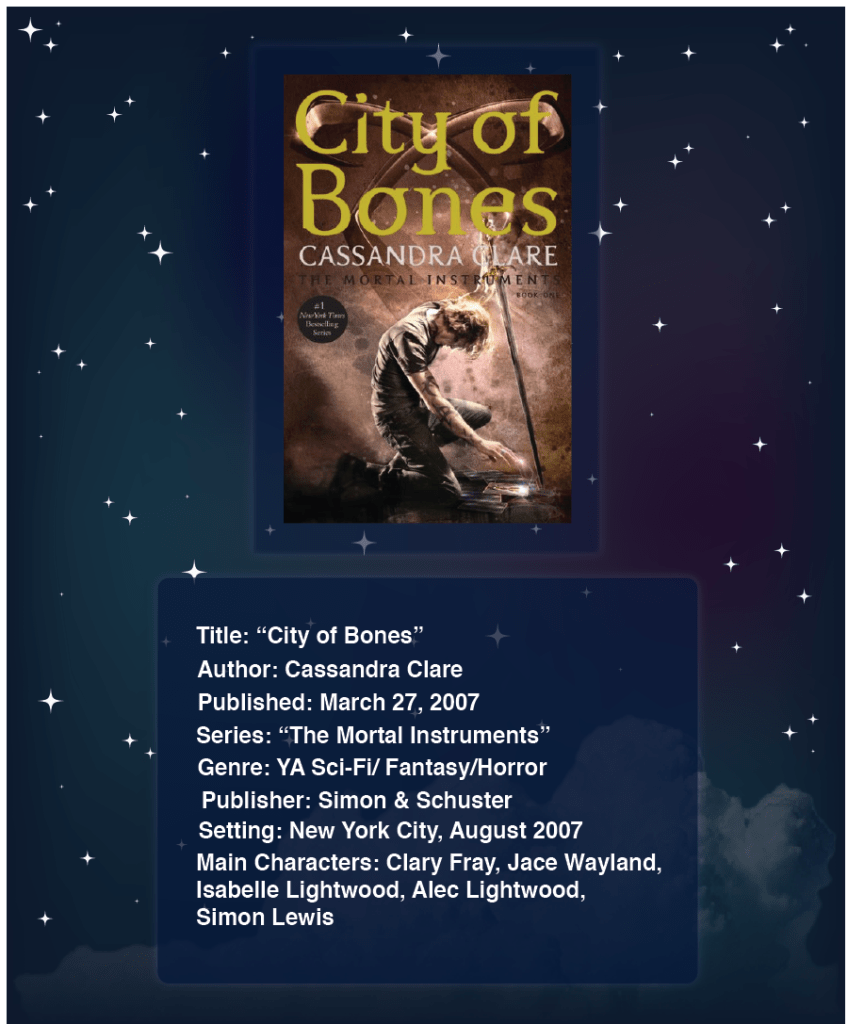
The trio of Isabelle, Alec and Jace are Shadowhunters, a breed of humans that are half angels and destined to hunt demons, and Clary isn’t supposed to be able to see them.
Clary leaves Pandemonium without telling Simon what she saw, but she can’t keep it a secret for long. Jace seeks out Clary at a cafe the very next night, right as she receives a disturbing call from her mother shrieking to not come home. Doing exactly what she was told not to do — a common occurrence throughout the book — Clary arrives back at her apartment with Jace to find that her mom is missing and a demon is lurking. When the demon poisons Clary, Jace heals her with a rune, confirming what he already expected. Clary is a Shadowhunter.
The world as Clary knew it is gone, replaced by one that hides werewolves, vampires, angels, warlocks and everything in between behind what the Nephilim call glamours. The stories are all true, and it’s now up to Clary to join forces with the Shadowhunters to rescue her mom, find the Mortal Cup (a “Holy Grail”-esque object that holds the key to creating more Shadowhunters in unethical ways) and perhaps discover her true self along the way.
The Good
Despite being way older than the intended demographic, there’s so much that I enjoyed about this book — which is a relief because I already own the rest of the series and it would be awkward if I hated it.
The world Clare builds with every page can easily be pictured and her way of divulging details without overwhelming the reader is *chef’s kisses*. The audience learns about the existence of Downworlders (creatures that aren’t human), the importance of the Clave (sort of like the executive board of the Shadowhunters), the uprising of Valentine (Shadowhunter turned super villain) and so much more through action instead of a sit down of Clary bombarding Jace with questions. Twilight is guilty of this interview method, and, to me, it just feels boring and lazy.
I never felt like the plot line had to come to a halt so that Clare could flesh out her world. Instead the realm of Shadowhunters that is cleverly hidden behind the world we already know is revealed to readers with each turn of the page through steady suspense and adventure.
And with Clare’s great world creation comes fantastic characters.
Our band of main characters are mostly teenagers. We’re going to place our main female protagonist Clary to the side for now. I have more to say about her later.
Let’s focus on the other four members of our pack of heroes: Jace, Isabelle, Alec and Simon.
Izzy and Alec Lightwood are siblings who were raised by their parents at the Institute, a safe haven for Shadowhunters in New York, to be demon slayers. Jace Wayland was initially raised by his father who hid his abuse in the form of discipline, duty and self righteousness. After watching his father be murdered at 10 years old, Jace was taken in by the Lightwoods. Meanwhile, Simon is an ordinary, nerdy human tagging along because of his not-so-secret crush on his best friend.
One of my biggest pet peeves in YA literature is when teenagers don’t act or talk like teens. Luckily, despite Jace and the Lightwood siblings being out of touch with what’s considered average human behavior, I felt that these kids interacted pretty similar to my friends in high school. Minus the demon hunting.
There’s loads of bickering, plenty of crushes and tons of sarcasm. It makes an otherwise heavy storyline light and humorous. The below exchange between Clary, Jace and Simon is one of my favorites:
Jace: “Do you remember back at the hotel when you promised that if we lived, you’d get dressed up in a nurse’s outfit and give me a sponge bath?” asked Jace.
Clary: “It was Simon who promised you the sponge bath.”
Simon: “As soon as I’m back on my feet, handsome,” said Simon.
Jace: “I knew we should have left you a rat.””
However, we do get moments where the reader is reminded that these aren’t normal teenagers.
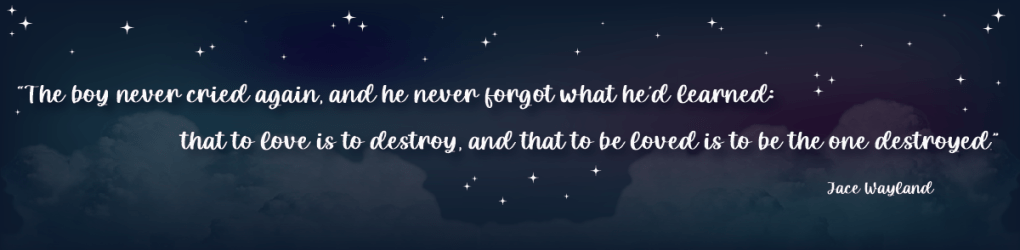
Jace tells Clary a story of the time his father bought him a falcon to train, only to kill it once the bird was tamed and the pair bonded. “The boy never cried again, and he never forgot what he’d learned: that to love is to destroy, and that to be loved is to be the one destroyed.” It was a traumatic lesson that reflected the relationship between Jace and his father and explained why Jace had created his confident and uncaring personality to ward off anybody who’d try to break his shell and thus hurt him the way losing his father had.
Speaking of Jace, he has impeccable character development in just this first book. When we first meet Jace, he’s boisterous, charming and very sure of who he is and his purpose in life. He’s willing to die for the greater good, although he explains to Clary later that it’s because he had nobody to care about prior to meeting her. However, as the story unfolds, we start to see him unravel as he realizes that everything he was so sure about himself is a lie.

Valentine is Clary’s father. Her mother Jocelyn fled Valentine after the Uprising. And surprise! Jace is not Jace Wayland at all. Instead he’s Jonathan Christopher Morgenstine. The first son of Valentine and Jocelyn, who was believed to have died in a house fire set by Valentine himself to create a ruse that he and his family perished. This means that Jace and Clary are siblings … We’ll touch base on this disgusting realization later.
Figuring out his true identity hits Jace hard. At the end of City of Bones, when Jace and Clary face Valentine together and discover they’re siblings, Clary notices Jace’s immediate difference. “Jace angry, Jace hostile, furious, she could have dealt with, but this new Jace, fragile and shining in the light of his own personal miracle, was a stranger to her.” (page 459)
I love a flawed, complex, multidimensional character, and Jace fits the bill perfectly.
Finally, I enjoyed the overarching themes that City of Bones touches on are expansive, including, love, identity and religion.
Love is a constant theme throughout the book. Let’s be honest, can you have a coming-of-age story without a little love?
We have a confusing web of crushes and desires. Simon loves Clary. Isabelle flirts with Simon. Alec loves Jace. Jace and Clary love each other *gag*.
But Clare presents love as so much more than romantic relationships.
Luke has been in love with Jocelyn since they were kids. So much so that when she escaped Idris during the Uprising with her unborn child, Luke tried to follow her and eventually sought her out amongst the mundanes. Despite never receiving the love and affection from Jocelyn that he felt for her, he still remained a faithful friend and helped care for Clary.
Clary even admits that she loves Luke like a father, which I’m sure stung Valentine considering he despises Luke. On the other hand, Valentine claims to love Jace despite all signs pointing to him being abusive and manipulative toward the boy.
In the end, love is complicated no matter how it presents itself.
For the sake of analysis, I want to lump identity and duty together because they’re intertwined throughout the book.
In the very first pages of the book, we know that Clary is suffering from the identity crisis that plagues most teens.
“She wasn’t even sure why it was that she liked [Pandemonium] — the clothes, the music made it like a dream, someone else’s life, not her boring real life at all.” (page 17)
One could chalk up this feeling to her being a teenager — Magnus Bane, the High Warlock of Brooklyn, sure does — but it’s ultimately what draws her toward Jace and into the Shadow World. When she learns that her memories were blocked and her Sight hidden by her mother, Clary sees it as an opportunity to discover who she truly is as a person. On pages 246 and 247, Bane and Clary exchange blows about her struggle with identity and his hand in it as the warlock who put a spell on her brain.
Clary: ‘“All my life I’ve felt like there was something wrong with me. Something missing or damaged. Now I know — “
Bane: “I didn’t damage you.” It was Magnus’s turn to interrupt, his lips curled back angrily to show sharp white teeth. “Every teenager in the world feels like that, feels broken or out of place, different somehow, royalty mistakenly born into a family of peasants. The difference in your case is that it’s true.”’
Throughout the book, Clary juggles whether or not she even wants to accept her new-found sense of identity by embracing the Shadowhunters or avoid it by holding onto the boring life she lived before she knew that demons and angels existed.
Alec is also struggling with an identity crisis as he wrestles with his sexuality. Clary successfully guesses that Alec is gay, to which Isabelle makes her swear to keep the secret because the Clave isn’t accepting of homosexuality. Alec hides his true feelings for Jace behind their roles of parabatai.
This secret that Alec is keeping may be the reason why he’s so strict to follow the Clave’s other rules. Perhaps he thinks that he can repent what he believes is a sinful side of himself by adhering to the law.
Unlike Clary and Alec, Jace was confident in his identity. He’s a Shadowhunter born and raised to rid the world of demons and serve the Clave. Jace’s confidence in his identity is actually brought up so much throughout City of Bones, it begins to seem like he says these things to convince himself that this is his purpose in life.
“‘I’m not unhappy,” [Jace] said. “Only people with no purpose are unhappy. I’ve got a purpose.’”
In fact, being a Shadowhunter is Jace’s entire identity — other than his sarcastic and charming personality, of course.
“I may not believe in sin,” he said, “but I do feel guilt. We Shadowhunters live by a code, and that code isn’t flexible. Honor, fault, penance, those are real to us, and they have nothing to do with religion and everything to do with who we are. This is who I am, Clary,” he said desperately.”
And that quote leads into the final theme I want to discuss, religion.
In a world where there’s no hypotheticals about the existence of demons and angels, you’d think religion would be prominent. While religious imagery and ideologies practically drip off the pages of City of Bones, religion isn’t exactly at the forefront of the characters’ belief systems.
Clary never stepped into an actual church until she and Jace entered one to find blessed weapons to defeat vampires. That’s when Clary and us as readers discover that religion is more of an ally to Shadowhunters than a practice. Nearly all religions pledge to defeat or conquer some form of evil, which is exactly what the Nephilim do. That’s why locked churches, synagogues, temples, etc. can be opened by Shadowhunters with a prayer that’s vaguely similar to the Our Father.
Despite this religious alliance, Jace has his own stance on whether or not there’s a higher being.
“When I saw [my father] lying dead in a pool of his own blood, I knew then that I hadn’t stopped believing in God. I’d just stopped believing God cared. There might be a God, Clary, and there might not, but I don’t think it matters. Either way, we’re on our own.” (page 274)
Jace’s firm stance on God not giving a damn, can be traced back to the fact that his father did believe in God, and it ended up with him being murdered and Jace being left helpless and fatherless. That type of trauma can definitely sway a person’s beliefs, and I’m curious to see how or if Jace’s opinion changes throughout the series now that he knows that his father is alive.
The Bad
There wasn’t a ton that I would consider “bad” in City of Bones. In fact, I can only think of two things: Clary and Simon’s obsession with Clary.
Clary is ultimately our main character. We’re following her discovery of and journey into the Shadow World. It’s her mother who is attacked and taken, her father who’s the villain and her brother *gag* who’s leading the way to assist her. But, as far as main characters go, she falls flat for me.
I feel like we don’t truly know enough about Clary to connect with her. We only get surface details. She has red hair, she likes to draw and read and … I honestly can’t think of anything else. She seems more of a vehicle to move the story along rather than an integral piece of the puzzle. This could be chalked up to her memory block or her lack of self identity. Maybe Clare doesn’t indulge the reader with details about Clary because Clary doesn’t know who she is yet.
Clary also gets on my nerves. I can’t understand how common sense evades this girl when she should have a natural instinct based on her bloodline. Not every female character needs to be a badass warrior like Izzy — especially since Clary wasn’t raised to fight — but I can’t make sense of how clueless Clary can be.
Even Simon, who is very mortal, had enough common sense to burst through the door and shoot the skylight out of Clary’s apartment building with an arrow to help disintegrate Abbadon. Where was Clary? Paralyzed with fear watching as her friends got destroyed by the demon.
Oh boy, Simon. I don’t mind his character. I think it adds to the story to have this mortal boy giving commentary on the absurdity of this world that his best friend since childhood somehow belongs to now. What I don’t like is his weird crush that borderlines possessive.
It’s obvious from the very start of City of Bones that Simon is crushing on Clary hard. His crush goes so far that when Simon finally admits to Clary that he loves her (after he catches Clary and Jace making out *gag*), he says that all those girls he’s dated before were just practice for when he got the courage to ask Clary out. Before stomping off, Simon emotionally slaps Clary with what his mother said of his best friend. “She said you’d break my heart.” (page 340)
As someone who grew up with a boy best friend that told me he loved me the week I started dating my now-husband, I would like to say YIKES. There’s nothing wrong with falling for your best friend. What is off putting to me is that Simon seems to try to guilt Clary into sharing his feelings. He tries to make her jealous by flirting with Izzy, and then he drops the whole ‘my mom told me you’d break my heart’ bit when Clary is the one seeking someone else out romantically.
Clary doesn’t owe Simon her affection. Simon also doesn’t deserve for Clary to call him only when she needs something after totally forgetting he even exists. There has to be a medium somewhere in there for those two.
The Ugly
We all know where this is heading.
Clare definitely pulled a Princess Leia and Luke Skywalker trick on readers, and it was not cash money. Just as it seems that Clary is breaking down the walls that Jace has built around himself, we find out they’re siblings and we have to pretend they weren’t just making out a few chapters ago.
There’s a lot of context clues that point to the pair not being brother and sister after all, including that they don’t look anything alike (siblings that share both parents tend to have similar features), they still have romantic feelings for each other even after the discovery (incest is taboo and illegal, so I just can’t see Clare letting this run wild), and the fact that Valentine is such a monster that I firmly believe that he’d lie about Jace being his son simply to play the boy’s emotions to get him to join the dark side.
Either way, it was a plot twist, that’s for sure.
Conclusion
Overall, City of Bones lays a pretty solid foundation for a hefty series.
Clare gives an expansive and immersive world, some complex and fascinating characters, a suspenseful and action-packed storyline and themes that kept me thinking long after setting the book down.
While I can do with way less incest and way more character development for Clary, I’m excited to jump into the second book and dive deeper into the Shadow World.
I’d give City of Bones a solid 3.5/5.
I’ll check back in once I finish the series. Wish me luck!

 Life of Bry
Leave a comment